How Devolver’s Ball x Pit Bounced to $10M on Steam
What do you get when an indie creator revives a 1980s Arcade idea with a Roguelike twist? May well be Ball x Pit that is currently topping Steam charts! Let’s explore how solo developer Kenny Sun built the indie game that bounced higher than anyone expected.
— by Maria Bolshman and Andrei Zubov

Roguelike is one of the most crowded genres in gaming today. Every month, new titles compete for players’ time with promises of a better “one more run”. Yet in 2025, we already have at least two Roguelike (Roguelite even, to be precise) hits: Hades 2 and Ball x Pit. And while everyone was sure of the success of Supergiant’s new game, the latter one was another unexpected hidden gem discovered by Devolver.
Ball x Pit, created by solo dev Kenny Sun and published by Devolver Digital, reimagined one of gaming’s oldest genres: Brick Breaker. The game borrows visual and gameplay elements from Vampire Survivors but reimagines them through fast-paced, Arkanoid-style gameplay packed with the chaos of bouncing balls and quick decision-making.
The result? By the end of its first week, Ball x Pit had sold around 400K copies, so the numbers speak for themselves. It wasn’t mere luck: players connected with the game’s flow, unusual meta, vast variety of characters and upgrades, and the balance that makes each run both accessible and rewarding.
UPD: Right after we published this article, Kenny Sun announced 750K copies sold since its launch.
In this piece, we’ll unpack what made Ball x Pit stand out, including:
• How the game performs in terms of revenue and DAU (kudos to AppMagic’s Steam analytics for providing the data!);
• How the game came together, what inspired its design, and who made it happen;
• What Habby, the studio behind Archero and PunBall, has to do with this new indie hit!
Let’s take it from here, one step at a time!
From Idea to Success
Behind the project is the New York-based developer Kenny Sun, who previously made minimalist Puzzle games like Yankai’s Peak and A Hollow Doorway. After years of exploring geometry and rhythm games, Sun wanted to try something more dynamic. This is how he ended up reimagining the Brick Breaker, one of gaming’s oldest genres from as far back as the 1980s: you launch balls to destroy walls of blocks, chasing chain reactions and perfect angles.
Devolver Digital joined soon after. The publisher has a soft spot for personality-driven projects and bold ideas. From the stylish chaos of Hotline Miami to the bullet-dodging absurdity of Enter the Gungeon and the twisted charm of Cult of the Lamb, every title feels distinct. Ball x Pit is no exception: unique, fresh, and full of character.
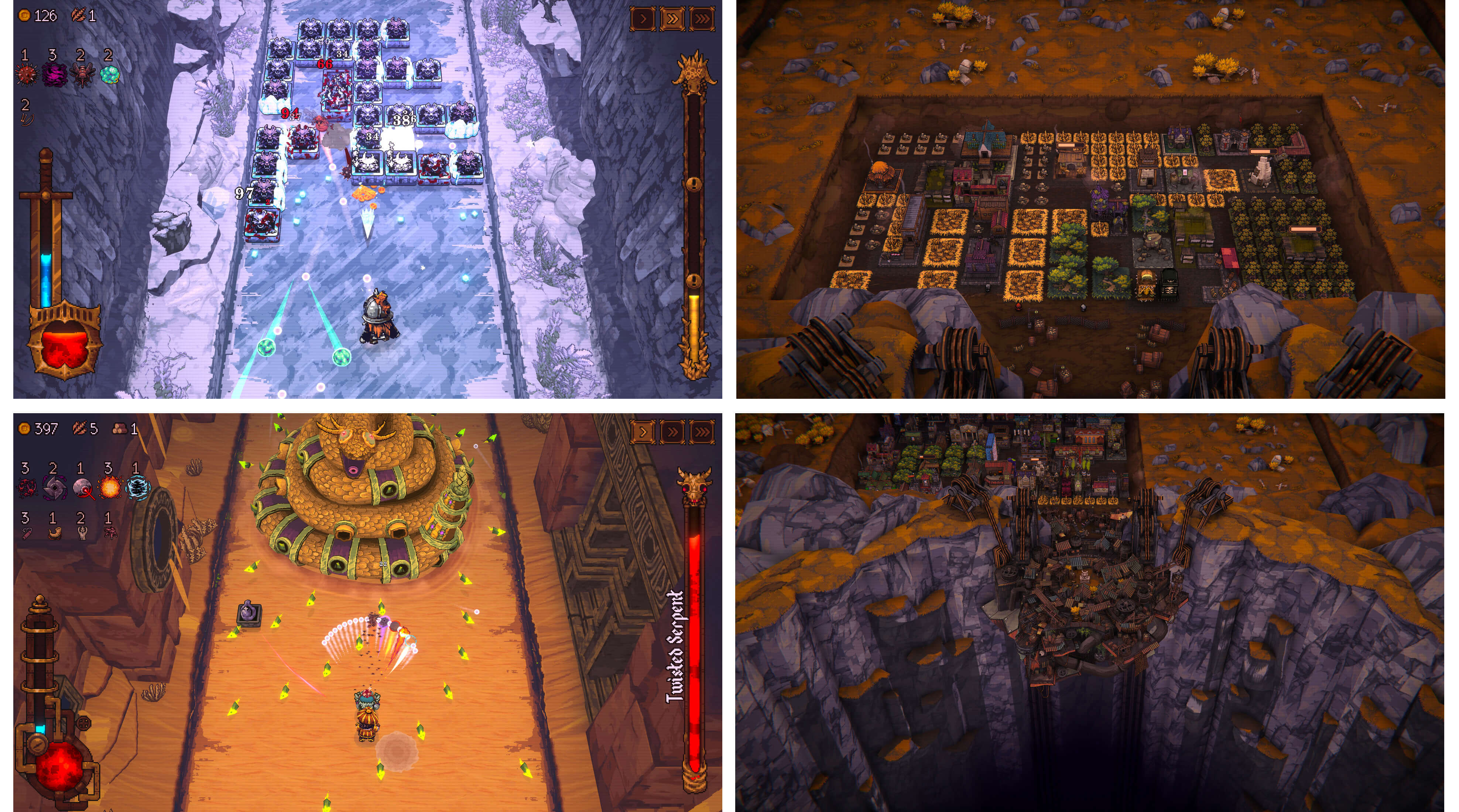
Ball x Pit gameplay screenshots
The game took center stage at Devolver’s 2025 Summer Showcase, where the spotlight was entirely on Kenny Sun and his project. By the time it launched on October 15, 2025, Ball x Pit had already built serious buzz. According to our data, the game earned over $1M in Day 1 revenue on Steam and came in at No.1 on Steam’s downloads chart with roughly 70K installs.
Within its first week, it sold over 400K copies, setting a high benchmark among solo-dev releases and making it to the top 10 best-selling games. To date, the game has earned over $9.8M!
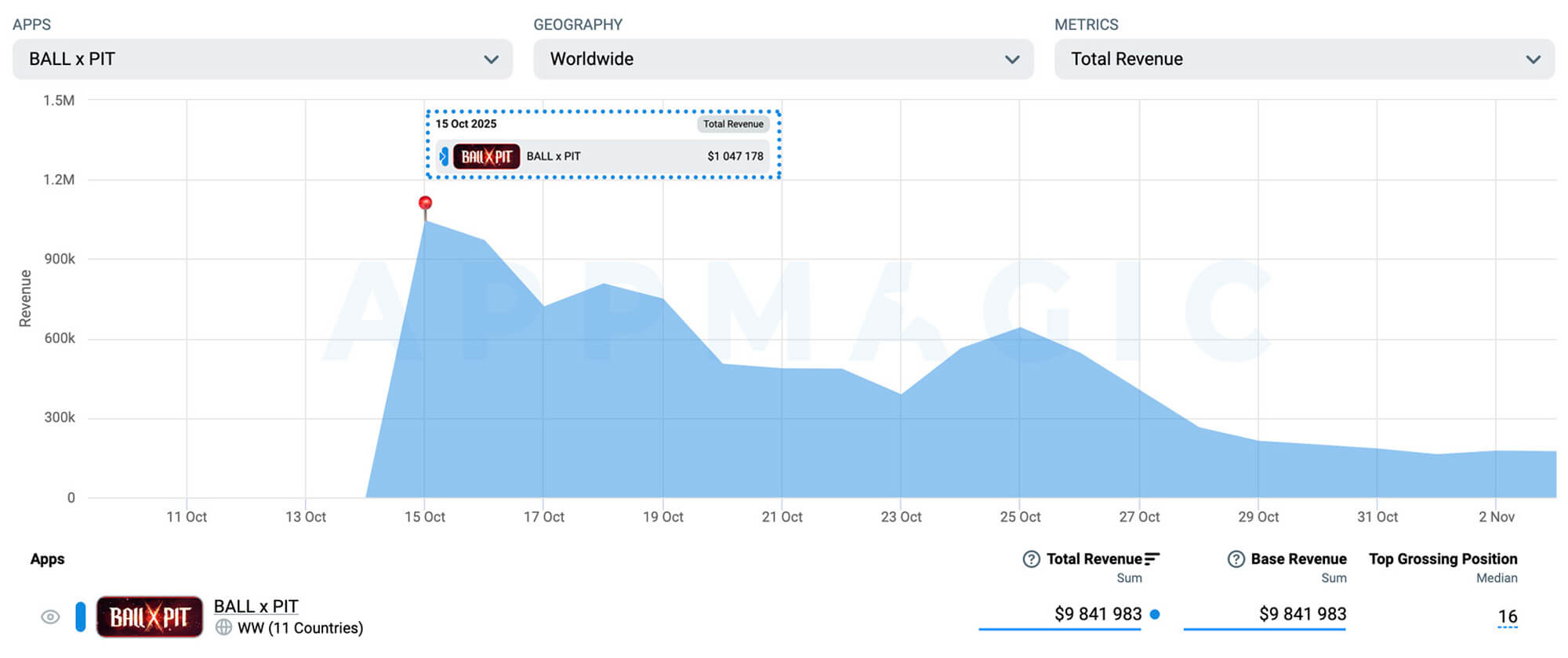
Global net revenue of Ball x Pit from AppMagic’s Steam analytics
Momentum stayed high on the player side, too. On October 26, Ball x Pit hit its peak with more than 200K daily active users (DAU), confirming the game’s strong post-launch engagement.
Critics also shared the enthusiasm. The game debuted with an 84 Metacritic score, praised for its sharp design, polished mechanics, and satisfying gameplay. Even Forbes called it “a surprise indie GOTY contender”.
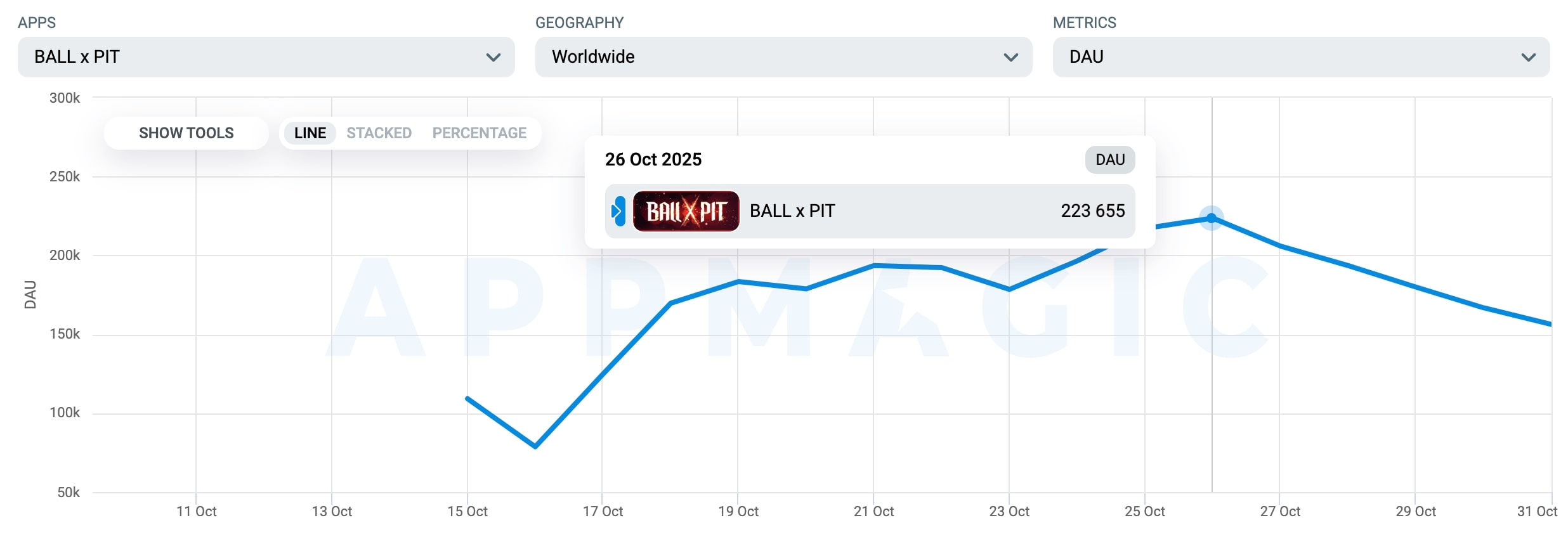
Daily player activity remained high post-launch
However, there is more to the story, as the roots of Ball x Pit go deeper—all the way into mobile.
When Indies Strike Back
To better understand *Ball x Pit*’s success story, let’s take a quick detour back to November 2021. Back then, Singapore-based mobile studio Habby, known for its simple yet sticky hit Archero, launched its new project called PunBall. The game mixed the old-school Brick Breaker format with Roguelike progression: short runs, power-ups, and meta upgrades. Habby’s approach followed a clear pattern: accessible mechanics, strong retention loops, and a clean visual style aimed at broad appeal—a formula that would soon become the studio’s signature.
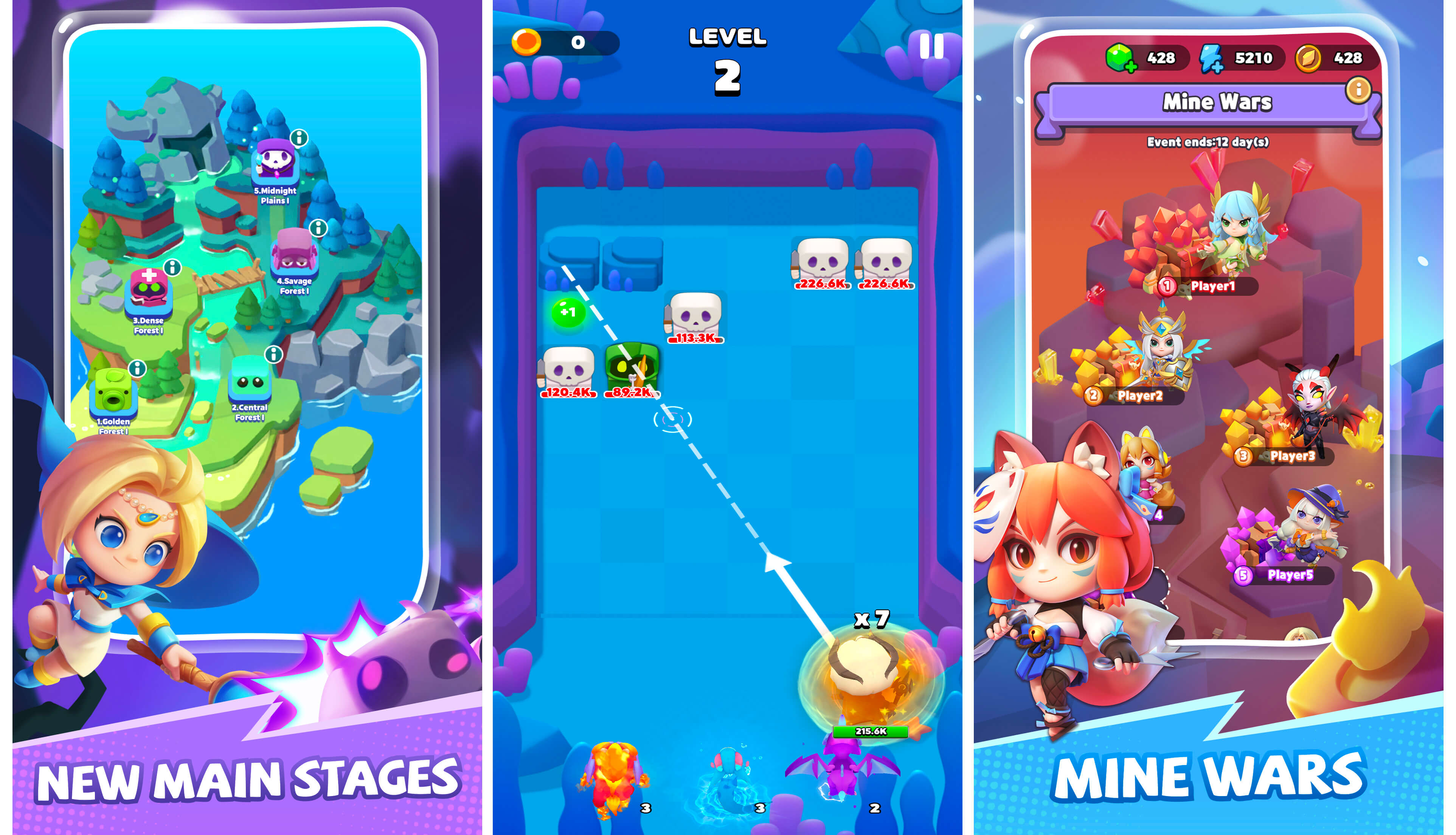
PunBall made some noise at launch. Its IAP revenue spiked past $3M in November 2021, doubling the revenue of the entire Brick Breaker genre on mobile. For a brief moment, it felt like Brick Breakers were back, but the surge was short-lived, and soon the genre went back to pre-PunBall levels.
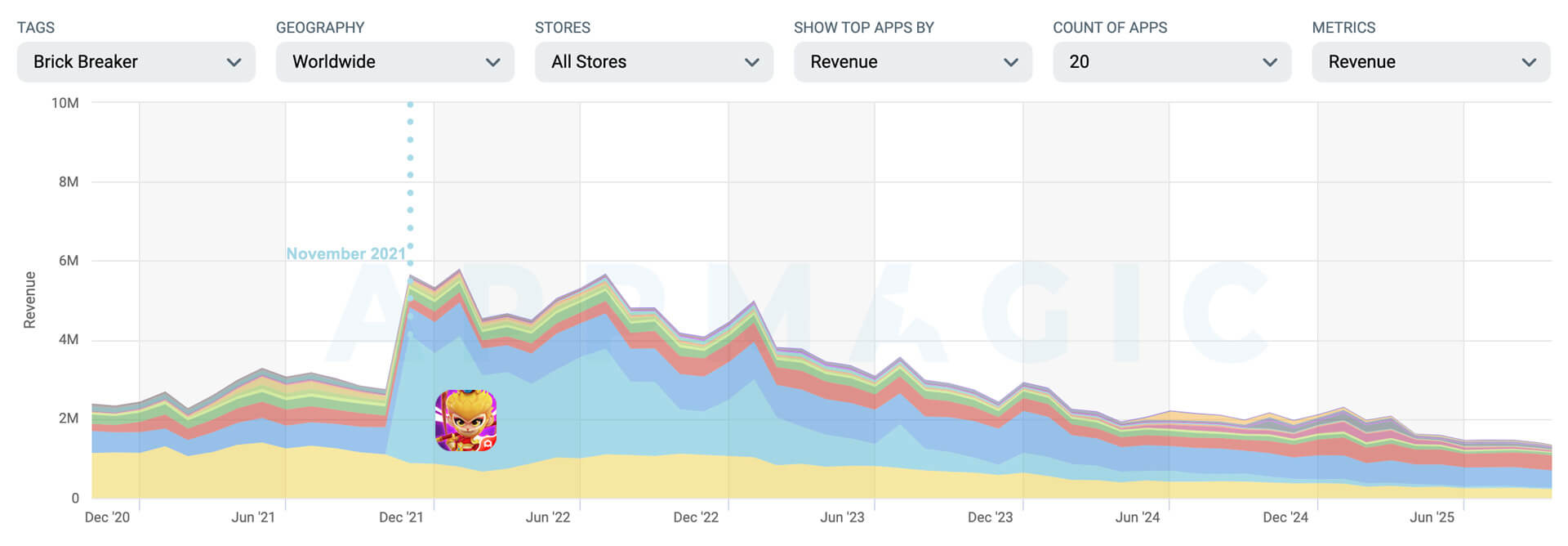
PunBall’s IAP revenue peak around its release
One of the most likely reasons the game didn’t succeed is its unclear positioning and imperfect balance between Midcore and Casual. On the one hand, it offers Roguelike mechanics and Archero-style progression with levels, gear, and talents, which appeals to Midcore players. On the other, its turn-based core makes the gameplay much less dynamic and feels too Puzzle-like for an Action-oriented audience. That balance is hard, and Habby would execute it perfectly in the future, but not this time.
In an interview, Kenny Sun recalled discovering PunBall on his phone and immediately noticing its potential:
“I knew that the core of the game had something special, but as I continued to play it, I felt that there were a number of elements I wished were different. So, a few weeks later, I decided to make a version of my own.”
The idea grew into Ball x Pit. Where PunBall didn’t find a lasting audience, Sun’s indie take on the concept did.
And that’s where things came full circle. Habby once drew from the indie scene, adapting the *Vampire Survivors*’ core gameplay to make it work for a wider audience with the release of Survivor.io. Now we see how indie can borrow back from Habby, building on *PunBall*’s foundation and fixing its imperfections to make a viral hit.
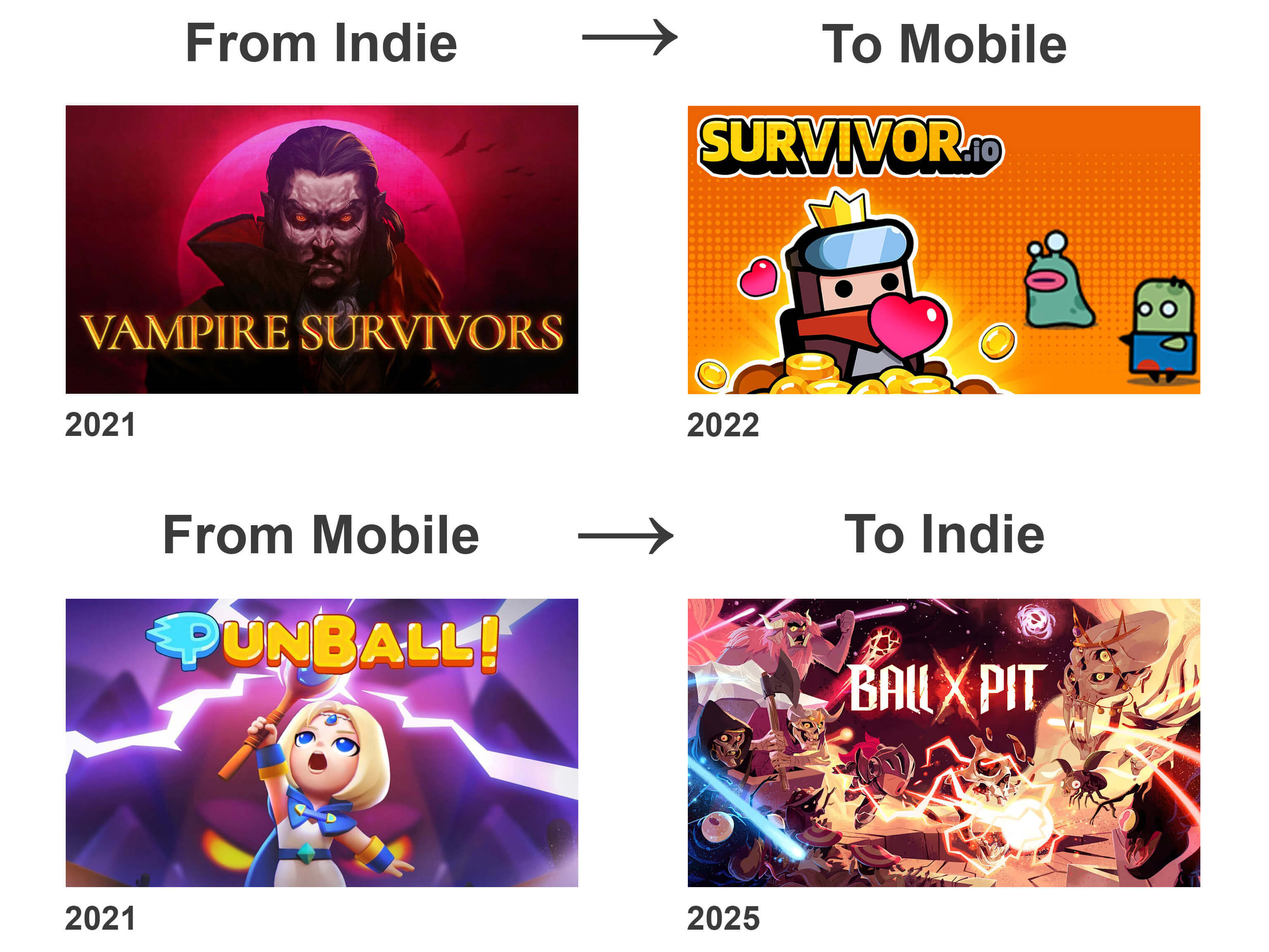
While there is a certain irony in that, the story illustrates how the creative industries work. It’s an ongoing process of generating new ideas and refining them, which is not possible without inspiration and constant experimentation.
Final Thoughts
In numbers alone, the success of Ball x Pit is hard to ignore: according to AppMagic’s Steam analytics, Ball x Pit grossed $9.8M in its first month, reaching more than 200K DAU at its peak!
But what really stands out is how it got there. While Ball x Pit took cues from many modern Roguelikes, PunBall's influence on its development is undeniable. And, despite *PunBall*’s brief performance, it helped set the stage for Ball x Pit, building one more bridge between seemingly polar markets: indie and mobile.
This case proves: you don't have to invent a new genre to make an impact. Sometimes, it’s enough to take a good idea, refine it, and polish what others overlook. Whether Ball x Pit ends up a one-off success or the start of something bigger, it sends a clear message: even in the crowded market of 2025, a solo creator with focus and taste can still make the whole industry bounce.