Researching Mobile Games: A Step-by-Step Guide with Antti Kananen
Our partner Antti Kananen from Games Alchemy breaks down how to research the mobile games market through the lens of both a developer and an investor.
— Antti Kananen

Antti Kananen. Games Executive, General Manager, and Product & Design Director. Former Head of Games at Games & Leaves, VP of Product at Huuuge, GM at SciPlay, and CEO at Koukoi Games. Writer of Games Alchemy and angel investor in games.

The Tough Reality of Doing Mobile Gaming Research
For many years, my day-to-day work has relied on using market intelligence tools. Over time, I had the chance to try a lot of well-known platforms that promised a high-level view of the mobile games market, e.g., revenue estimates, downloads, KPIs, category leaders, trend identification, and many more.
They were powerful, but also expensive, rigid, and sometimes too abstract for the kind of work I actually needed to do. My core challenge wasn’t access to data. It was a resolution. As a product leader, systems designer, and hobbyist angel investor, I rarely ask simple questions like, “Is this genre growing?” Instead, my questions tend to be more surgical:
- Is this specific subsegment within a genre growing or decaying?
- What monetization structures and strategies are actually working for those competitors on the inside and not just on the surface?
- Are live events being used as a core economic driver, or just as surface-level engagement boosts?
- Does a product’s observed KPI profile support a sustainable business case, or does it break at scale?
With previous tools, answering those questions required a lot of manual triangulation: exporting rough estimates, building parallel sheets over granular parts of the industry, and cross-checking assumptions with anecdotal industry knowledge… And still feeling that some questions were left unanswered.
The challenges in using them peaked at some point, when I realized that many were paying very premium prices for tools that were excellent at telling what was happening—on a certain level—but not on any level why, and definitely not how.
Finding the Right Tool to Use
I first came across AppMagic through industry circles and peer recommendations. The positioning was interesting: more affordable, but also more focused on practical, granular category analysis, monetization, and live service insights rather than just dashboards after dashboards.
“I didn’t expect it to replace my existing tools at first. I expected it to be complementary. Instead, it quickly became central, as it had some comfying ‘magic’ to it.”
What made AppMagic stand out was how it allowed me to deconstruct markets and products faster and more effectively, rather than forcing me to dive deeper into higher-level perspectives. The level of categorization, down to genres, subgenres, monetization placements, and event structures, matched how I actually wanted to take quick yet insightful looks to support decision-making or time investments across different research topics.
Instead of, say, abstract “puzzle” labels, I could start slicing reality closer to subcategories, how they behave, and how products perform within them, on top of which I was given complementary information about monetization and events.
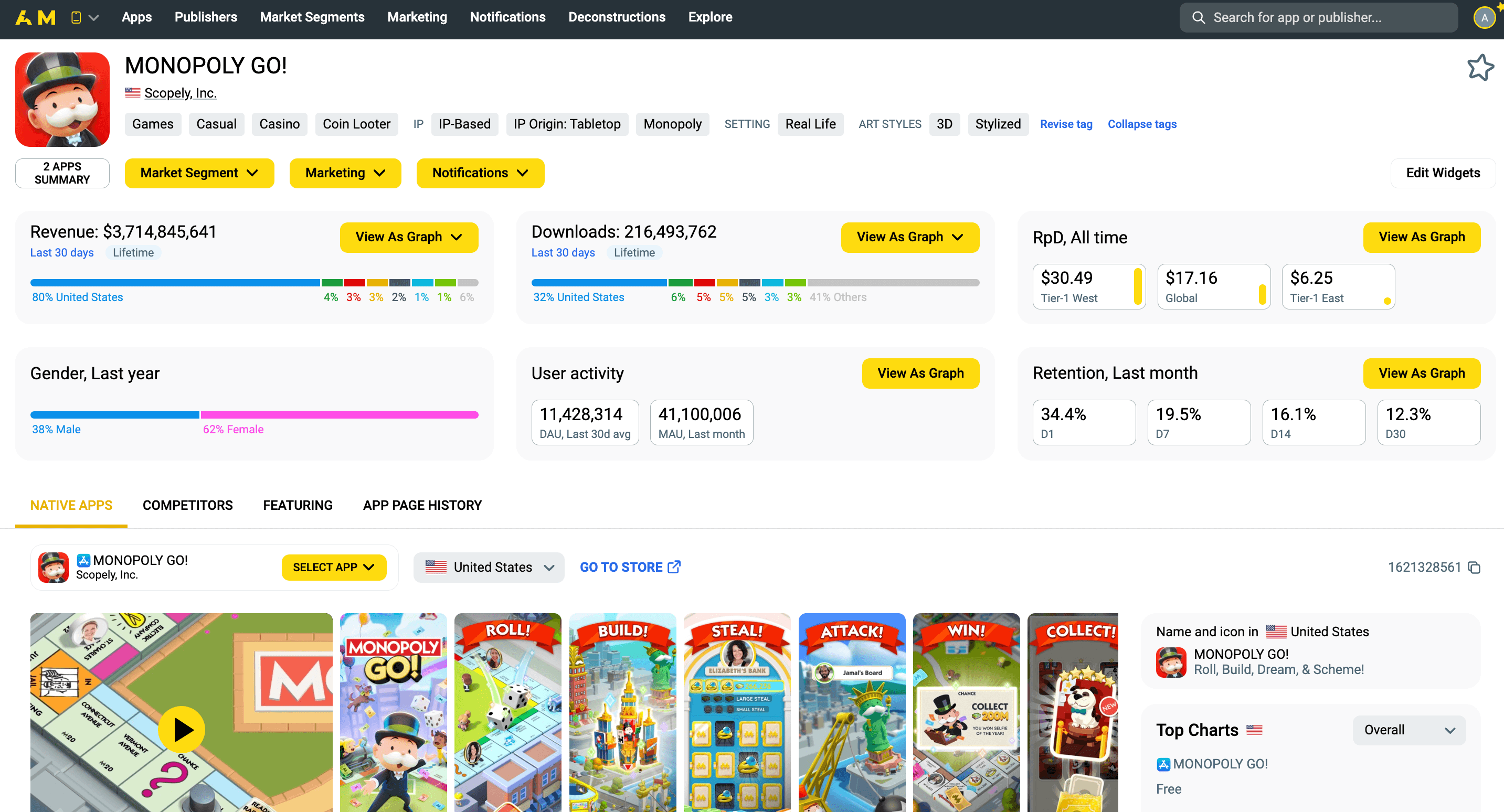
Getting started with AppMagic was straightforward. There was no heavy onboarding process or mandatory training period. The UI and data structure were intuitive enough that I could jump directly into exploration.
Within days, AppMagic got integrated into multiple workflows:
- Early-stage opportunity evaluation
- Competitor deconstruction
- LiveOps and monetization benchmarking
- Benchmarking for validating new concepts
- KPI benchmarking for monitoring game progress and investments
- Personal investment research
- And much more
There is depth to the platform, and it is the kind you discover naturally as your questions become more detailed. Eventually, it became a multi-purpose lens I now use to analyze both products and markets, and I’m happy to share a nine-step framework that helps turn market research into real results.
Using AppMagic: Example Scenarios
1. Evaluating Opportunities Within a Genre
By drilling into very specific subsegments, I can assess whether an opportunity is genuinely underserved, growing, mature, or declining. Let’s see how this works with the example of one of the genres that showed a tremendous growth in 2025: Screw Puzzles.
I’ve looked at the Screw Puzzle segment before, and back in 2024, it was already clear that pure 2D Screw Puzzle games were declining. The Market Segment dashboard showed that the subgenre leader, Screw Jam, was losing momentum, with no other title poised to take its place. The reasons were fairly typical: copycat games failing to provide fresh takes, overly aggressive monetization pressure, and a general lack of new ideas.
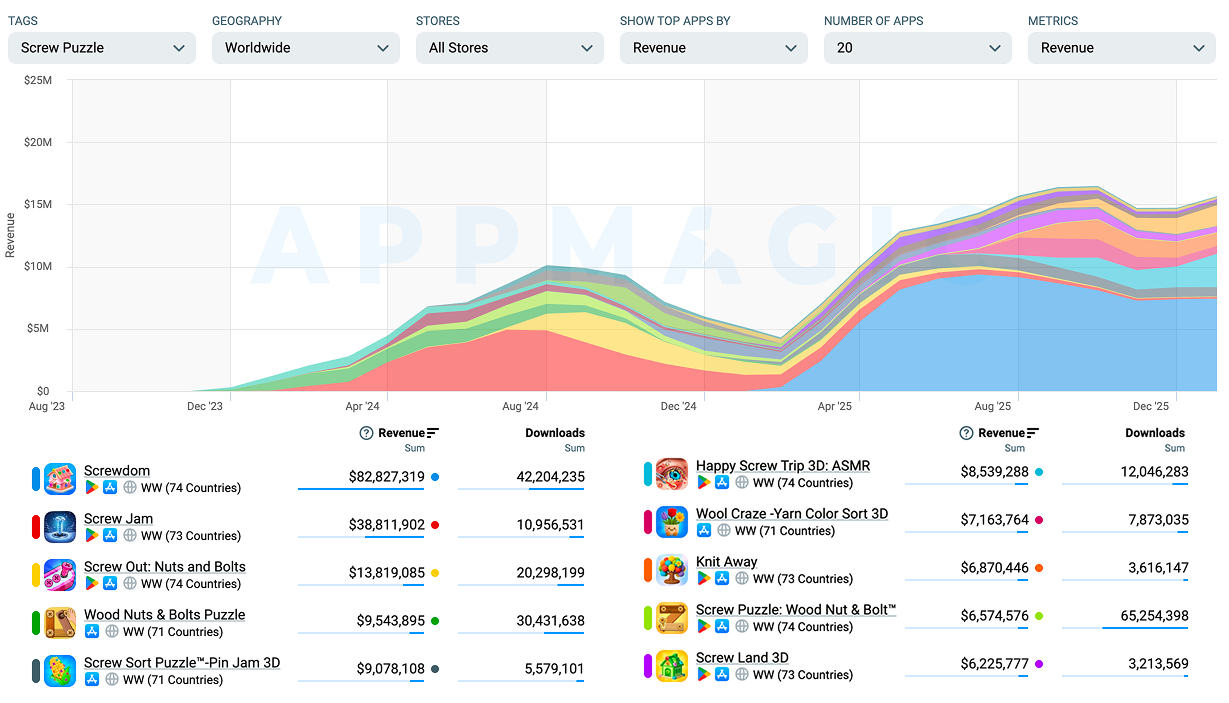 Screw Puzzles on the Market Segment dashboard
Then, the introduction of 3D Screw Puzzle games gave the segment’s growth another push. However, that growth was concentrated only around one title: Screwdom. That’s why the segment still didn’t invite a straightforward business case consideration. Further still, if you dove deeper into Screwdom, you would notice that its downloads had been going down, whilst cumulative RpD had been on the rise.
This is clearly something one needs to monitor in order to understand how their UA strategy may have reprioritized LTV optimization with lower user numbers over sheer traffic volume—to sustain the current business case. But in order to do it right, you need to start with the bigger picture, and that’s what you can do just by looking at the market composition. Starting from here, you can go further into product analysis—as far as you like.
2. Monetization Strategy & Placement Benchmarking
Instead of guessing where monetization pressure sits, I can actually explore all the essential economy aspects of my game of choice:
- What type of monetization strategies and placements it uses
- Which IAP placements drive the most value
- What upcoming monetization methods and psychological tricks are connected to them
- How aggressively the competitors push their monetization and economy
For example, Monopoly GO! is the fastest-grossing game to surpass $6B in revenue, and it serves as a great learning platform for anyone working with monetization. Using AppMagic’s Monetization Intelligence, I can actually take a look at the game’s vast library of offers. Going into a more granular level, tracking their placements and types, I can learn a lot about the game’s success in IAP monetization.
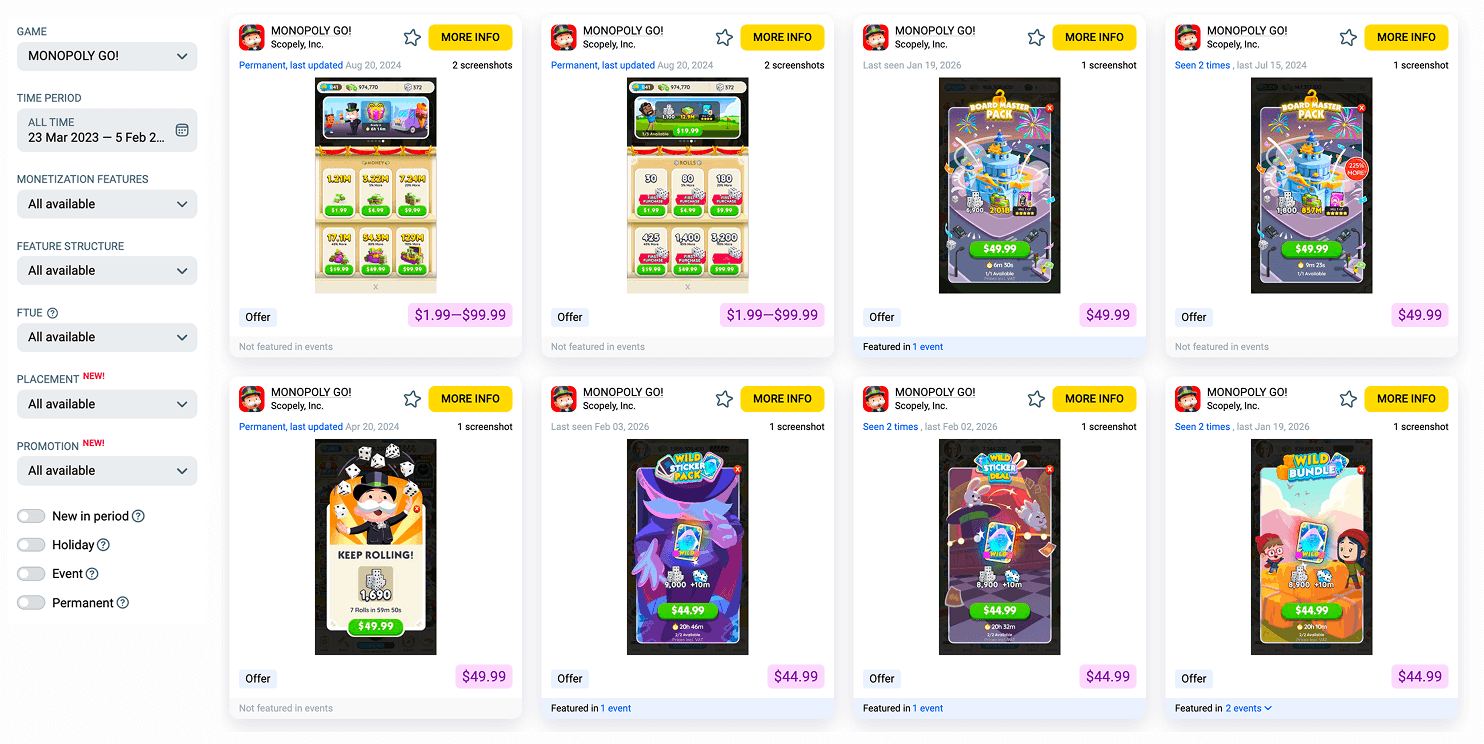 Monopoly GO! offers in Monetization Intelligence
But most importantly, I can see how these offers are interconnected with other aspects of the game, including any ongoing LiveOps events, and with each other.
3. LiveOps Calendar: Types, Cadence, and Strategic Weight
One of the most interesting things for me has been tracking:
- How frequently events run
- What types of events dominate certain segments
- Whether events are used as core economic engines or secondary engagement tools
This feeds directly into designing LiveOps systems that aim for top-percentile performance, not just table stakes, because having a clear view of how others do things also reveals what it actually takes to reach certain percentile targets with your games.
Take, for example, the Merge games segment with its $1.6B IAP revenue and constant year-over-year growth. Despite how promising it might look, it is important to consider what it really takes to get to the top. And such requirements are big ones, especially for live events.
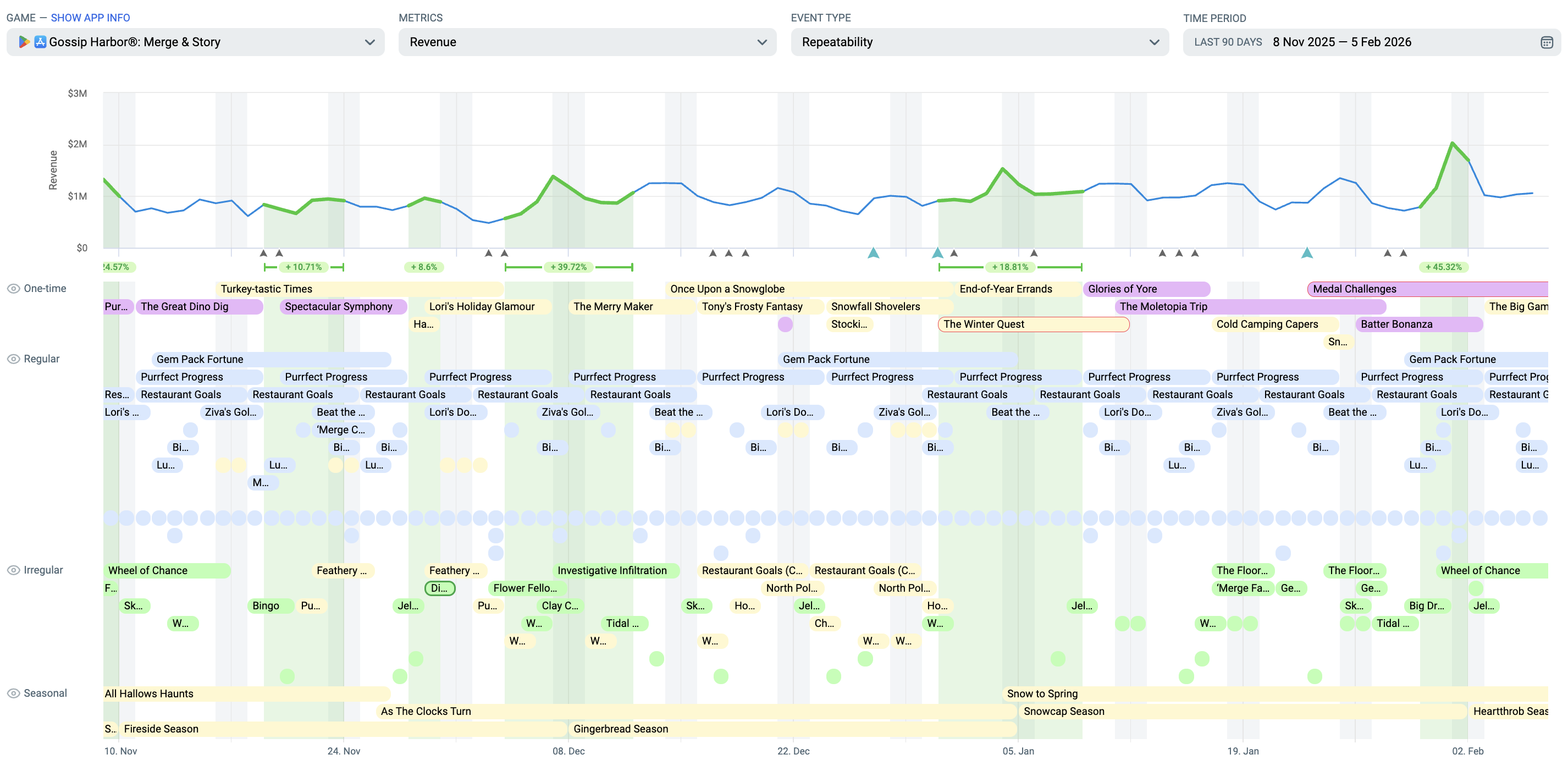 Gossip Harbor in the LiveOps & Updates Calendar
Even a quick glance at the LiveOps & Updates Calendar of Gossip Harbor, an undeniable leader in the genre, is enough to understand the scale of its LiveOps efforts. It’s packed with various simultaneous interconnected events telling a story of the resources you need to put into motion if you hope to sustain the possibility of getting closer to their level.
4. Investment Analysis (as an Angel Investor)
As a hobbyist angel investor in games, AppMagic helps me do the sanity check:
- Whether teams are targeting the right markets
- Whether their ambitions align with observable market realities
- Whether their differentiation claims hold up against existing competitors
In addition to the tools described above, it also helps to see a list of competitors in specific regions. Using the Top Publishers chart, I can review the list of competitors operating in the same country to better understand the company's background, its professional environment, and the overall state of the games industry in the region.
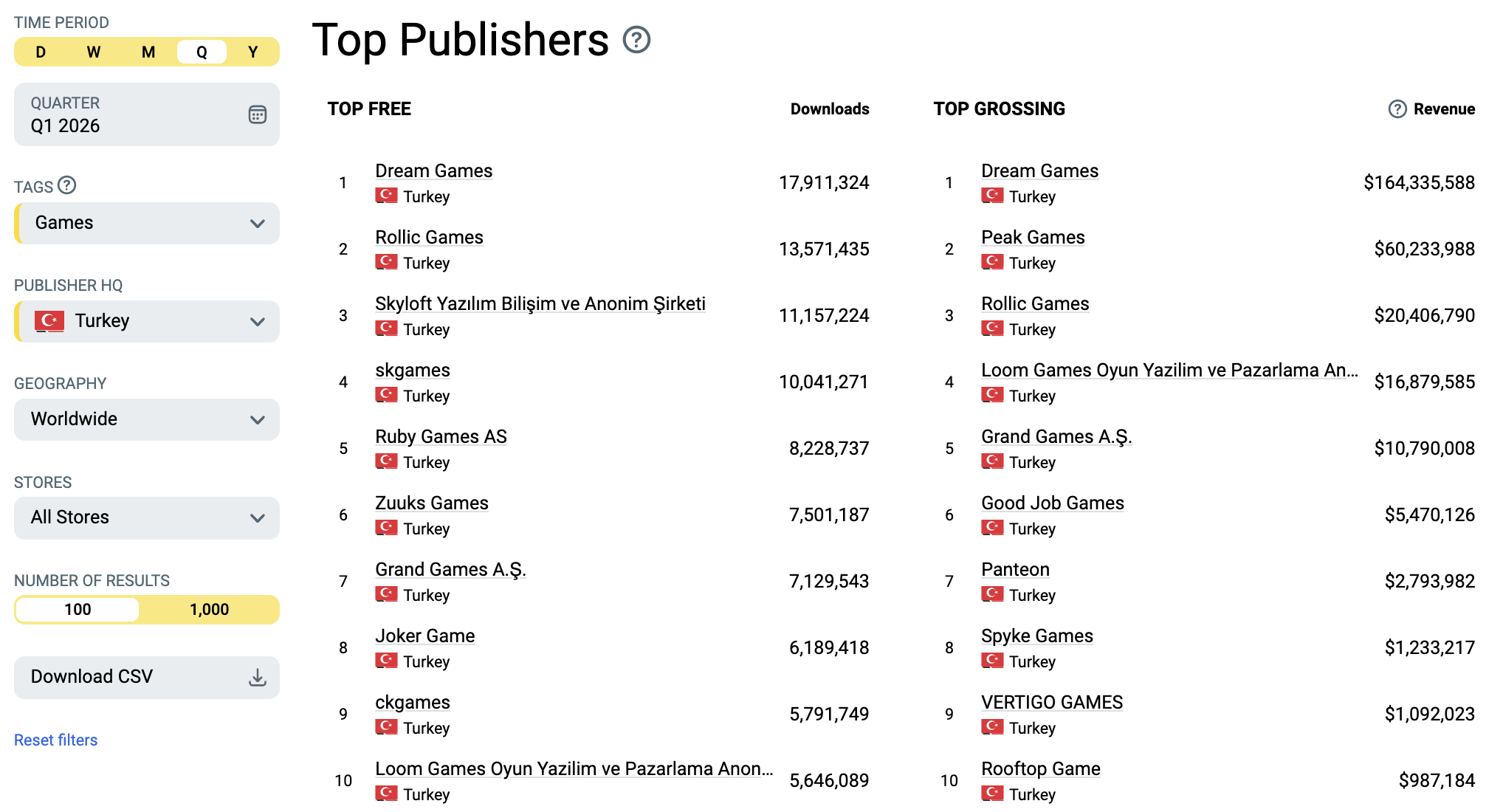 Top gaming publishers in Türkiye
5. Tracking Emerging Games & New Phenomena
To stay up to date and track major trends earlier than others, I can, as wanted, set up a custom early opportunity/warning system that allows me to:
- Spot emerging games and trends
- Follow them over time to assess sustainability
- Identify genuinely new systems or segment shifts, not just reskins
For that, I rely on several tools: Advanced Search and Notifications. The first helps me track every new release in the niche, even if it hasn’t built a revenue or downloads track record yet, while the second helps set up custom alerts delivered directly to my email. For example, I can track when the game in a certain niche reaches particular revenue or downloads figures; thus, the alert could be set for “Hypercasual Puzzles with daily IAP Revenue of $10K or more” to track new Hybrid Puzzles.
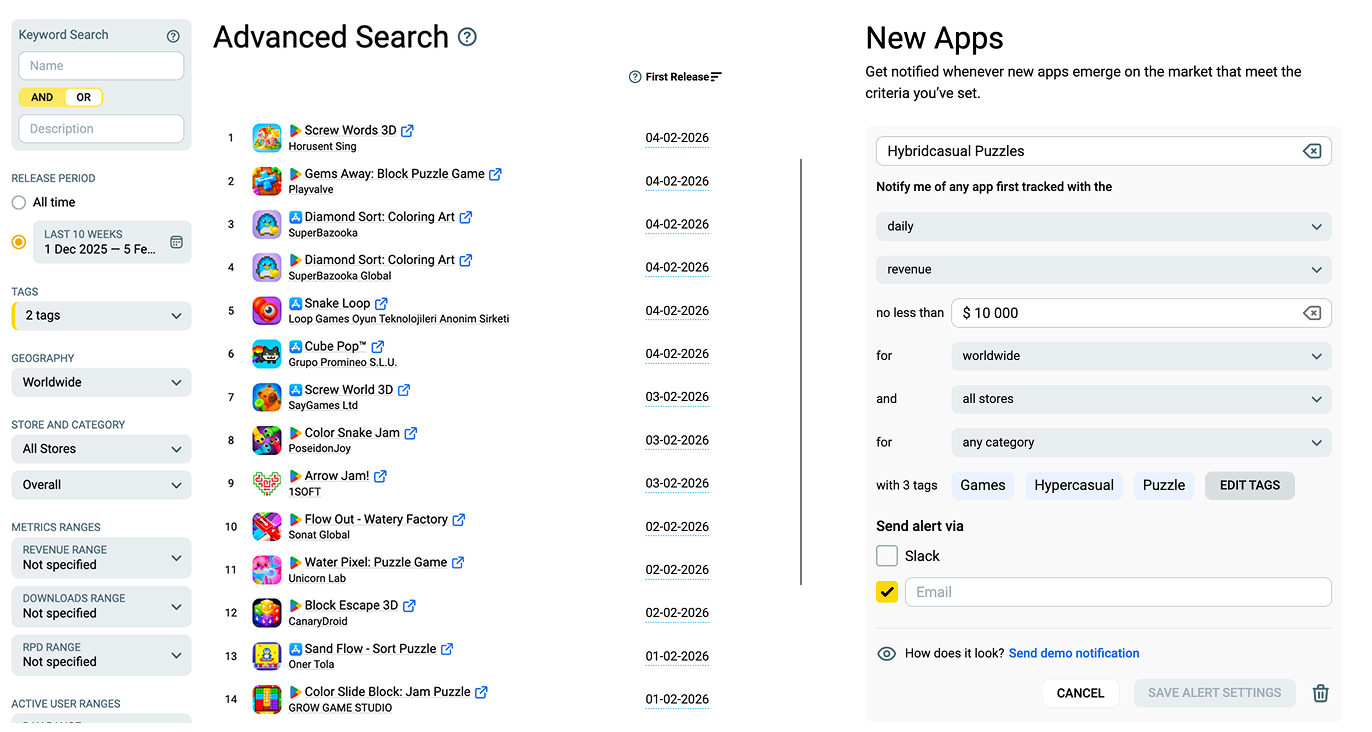 Screw Puzzles in Advanced Search
6. Creative Tracking & Benchmarking
A proper analysis shouldn’t end with the product overview only. Sometimes, it can be even more important to take a look at the UA side of things:
- Spotting the highest-spending creatives by competitors
- Monitoring creative trends
- Network and regional data
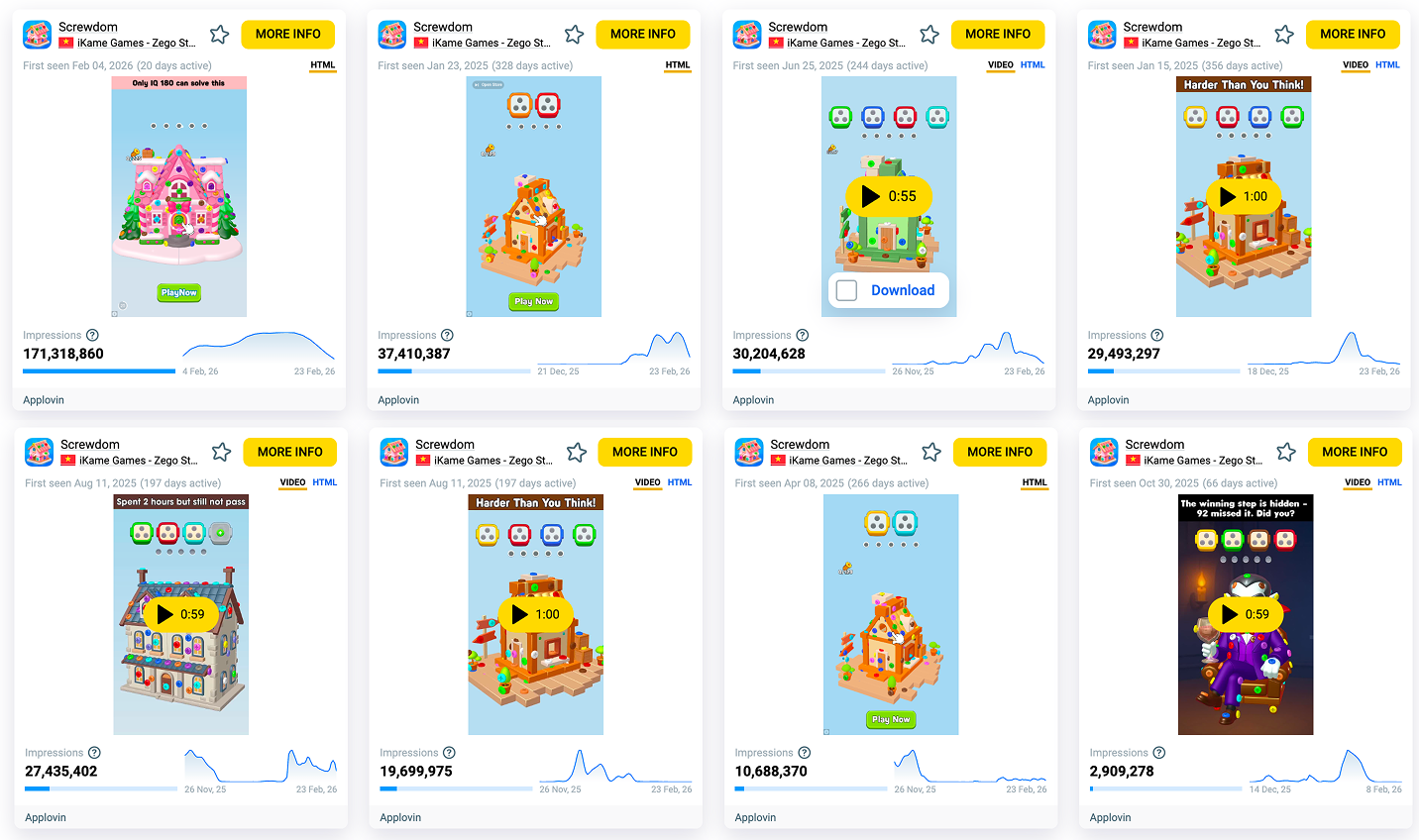 Screwdom creatives in Ad Intelligence
If we look at Screwdom as an example, it’s clear that introducing 3D into the Screw Puzzle was not only about gameplay, but a UA decision, too. Its creatives are built around 3D puzzles, highlighting the game's unique proposition and underscoring the importance of a marketable core gameplay for new Hybridcasual games. This allows the publisher to showcase actual or semi-actual gameplay for UA creatives and to cheaply scale the required volume of creatives.
“The biggest change after adopting AppMagic wasn’t a single “big win”. It was something more valuable: confidence.”
From these Ad Intelligence views, you can also build confidence in what works and what the segment-wide sentiment is. Like, if you’re not seeing fake ads, maybe you can somewhat confidently assume that you should not lean on them fully in your strategy.
Step-by-Step: How AppMagic Fits Into My Rhythm
With AppMagic, I reach conclusions faster, and they are supported by much stronger evidence. It helps me make confident decisions: from killing weak ideas early to doubling down on opportunities backed by real market signals.
That’s why I most often use the tool during the active concept or investment analysis phases. My typical flow would look like this:
- Identify a question or hypothesis (product, market, monetization, system, etc.)
- Slice the market down to the right level of granularity
- AppMagic-deconstruct relevant competitors: KPI ranges, monetization strategies, and live system patterns
- Granular self-deconstruction, as required, including macro/product layers, and cross-checking against what the tool shows
- As needed, validate marketability layers: channels, creatives (including possible volume requirements), trends, risks, and opportunities
- Feed those insights into validation models, design decisions, or investment theses.
Yes, this might take time and is always about creative thinking with data informing the work and interlinking. But it always translates into meaningful time savings, fewer blind spots at early validation stages, and better alignment between product strategy and actual market reality.
It also changes the quality of internal discussions: conversations become grounded in data rather than opinions, which makes decision-making clearer and more constructive. But most importantly, it helps overcome the biggest friction point in market analysis: the gap between macro-level data and actionable insight.