The Collectathon Boom: Is Steam Going Hypercasual?
Tidy-up games went from one breakout hit to dozens of Steam releases in just a few months. We look at what’s driving the collectathon boom, where AI fits in, and how developers are trying to stand out.
— Maria Bolshman and Evgeny Kolodyazhny

Fast production, instantly readable gameplay, and endless variations on the same proven idea—that's basically the old Hypercasual playbook. For years, we watched it play out on mobile, except now, we're seeing the same logic emerge on Steam.
The first hints came with friendslop games, where simple, shareable concepts became one of Steam's biggest recent trends. Now another format is taking that simplicity even further—collectathons. One room, thousands of objects, and one simple job: put everything back where it belongs. That's the basic idea behind a new wave of collectathon-style sims, or, as we'll call them here, tidy-up games.
April brought the first big signal with Librarian: Tidy Up the Arcane Library!, which built a premium game around sorting 3,000+ books. By late June, Supermarket Chaos was doing much the same with 4,000+ supermarket products.
Then the trickle turned into a flood, with 13 tidy-up games launching in August and roughly 17 more in September. Some highly advanced math tells us that's 30+ titles already, and judging by the pace, we wouldn't be surprised to see that number cross 100 by the end of the year.
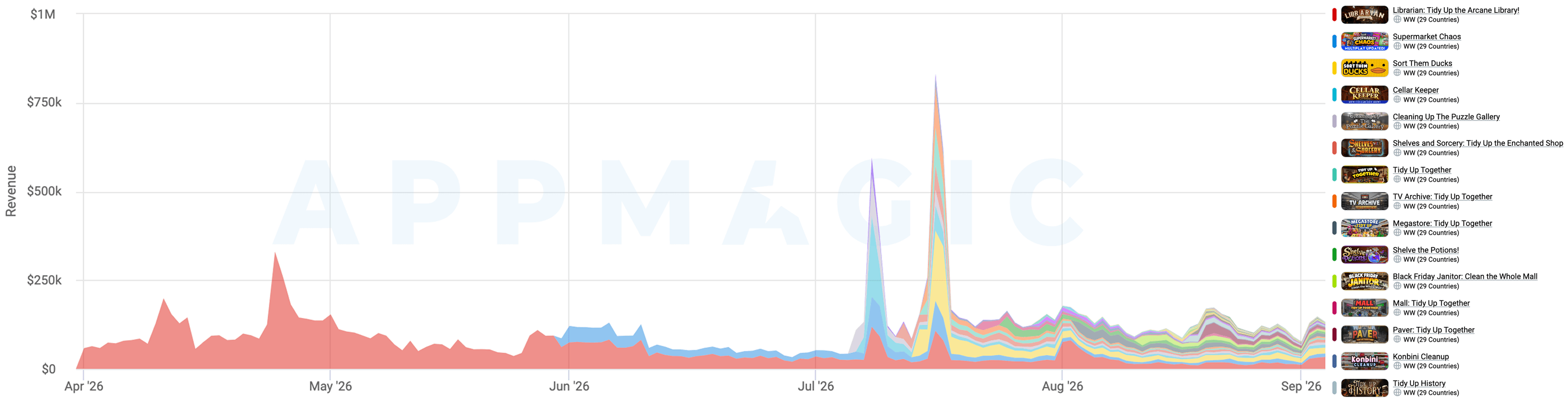
Steam's growing wave of tidy-up games
Going from one breakout example to dozens of variations within a few months is quite a leap, even by Steam standards. So how did collectathons get here so quickly? What made them so tempting to replicate, where does AI fit in, and how do you stand out when everyone is working from essentially the same idea? We'll get into all of that, but let's start with where tidy-up games came from.
First, There Was the Mess
Sorting thousands of objects is very much a new trend in Steam simulation games, but its roots go back to a cleanup sim niche that's been around for years. Games like House Flipper and PowerWash Simulator had already proven there was a huge audience for turning messy spaces back into order, with both growing into franchises and selling millions of copies. Collectathons narrow that proven appeal down to organizing objects.
We explored the cleanup category in our article on Steam's simulation games, including the abovementioned Librarian, which took that organizing part and turned it into the core gameplay. The game went on to sell more than 1.6M copies and generate $9.2M in revenue, while that premise became a blueprint for a new wave of tidy-up games.
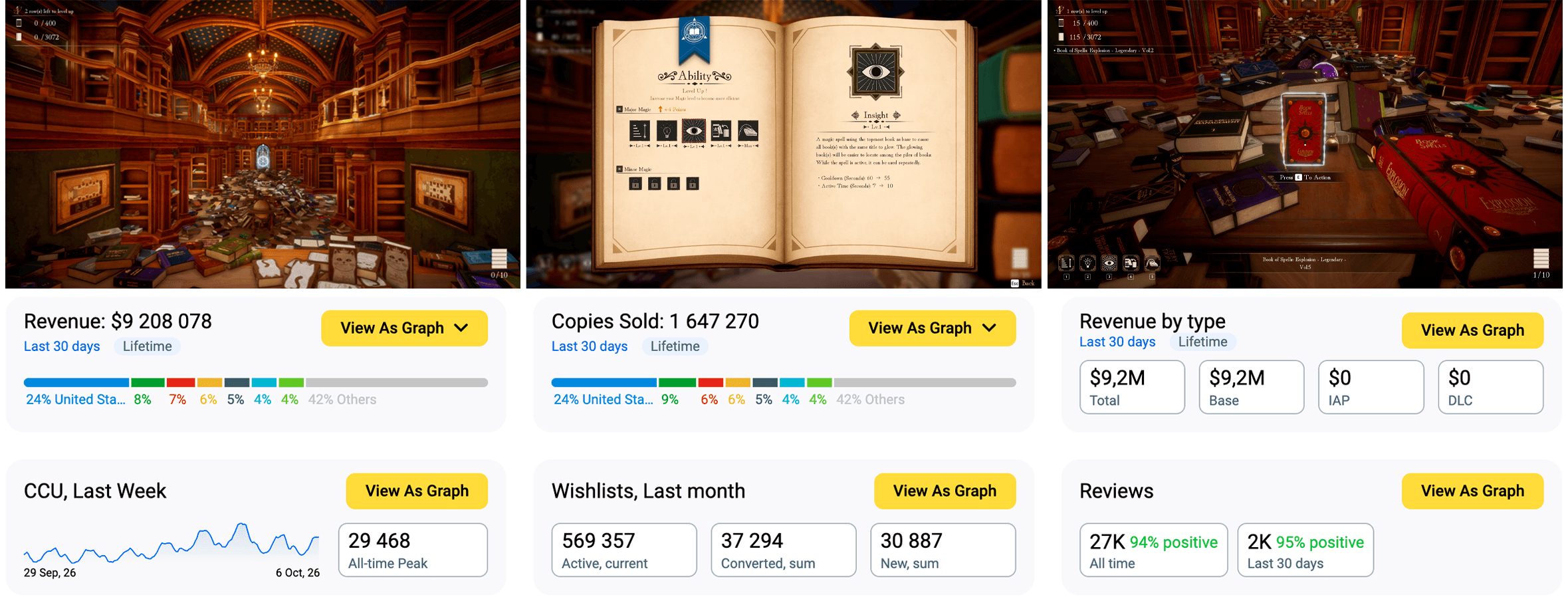
None of the releases we've tracked since has come close. But developers haven't stopped looking for new ways to package the formula, with much of that experimentation happening around the setting.
Any Mess Will Do
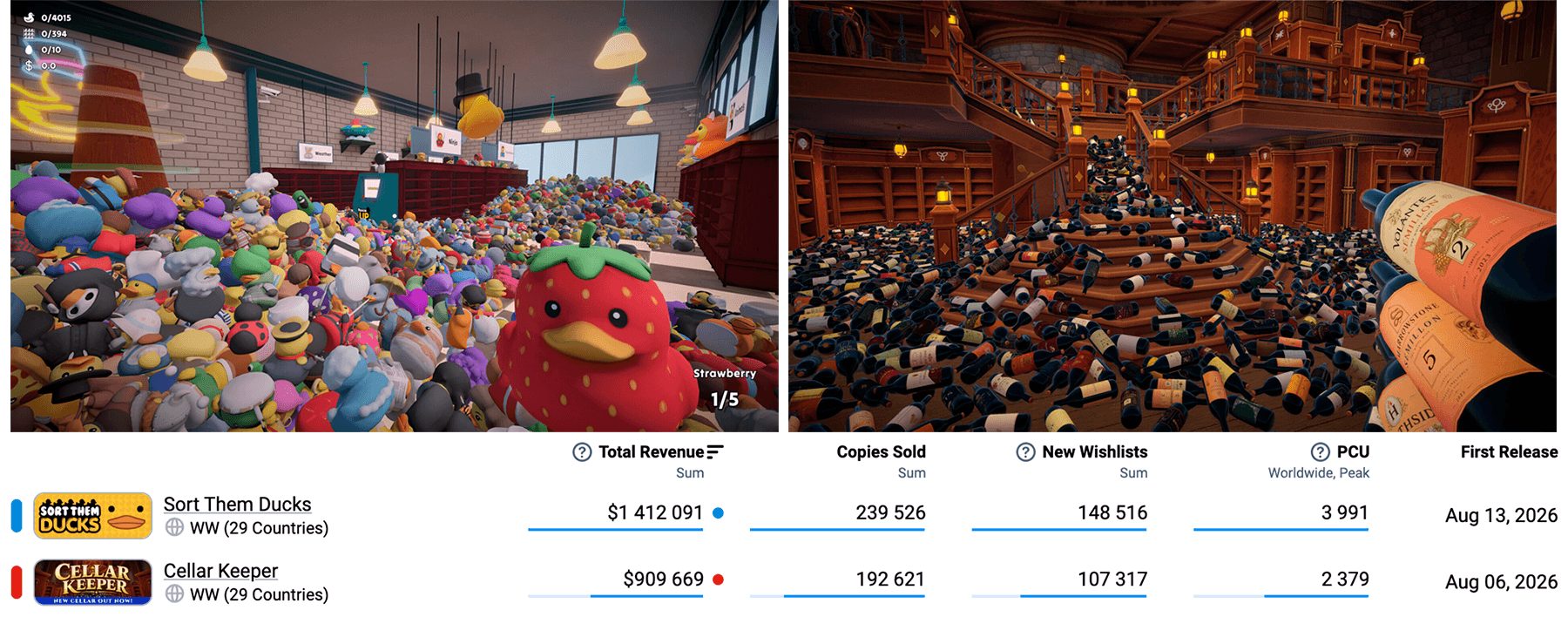
As it turns out, almost anything can provide the mess… Sort Them Ducks went with, well, 4,000+ rubber ducks, spread across hundreds of categories, from pirates and wizards to astronauts and dinosaurs. Released by Mr.Duck on August 13, it has since sold 239K copies and brought in $1.4M, making it one of the strongest tidy-up games we've tracked after Librarian.
Not every game needed such an unusual hook, though. A week earlier, EgoTrampoline released Cellar Keeper with a more familiar setting and a straightforward job: a wine cellar filled with 2,400+ misplaced bottles that players have to sort back onto the shelves. That simplicity hasn't stopped the game from reaching 192K copies and $909K in revenue, showing that tidy-up games don't need a big twist to find an audience. Or maybe wine lovers are just a very reliable demographic…
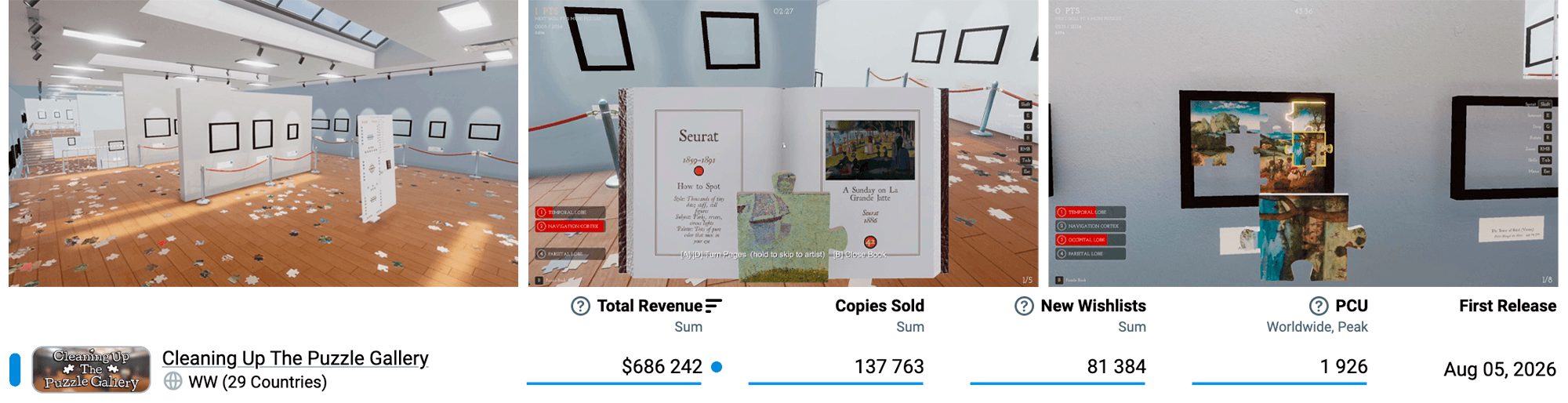
Th3GameStudio added more to the sorting with Cleaning Up the Puzzle Gallery. Released just a day before Cellar Keeper, it turns the cleanup into a series of jigsaws, asking players to rebuild famous paintings from thousands of pieces scattered around the gallery after an earthquake. The game has sold around 137K copies for $686K and has since grown to 5,000+ pieces across around 200 paintings.
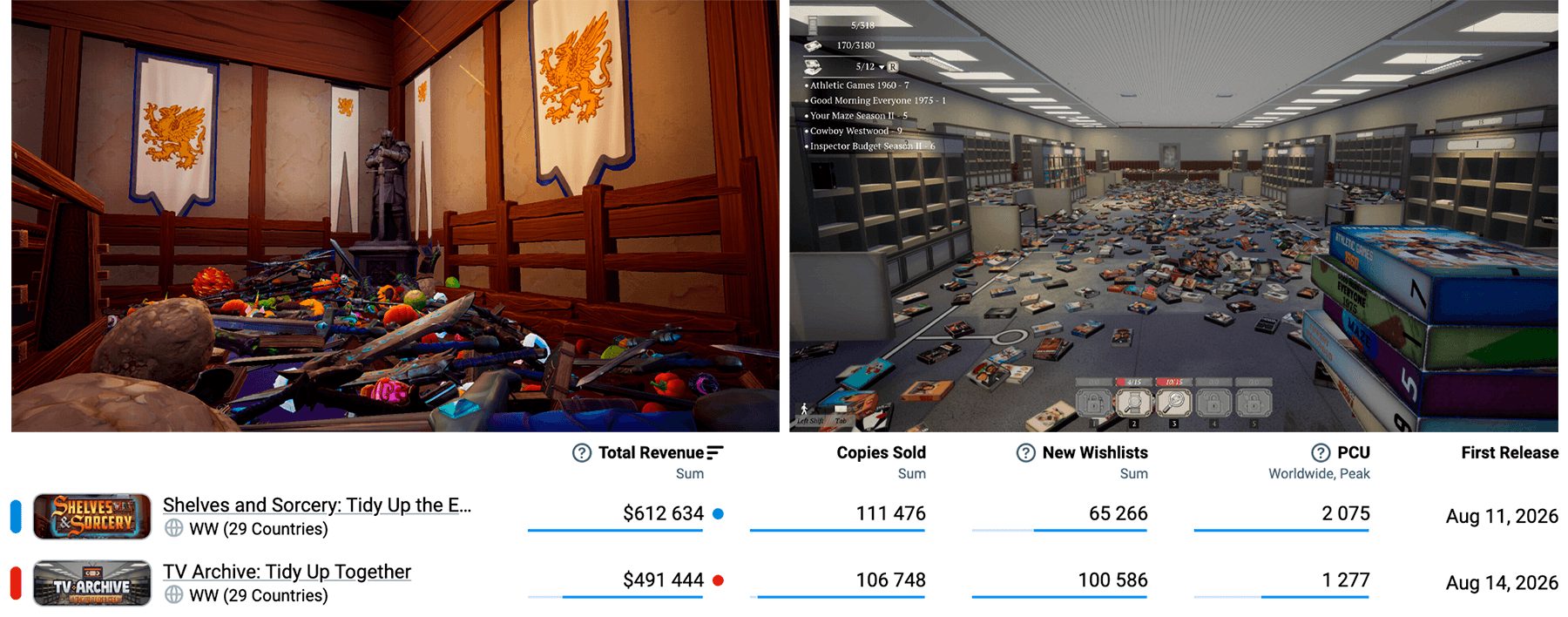
There's also fantasy, which inevitably found its way back into the mix. Shelves and Sorcery: Tidy Up the Enchanted Shop, released by Teddy Bear Games on August 11, shares some thematic territory with Librarian. It does more than swap one magical interior for another, though, with three shops of different sizes, spells, permanent enchantments, and global leaderboards. The game has reached 111K copies and $612K in revenue, while TV Archive: Tidy Up Together, released just three days later, has found almost as many buyers at lower revenue ($491K) by trading fantasy for videotapes, which players can organize alone or through online co-op and PvP.
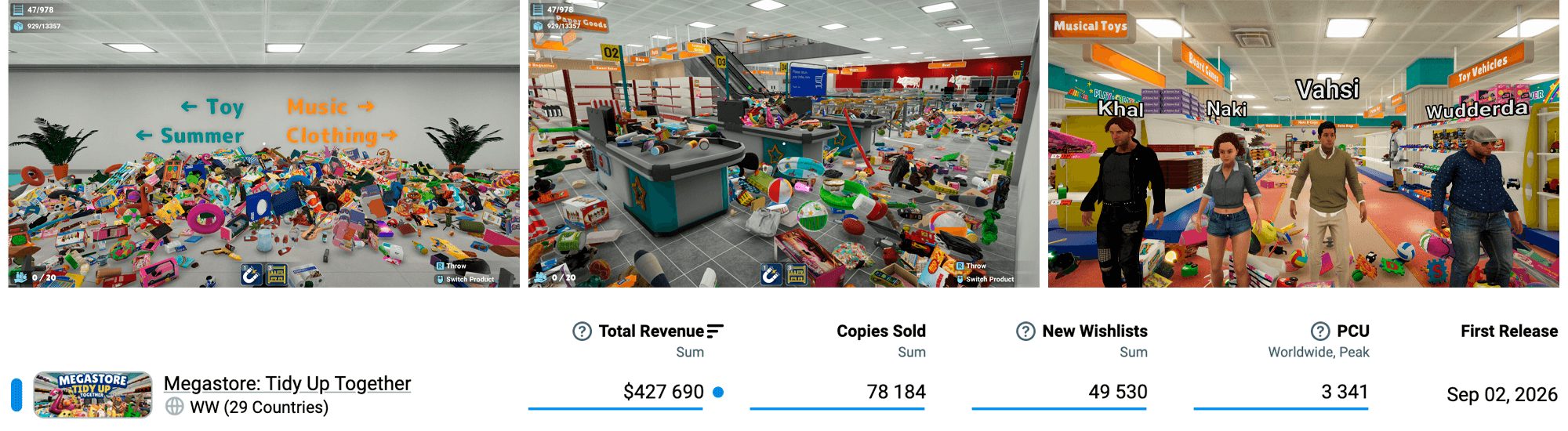
Then September brought Megastore: Tidy Up Together, and the “mega” part is there for a reason. Where Supermarket Chaos had launched with 4,000+ products across 16 supermarket sections (and brought in $1.8M from 421K copies), Yolo Games Studio takes players through four increasingly large stores, from a toy shop and electronics store all the way to a two-story megastore, either solo or in online co-op. Around 78K copies and $427K this early make it worth watching, especially as Megastore reflects where the tidy-up formula is already heading: bigger scale and multiplayer.
A Five-Dollar Game in the AI Era
So setting is an obvious place to start when everyone's fighting for attention, but it doesn't stop there: we're seeing games stretch into multiple locations, add multiplayer, or pile extra systems on top of the sorting loop. Basically, several games can share almost the same mechanic, but the package around it still gives players a reason to choose one over another.
And when the market is this crowded, price becomes part of the pitch too. After all, a lower entry point makes it easier for players to give another variation a chance, as we explored in our Steam pricing research. In fact, nearly every tidy-up game we've tracked so far is priced between $4.99 and $5.99.
Unlike mobile Hypercasual, where the business model usually depends on ad revenue, tidy-up games are sold as complete premium experiences. So for five dollars, players get the whole experience upfront, with no microtransactions or service layer attached. DLC could become a next step for some of these games, but the base experience doesn't depend on it to feel complete.
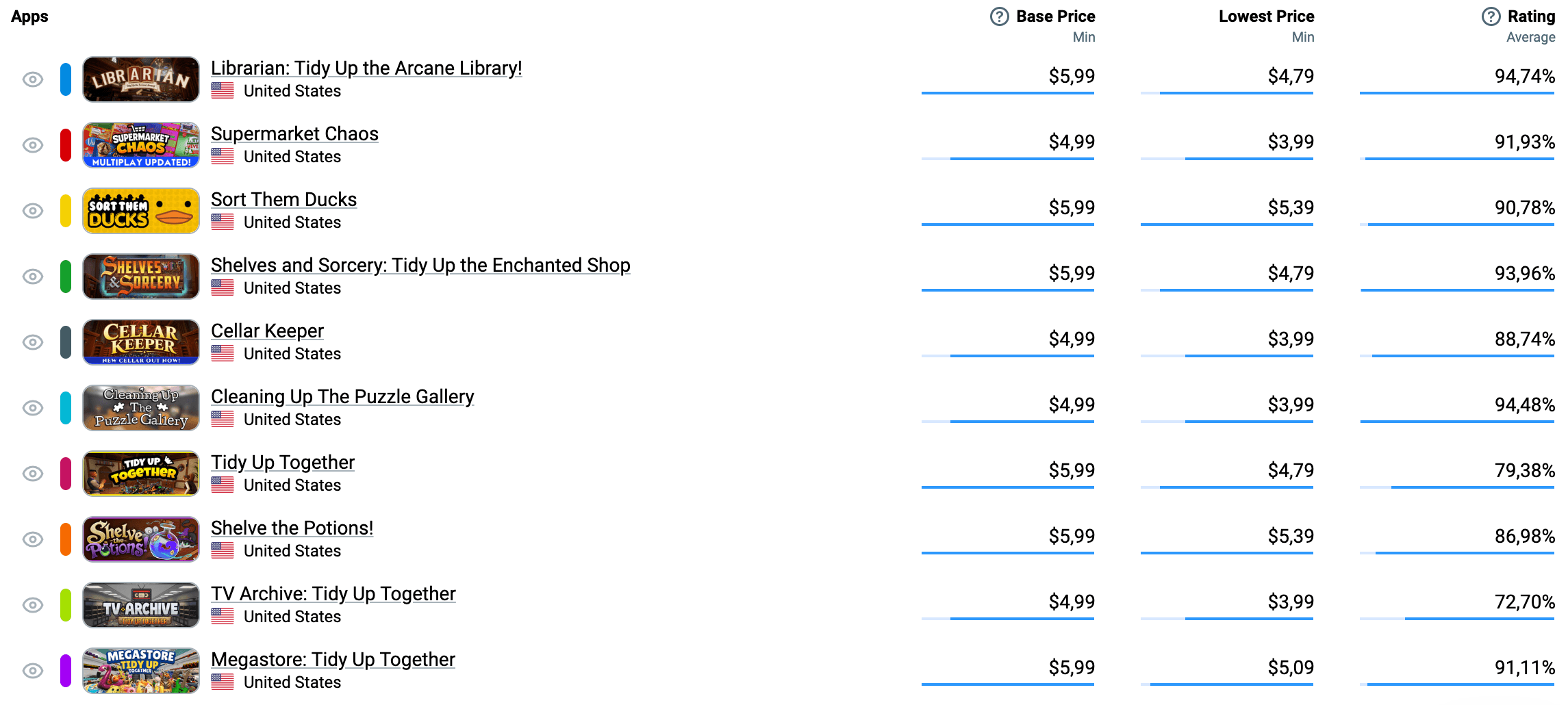
Pricing and average ratings across selected collectathon titles
As for ratings, scores range from roughly 73% to 95%, with six of the ten games above 90%. So a small scope doesn't seem to bother players much, as they treat the games on their own terms and understand the scale of the purchased projects.
All of that is good news for indie developers and small teams, especially since collectathons don't require a long or complex production cycle. One location, a bunch of existing assets, and a solid sorting loop can already cover most of the product. For an experienced developer, that can mean a very short timeline even without LLMs. Add AI agents for code, asset work, localization, or marketing, and production can move even faster.
Which brings us back to the speed of this whole wave. When dozens of variations start appearing within months, it's hard to believe AI isn't playing some role. Developers may say they don't use it, keep it around the edges, or be completely open about it, like the team behind Package Chaos, which disclosed using generative AI for its package sticker textures. Either way, call it a coincidence, but the release pace is doing a lot of the talking!
Hypercasual, Steam Edition
So what, is Steam actually going Hypercasual? Not literally, and definitely not across the whole platform. But some corners of it are getting there, just on Steam's own terms. Here, the same logic comes wrapped as a $5 premium game: one readable loop, a low price, fast production, and a concept that can sell itself in a screenshot, stream, or short clip.
Mobile has spent years moving the other way, adding more meta, progression, and systems to once-simple games, while parts of Steam are testing how far one simple loop can go as a complete premium game. Prediction? Give it another month and we may need a collectathon to keep track of all the collectathons…
This article was featured, along with other pieces, in our biweekly AppMagic Newsletter from October 7, 2026. If you’d like to receive insights like this ahead of others, subscribe here or in the form bellow.