Dating Apps Market Overview
Let’s have a look at what’s been going on with dating apps from September 2018 to August 2021!
— by Diana Levintova

Ah, the season of summer flings and romances is no more, and fall is taking over with its chilly mornings and seasonal coffee brews. We felt it was the right time to take stock of matters of the heart through the prism of dating apps. Originally curious about the 2021 trends in this segment only, we ended up analyzing an extended timeline of the entire three-year period to tap into the more tectonic changes. So, let’s have a look at what’s been going on with dating apps from September 2018 to August 2021.
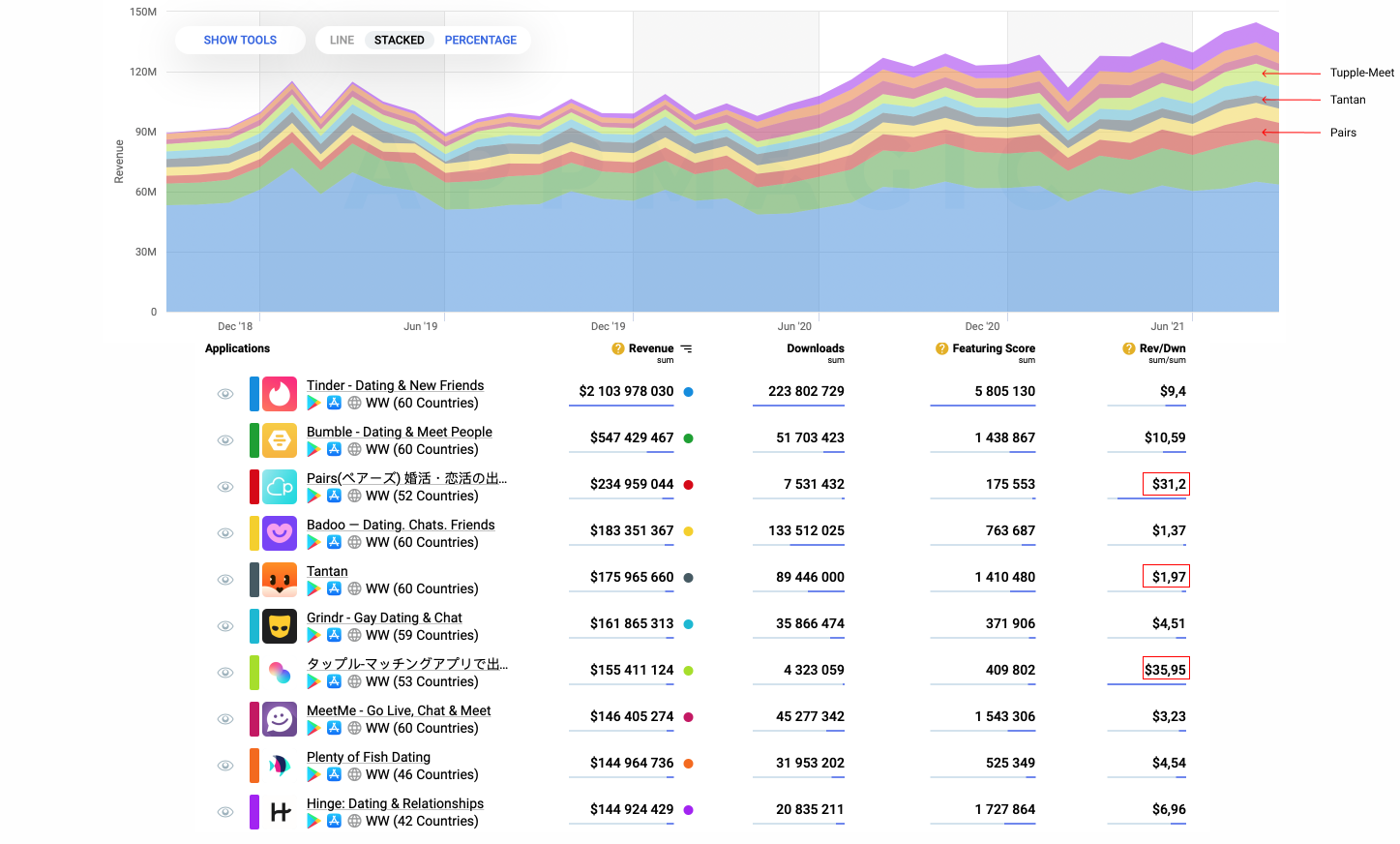
First, let’s dig into the overall metrics of the dating market top performers worldwide over the last three years.
We see right away that Tinder is in the lead by a landslide for both revenue and downloads. Well, after all, it is one of the pioneers, and a classic at that, famous for its “swipe right/left” solution that would later be adopted by many dating apps. Its range of paid features has grown over the past couple of years and is pretty extensive today, including super likes and prioritized likes; unlimited rewinds (when you’ve swiped wrong by mistake or changed your mind the very instant after); “passport to any location” (matching with people anywhere in the world, not just in your location); messaging before even matching; and many more. You’ve got subscription tiers covering the more premium features the higher the tier, so yes—Tinder has it all figured out.
Then there are two other dating apps that have been quite popular for a while now: Bumble and Badoo. What is peculiar is that earnings per user from the worldwide perspective for Bumble are almost 10 times higher than for Badoo: $10.59 versus $1.37 respectively. That can be linked to the fact that, traditionally, most revenue comes from the USA, and, while Bumble is quite popular there (34% of downloads are made in the States), Badoo finds itself highly popular in emerging countries such as Brazil (16% of downloads) and Russia (12%).
As for the more country-specific apps, in the top grossings chart’s third and seventh positions we will find two Japanese apps (Pairs and Tupple-Meet respectively) that, as you can see, generate quite a lot of revenue despite not so many downloads (7.5M and 4.3M accordingly). In fact, you won’t even see these two titles in the top 10 by downloads. This obviously means that earnings per user are rather high. Nevertheless, let’s not get ahead of ourselves here: this is a pretty standard situation for Japan, where earnings per user in gaming apps are about 4 times higher on average compared to the USA.
Another regional leader here is *Tantan*—a Chinese-produced dating app that generates surprisingly low earnings per user compared to the two Japanese titles above: $1.35 compared to $25.57 (Pairs) and $28.46 (Tupple-Meet). That’s rather odd, since the Chinese usually spend quite a lot of money (if we count by user) in mobile apps as well: 3 times as much per person as in the USA.
Another app to make it neatly to both top grossing and top free charts is MeetMe. It positions itself as a platform where people look for different kinds of relationships: from friendship to serious dating. To set up your profile, you are asked to fill in a questionnaire with generic questions standard for this kind of app. Afterwards, you get access to a personalized selection of matching profiles that you could swipe right or left; when matching is complete, you would be able to message directly (here you can also send pictures or videos inside the app). What is special about the app is the livestream feature that you can actually monetize: attracting a bigger audience, you increase your chances of receiving in-app gifts, which can in turn be exchanged for *MeetMe*’s in-app currency of diamonds.
Actually, the top grossing chart indicates that most of the apps are specific to one or two countries, getting the lion’s share of their revenue from there, except for Badoo and Tinder: with these two, revenue comes in from all over the world. Most other apps usually make their major earnings in the USA or Japan.
Another overall takeaway is the worldwide market of dating apps growing 74% in revenue over the period: from $101M in September 2018 to $176M in August 2021. In terms of downloads, the market growth is somewhat less pronounced, albeit still significant: from 23M to 31M (up 34%).
However, since the majority of us are mostly interested in the Western market, and in order to account for major distortions caused by huge amounts of downloads coming from developing countries where they are not linked to comparably high revenue, we will focus on the USA in particular further down. As a standalone market, it is a good representation of the dating app trends in the West in general.
So, what do we have here? The national market grew similarly to worldwide: from $55M in September 2018 to $96M in August 2021 (up 74%). Again, in terms of downloads, growth is less pronounced: from 6.9M to 8M (just 16%).
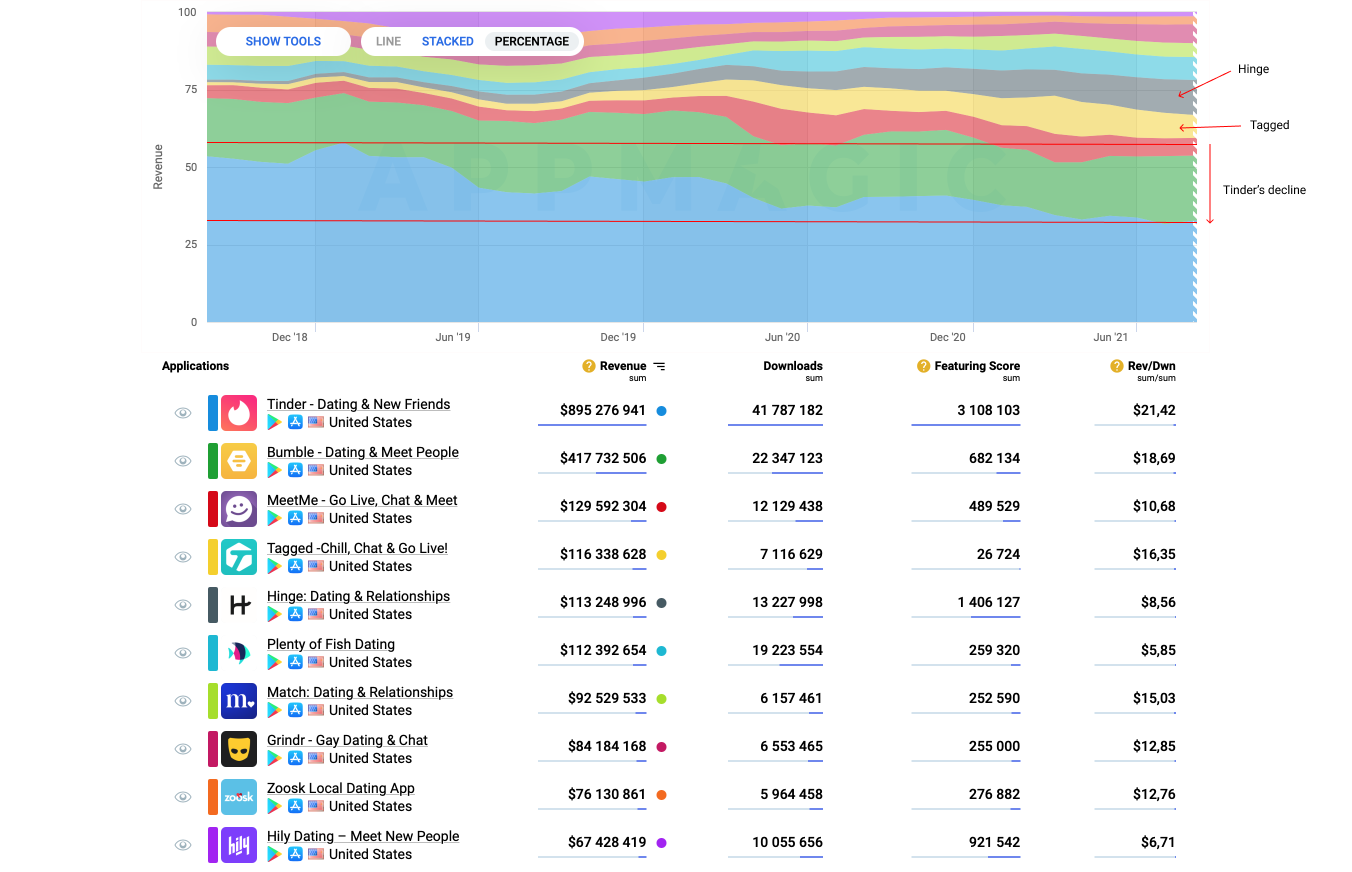
At the top of our grossing chart sits Tinder, which is no surprise whatsoever. Still, mind you—the app’s position is not as strong as it used to be: at its peak in January 2019, Tinder accounted for a massive 54% of the market share revenue-wise in the USA, while its current position in terms of earnings is nearly half that, coming in at just 29% and continuing to shrink slowly. You can see it clearly from the graph: Tinder is the blue area at the bottom. (We have color-coded each app from the top charts (to the left from the picture) to match its own specific area in the graph. Thus, you can track their dynamics at your own discretion.)
The second position is taken by Bumble that has been growing its share through the years: its revenue was up by 65% from $8.8M in September 2018 to $14.5M in August 2020.
The revenue chart’s third position is occupied by Hinge, which we can also spot coming in fifth in the downloads chart; it too has been gradually but steadily improving its metrics over the period. Its revenue went up significantly: from $0.38M to 7.8M. As for the app itself, it has one of the coolest slogans out there, which is “Designed to be deleted”. See what they did there? According to the company's own stats, 3 out of 4 people go on second dates with those they’ve matched with in the app. Its major selling points include, for one thing, the option to filter your potential matches by traits that matter to you, such as religion or height. Another prominent feature is that Hinge offers you matches based on your shared Facebook contacts, thus assuming that you’re more likely to have something else in common since you two come from the same social group.
MeetMe has delivered great results as well, almost doubling its revenue from $2M to $3.9M and peaking in July 2020 with a neat income of $6.2M.
One app that is actually on a highspeed market conquest mission is Tagged: it is already accountable for 5% of the market in terms of revenue. It grew its inflows from $0.4M to $5M during the period. What is so special about it? Well, for one thing, it is not your average dating app but more like a platform to find friends and connections rather than flirt. For another, it lets you do live video streams in order to gain viewers who you might just match with then! Interestingly, Tagged originally launched as an under-18s app only, but was quick to switch to 17+.
Another app that did not make the illustrations but is certainly worth mentioning is Joi: it did none other than hit the top 10 in 2021, and it seems like a serious contender that is bound to make a few titles budge sooner or later. Released in the beginning of the pandemic—in February 2020—it is positioned today as an app that helps you socialize in the era of taunting social distancing. One special feature that this app is built around is instant video chats: as soon as you are matched with a potential future friend, you can video call them. This option has actually become a big thing over the last few years and can now be found in almost all apps, from the very freshly minted to the old-timers along the likes of Tinder and Bumble who had no choice but to add video chats lately, too, in order to not fall behind.
Overall, the tops charts analyzed above demonstrate convincingly that the market today is definitely looking for new formats and is eager to go beyond the dating framework.
As we see, there are many apps in the top 10 that are positioned by developers as apps for socialising and meeting new people, however, after actually checking them we found out that people still use these apps in order to find dates. Is it an issue with the way business development teams deliver the message to the users, or with the content of the message that is outlined a little blurry, or maybe with the fact that basic human instincts always win? That’s the question to the marketing departments to answer. The only thing we may say for sure is that people no longer want to just chat with those strangers we might meet online, but we enjoy seeing their faces and hearing their voices, too. And, in that regard, the market is still up for grabs, and the slices of this pie can still be redistributed. High-pace innovation will be key, so let’s see who matches that best!