2020-2021 Market For Educational Apps
Education is a market of immense proportions. And only a small fraction of it is yet digitized. As educational apps more and more often come in handy, so, we felt it is the right time to do an overview of the market.
— by Diana Levintova

Fall is when most of the students return to their textbooks and get on with their studies after the summer break. Education is self-investment, and, from youngsters to adults, most of us are keen on pursuing it this way or another throughout life, and more and more often mobile apps come in handy for the purpose: from organizing and streamlining our educational activities to literally supplying them. This inspired us to do an overview of the most popular and successful educational apps around the globe in the most recent academic year: August 2020 to July 2021.
Before moving on to the actual top charts, we suggest you have a quick look at the general trends in the market to get a feel for some global and regional context.
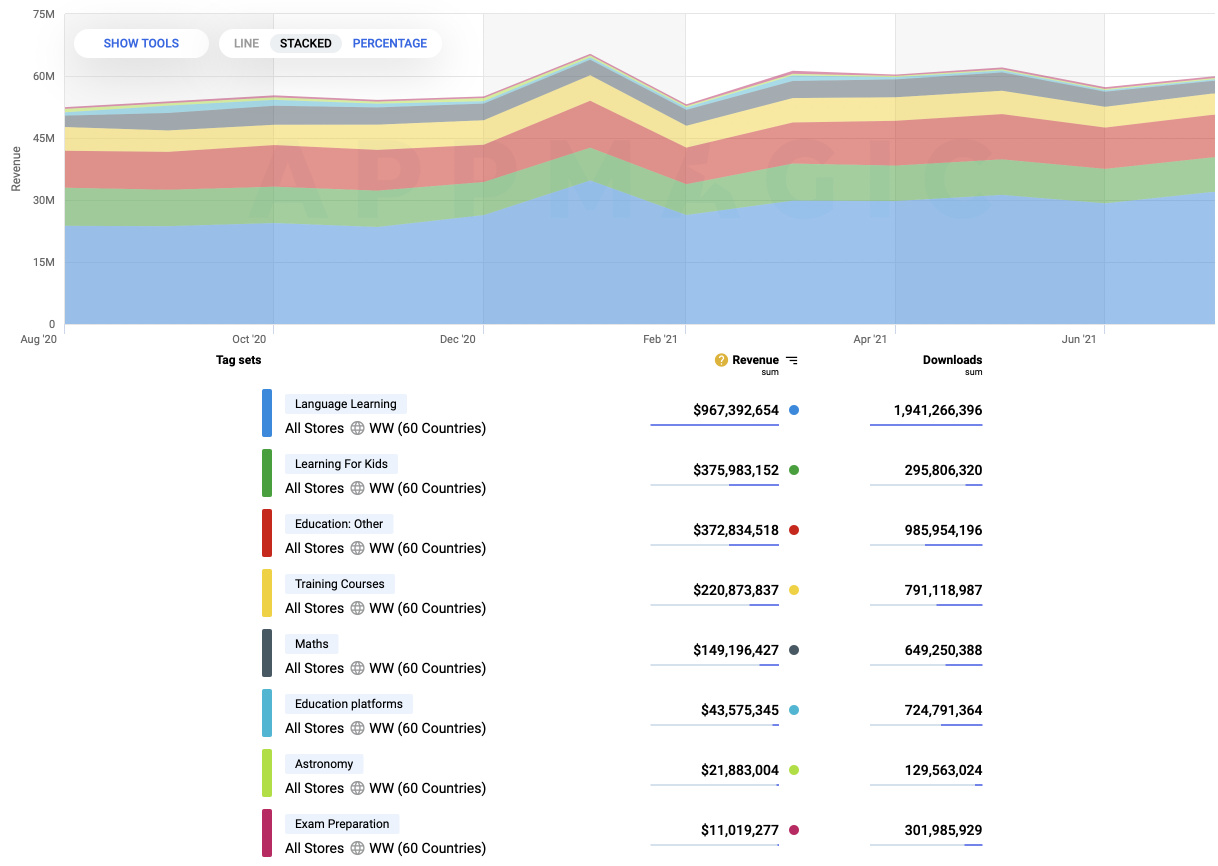
The graph for worldwide revenue earned by educational apps (split by category) indicates clearly that the overall market went down slightly compared to the previous year: that’s a 5% shrinkage if we look at June 2020 compared to June 2021. Trends-wise, unsurprisingly, the biggest peaks come in September; and yet this year, peak earnings were 9% lower than in 2020. As for segmentation, the biggest share belongs to the Language Apps—they hold 45% of the total market; then follow the Apps For Kids with 17%; next up are apps from the Other category with a 17% share (they have no category attributed and include solutions for, say, general mental abilities training or piano practice); and then we have Training Courses (10%), Maths (7%), Education Platforms (2%), Astronomy (0.9%) and Exam Preparation (0.5%).
Now, let’s go over the regional trends briefly and find out how the situation has evolved in different countries.
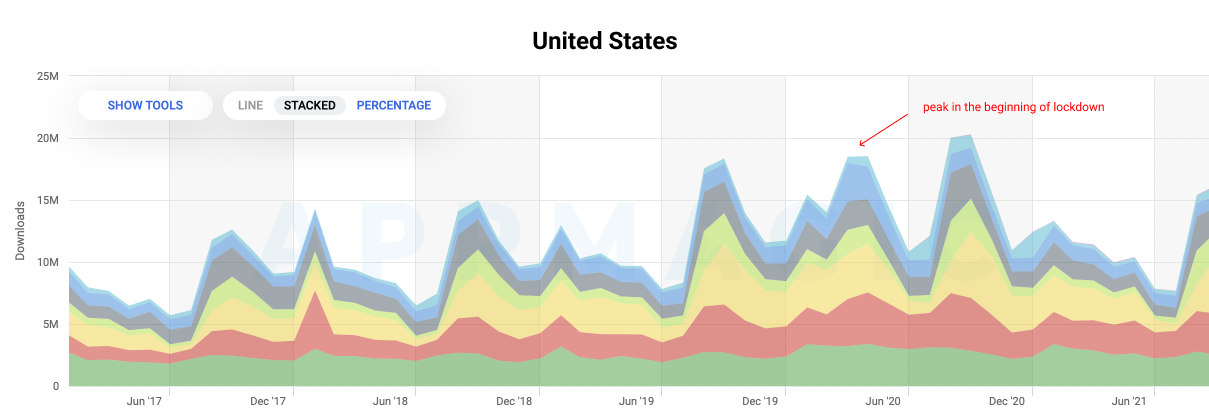
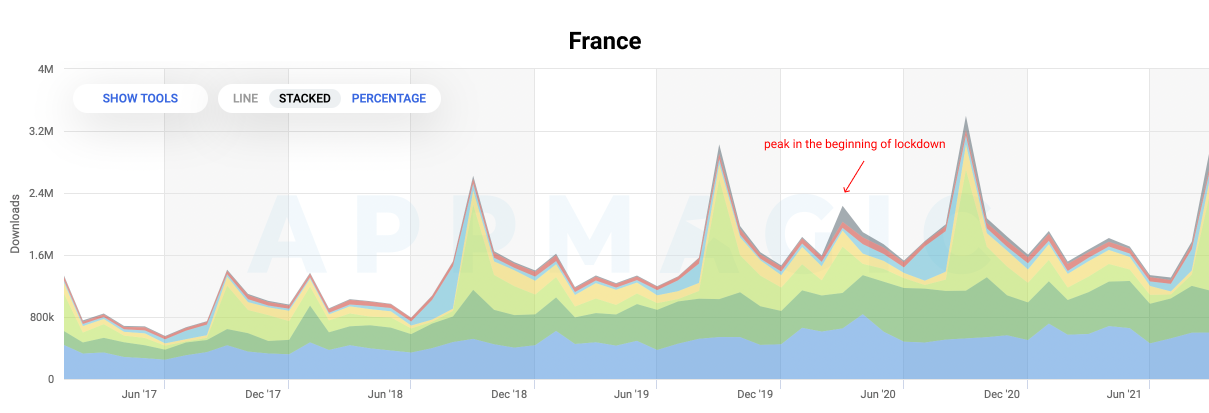
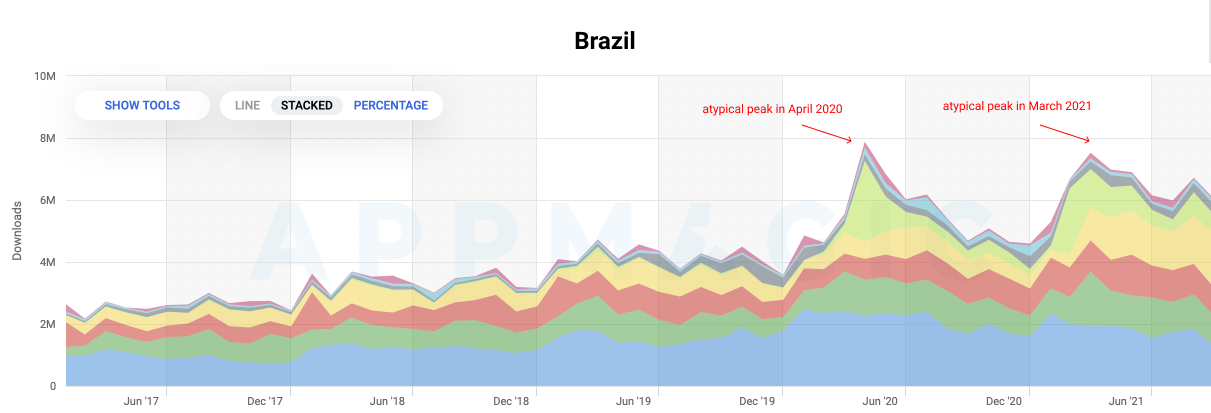
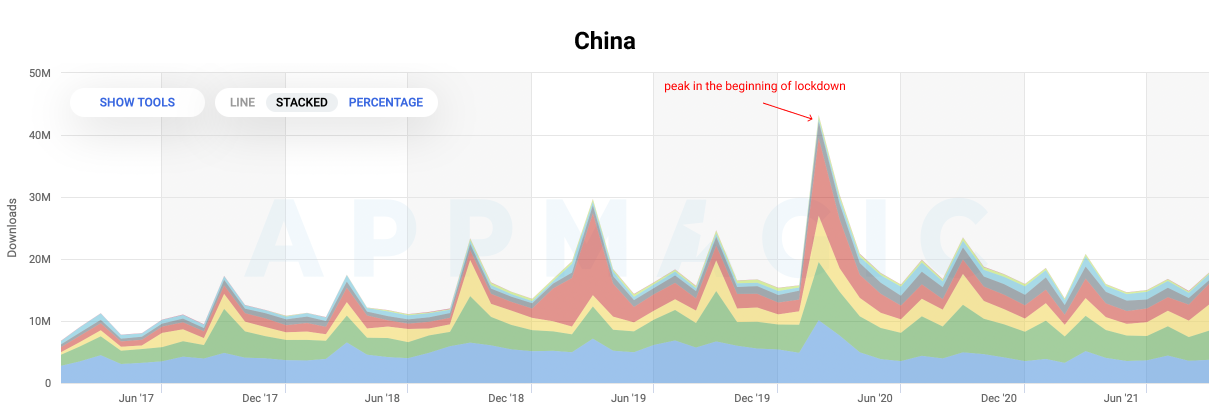
In the USA, there is a seasonal peak in September 2020 and another smaller one in January 2021; also, at the onset of the lockdown, there was an abnormal rise of downloads in March 2020. As for France, the trend there is quite similar to the US: a large peak in September and a smaller one in January, as well as the irregular growth in March 2020 (but not as dramatic as in the States). For Brazil, the situation was different: there were no major peaks, with the market growing million on million over the years and then booming in April 2020, only to follow up with another boom in March 2021 when two tough lockdowns were imposed in the country. The final graph is for the Chinese market: there is similar behavior, but the peaks in September and March are not as prominent. Now, an extreme surge in revenue occured in February 2020, but there is probably no need to remind anyone that in China, the lockdown was introduced earlier than in the rest of the world. The situation went back to normal more or less afterwards, but in 2021, user interest in educational apps was not as high in both September and March as previously in 2020.
Now, let’s have that detailed look at the most successful apps worldwide, starting from the top 10 downloaded titles and then moving on to the grossing top 10.
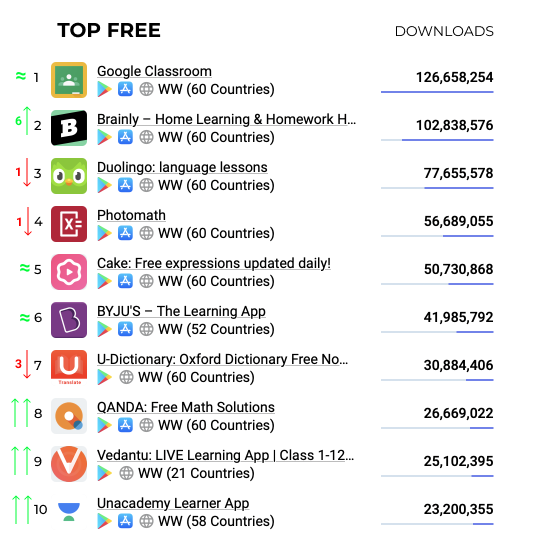
The first position is firmly occupied by the same app as in the academic year 2019-2020. Google Classroom grew its downloads by 7% compared to the previous period and is still on top. The app is designed to facilitate the teaching process: using their Google account, students can find explanations on specific topics, see the graphs their teacher is presenting and using, do and take part in surveys, and much more.
The runner-up is Brainly, which must be popping champagne over its success: the app managed to grow its users by 406%! Its purpose is to make the process of doing homework easier: here, students can find step-by-step guidance on solving math problems, ask the community for advice, or even find a tutor!
Another app from the top is Duolingo: while it is only in third place in the downloads chart, further down below we will see it dominate the revenue chart in the very top spot. Today, Duolingo is considered to be the most popular app for learning foreign languages; it supports more than 35 of them.
The three apps that we would like to draw your attention to as they showed quite a large growth over the academic year 2020-2021 are QANDA, Vedantu and Unacademy Learner App. QANDA, which grew by 225%, is an app that helps solve math problems—from algebra to statistics. The only thing a user needs to do is take a picture of an equation or formula they are working on, and they get an answer straight away. *Vedantu*’s downloads grew by 92%: this app, mostly popular in India, targets students from grades 6 to 12, offering various online classes and tutorials for a wide range of subjects live—i.e. in real time. Last but not least, we have Unacademy Learner App: its downloads went up by 53%, and its feature set and offering is similar to *Vedantu*’s.
So, let’s get to the money side of things and explore the top 10 apps by revenue!
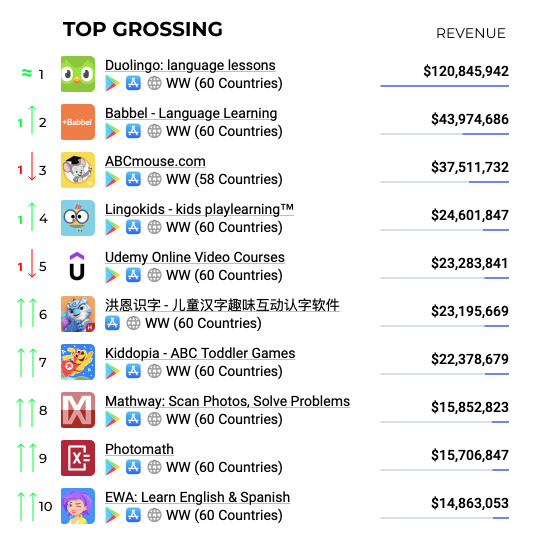
As was mentioned above, the leader here is Duolingo, whose revenue grew by 56% over the year. The two other successful players that are quite comfortable in their seats in the top 3 are Babbel and ABCmouse.com. Babbel grew its earnings by 48%, offering users to study foreign languages together; it has been confirmed that 100% of students improved their oral proficiency in the space of 3 months. As for ABCmouse.com, the app is an online learning platform for kids aged 2-8 years old; it covers reading, math, art, music and a few other subjects, and it has upped its revenue by 6%, tailgating Babbel one position behind.
There are five newcomers in our top 10 chart, too. The first one is Hong En Literacy: an app for kids helping them learn hieroglyphs in game form. The app increased its earnings by 92% compared to the previous academic year. Next one is Kiddopia: another educational game for children that covers a range of disciplines, such as math, languages, and social skills; and it doubled its earnings this year! Position 8 is occupied by Mathway, which is very similar to QANDA in the sense that it provides solutions to math problems by analyzing scans of the questions; now, it’s revenue grew by 114%.
Rounding up this top 10 chart are Photomath (400% revenue growth) and EWA (75% revenue growth). The former is, as you may have guessed, an app for learning math: it covers all grounds starting from algebra and geometry and all the way to statistics. Users can solve equations and inequalities and find solutions right in there if they get stuck. EWA is yet another platform for studying foreign languages: English, Spanish and French in particular. Its users can read books and watch shows, by doing so absorbing new words and phrases with a greater degree of interaction and involvement.
In conclusion, let’s evaluate the shares of app categories for both top charts. Now, everything seems to be more or less evenly distributed. The revenue chart comprises language apps (50%), apps for kids (20%), learning math (20%) and training and qualification courses. With downloads, it’s a bit different: 30% for language apps, 20% for exam preparation, 20% for general study, 20% for learning specifically math, and 10% for training and qualification courses. Interestingly, apps for kids did not make it into the downloads top chart as a separate category, but they do have the second highest share of the revenue pie, as well as the highest earnings per user of all categories.