Voodoo’s Epic Plane Evolution: 3 Small Steps to Entering the Top 10
Epic Plane Evolution climbed into the Top 10 Hybridcasual chart in Q2, showing how even small changes can boost revenue sky-high. Here’s a closer look at the key moves that made it happen.
— by Alina Zlotnik and Lera Kalashnikova

Epic Plane Evolution by Voodoo may look like just another Hypercasual title, where players pilot planes and chase distance records. And yet, released in June 2024, it pulled off something big in Q2 2025. The game landed in its category’s top-grossing chart, with monthly IAP revenue jumping from $592K in April to $1.4M in May. We noticed this growth when preparing our Top 10 Hybridcasual Games in Q2 2025, and such a breakout stood out as a case worth deeper investigation.
Turns out, for a long time, the game has struggled to move past the $10–12K mark in daily IAP revenue. However, in April 2025, things shifted dramatically: revenue began to climb, driven primarily by the US market.
 Daily revenue distribution by country
This title had been acquiring US users before, but this time, the payoff was striking. Even more interestingly, the surge wasn’t spread evenly: the App Store became the main growth engine, while Google Play revenue barely budged at $2–3K a day.
Now, that’s unusual for a Hypercasual game. Traditionally, these titles lean heavily on ad monetization (IAA) rather than in-app purchases. Which means one thing: inside the game, something must have changed. In fact, the data suggests meaningful internal shifts that started back in winter, paving the way for a new monetization model that unlocked growth in the US market.
 IAP revenue distribution by store
This makes Epic Plane Evolution a case study for how Hypercasual can evolve into Hybridcasual, given the right moves. In this article, we’ll break down step by step what exactly helped the game surge in rankings and answer the following questions:
- What kind of gameplay supports these big changes?
- How has the game’s monetization evolved toward Hybridcasual?
- What results has the new approach delivered so far?
- Can Voodoo turn this sudden success into sustained growth?
And, of course, the real takeaway isn’t only about this game. It’s about the lessons developers can extract from its transformation—and how those insights can shape future scaling strategies across the market. So, let’s dive in.
The Foundation: Simple Yet Tactical at Its Core
At first glance, Epic Plane Evolution feels easy: launch a plane with a slingshot and aim for the finish line. However, beneath that simplicity lies a tactical layer. Players can use rockets to speed up their planes or adjust their trajectories to cover more distance and dodge obstacles.
To cover any kind of distance, you get a certain amount of coins (which buy you upgrades for the plane), the slingshot, and coin multipliers. This turns into a repeatable loop of “fly, earn, upgrade.” To prevent monotony, the game adds variety through new planes, locations, and obstacles.

Players are taught the basic mechanics in the first level, where there are almost no obstacles, but the real challenge starts afterward. As players progress, obstacles become a key element of the gameplay, often hindering progression—which is also tied closely to how the game monetizes.
How Monetization Evolved: 3 Steps to the Top
And this is where things get really interesting. *Epic Plane Evolution*’s monetization differs notably between the iOS and Android versions of the game. While we can only guess the reasons behind it, Voodoo decided to adjust the iOS version with gradually introduced monetization. And this change marked its first step toward rising to the top of the charts.
Early levels rely heavily on the ad-based model that features: - interstitials once every few levels; - rewarded ads to double the end-of-level income; - rewarded ads for extra hard currency.
At the same time, the in-game bank is open from the very start for iOS users, offering ad removal and packs of gems: the hard currency, which is required for upgrading rockets and boosting progression. With the exception of interstitials, these systems remain non-intrusive during the first hours of gameplay, making the onboarding smoother and more player-friendly.
The real turning point comes right after the first level, when the game introduces plane tickets: a consumable currency required to launch a plane. Players start with 20 tickets as a one-time allocation, after which they autorefill every 20 minutes. Need more? Feel free to buy them—or, in limited amounts, earn them through rewarded ads. This system doesn’t replace interstitial ads. Even after spending tickets to play, players have to deal with ads popping up every few levels.

This approach is central to monetization: as levels grow tougher, players naturally burn through their tickets faster, creating subtle but powerful pressure—either wait… or pay to keep flying. First introduced in late winter to early spring 2025, plane ticket packs quickly climbed into the top IAP charts on iOS, turning into one of the game’s core revenue drivers. But that was just the beginning.
The second step was a major redesign of hard currency use. In earlier iOS versions of the game, its role was somewhat minor: rocket upgrades, for example, could be earned through ad views, while now, each rocket launch requires at least one unit of hard currency, with the price increasing for back-to-back upgrades.

This change created consistent demand for hard currency and opened the door for fresh monetization levers, leading to adjustments in the in-game economy. As a result, in April, prices of existing offers were significantly increased, and you can use our App Page History tool to look up these changes at your own convenience.
The third big change concerned the ad removal system: the IAPs that allowed players to purchase a pass to disable interstitial ads were removed. Instead, the game introduced VIP Membership, which includes ad removal, unlimited tickets, and daily refills of coins and “skip-its”. Interestingly, the timing of these VIP offers is segmented: some players receive them right from the first level, while others only encounter them later as they progress.
 Pricing changes in App Page History
Sure, this gradual rollout of new monetization features has been intentional. High-cost offers at the very start risk pushing players away, but when introduced after they have already become invested, these offers find a more receptive audience. It’s a simple trick, and it works if done right.
📩 Want more insights like this? Get our monthly Expert Insights with key trends, market data, and expert takeaways—reach out to Stan on LinkedIn or by email: [email protected].
Together, these changes transformed the game from ad-driven monetization to IAP as the primary growth driver. Now, let’s turn to the metrics and measure the impact they had.
Speeding Up: The Numbers Speak for Themselves
The bigger picture of these changes becomes clear when examining the growth of the average check per transaction in the US segment—from around $5 in April to $13 in July, more than doubling in just a few months.

Revenue distribution by offer provides an even deeper insight. On iOS, hard currency packs (gems used for rocket upgrades) dominate the IAP revenue, while refined offers still play a major role. For example, large plane ticket bundles now contribute 7.1% to the revenue, and the higher-priced “remove ads” offer accounts for 11.7%.
The changes on Android turned out to be less ambitious and, as we mentioned before, they didn’t drive revenue at any comparable pace. Here, monetization remains ad-heavy, with some core upgrades still unlocked through ads, but offer prices have also been increased. That’s why “remove ads” and skip-its remain the leading purchases, reflecting a very different monetization balance.
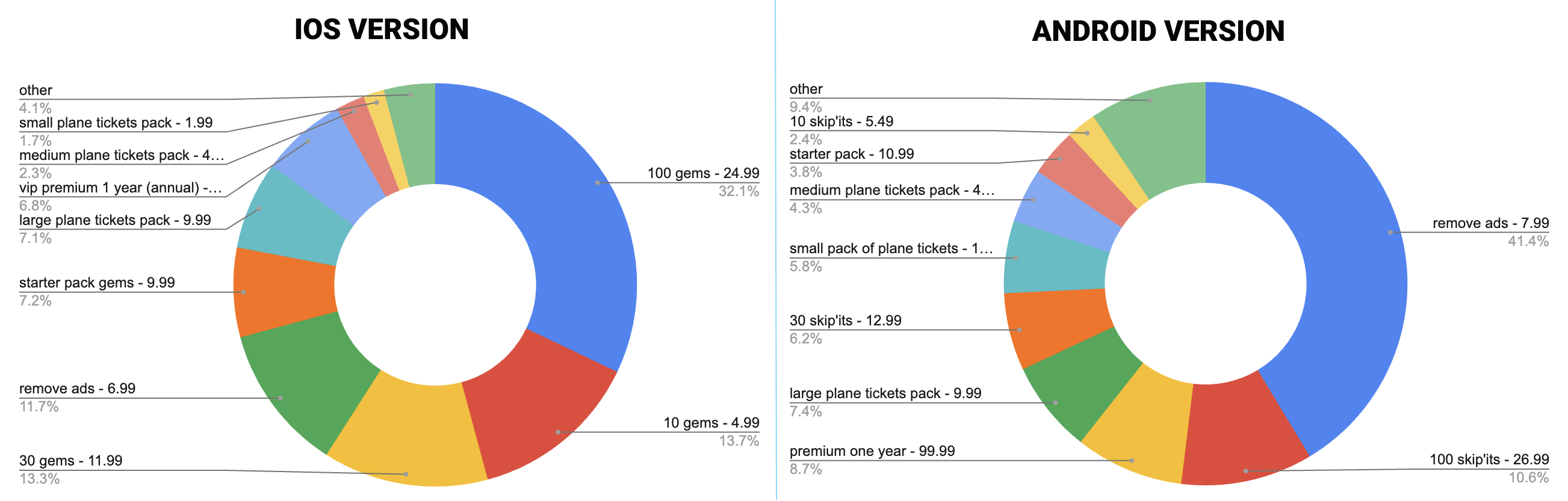 Revenue distribution by offer
On Android, the story looks very different. The average check barely moved and never crossed the $8 threshold, with the same old purchases leading the way. That’s likely why the platform couldn’t match the impressive success seen on iOS.
Overall, Epic Plane Evolution made a bold leap into deeper hybrid monetization, and it worked initially, propelling the game to an all-time high. Whether this was the result of a smart targeting strategy or an intentional “soft test” before a global push, the payoff was clear.
But then came the question…
Can Voodoo Keep It Up?
Just as the game seemed to settle into its happy ending, a new twist emerged. In August, both daily revenue and downloads began to slide globally, but this was once again linked to the US slowdown. With UA efforts reduced, revenue followed, revealing how dependent the game’s growth had become on a single region.
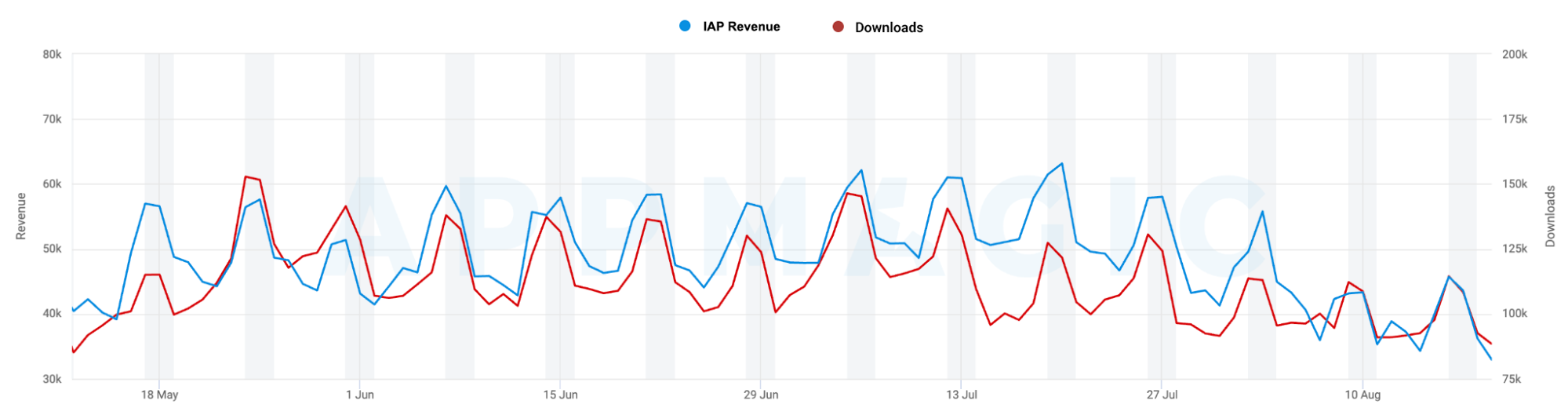 Epic Plane Evolution’s global revenue decline
The reason may be structural: despite updates, the game remains closer to Hypercasual in nature. Players expect simple but engaging gameplay rather than incremental yet persistent tricks of an increasingly tight monetization. Along the way, without strong meta systems, retention suffers, while UA in the US keeps getting more expensive, making new traffic acquisition more difficult.
So, what’s next? One possible way forward could be expanding into new audiences through a stronger creative strategy or mixing these adjustments with features that are more explicitly hybrid. For the time being, however, *Epic Plane Evolution*’s growth looks overly dependent on one region and not yet sustainable in the long run.
Key Takeaways
Epic Plane Evolution surely proved one thing: a simple Hypercasual game can transition smoothly into near-Hybridcasual territory with small but smart adjustments to its economy and monetization. Sometimes, the devil really is in the details.
Player expectations are shifting along with the market. Today, they’re willing to spend—even in games with simple core loops—as long as they feel consistently motivated. And hybrid systems provide exactly that, but the catch is in combining the right tools with the right approach.
For Voodoo, the gradual monetization rollout was the decisive factor that pushed the game to the top ranks. When done well, this approach raises the ceiling of what players consider a “comfortable spend”—a takeaway worth learning from for other developers.
💡 Now that this is sorted, how about getting the full picture? You’ll definitely want the breakdown of all the fresh competition in the chart. Luckily, we’ve got you covered with our Top 10 Hybridcasual Games in Q2 2025, so don’t miss it!