No Guesswork: How EVADAV Turns Market Data into App Ideas with AppMagic
How do you turn market data into real products? This case study breaks down how EVADAV uses AppMagic to spot niches, validate demand, analyze competitors, and launch revenue-generating apps.
— Victoria Beliaeva and Maria Bolshman
EVADAV TRAFFIC GROUP is a performance-driven company operating across more than 150 traffic sources. It reaches a global audience of over 300 million users and generates billions of impressions daily. Alongside its ad tech and media-buying business, EVADAV also builds and launches its own mobile apps.
Challenge
For EVADAV, building new apps means connecting product decisions with traffic expertise. The team needs to find niches where demand is already visible, monetization is proven, and paid acquisition can work from the start.
This can’t be done by looking at a single successful app. The challenge is to cut through market noise, compare similar products, and understand how those apps make money and acquire users before committing to development.
Solution
In 2025, EVADAV turned to AppMagic to make this process more structured and easier to manage. With AppMagic, the team could do the following:
- Identify niches that match their growth model
- Compare similar apps and see how revenue is distributed
- Evaluate monetization through revenue, downloads, and RpD
- Review traffic sources and ad activity across target markets
Result
Using this workflow, EVADAV launched two products: Pure AI Note and Pet Coach.
Both apps are already generating revenue, proving their product-market fit early on. The key outcome here is a repeatable process for turning market data into product decisions.
Below is a step-by-step breakdown of that process, showing how AppMagic tools are used at each stage.
Step 1: Cutting Through Market Noise
Top charts are often dominated by apps that have been around for years. They keep growing thanks to existing user bases, strong store visibility, and brand recognition. For teams trying to spot new opportunities, that kind of data can be misleading. EVADAV avoids this trap by limiting the scope from the start.
With AppMagic’s Advanced Search, the team narrows the entire market down to iOS apps launched in the past 6 to 24 months and ranks them by revenue. This filter removes older apps and brings forward products that are already gaining traction.
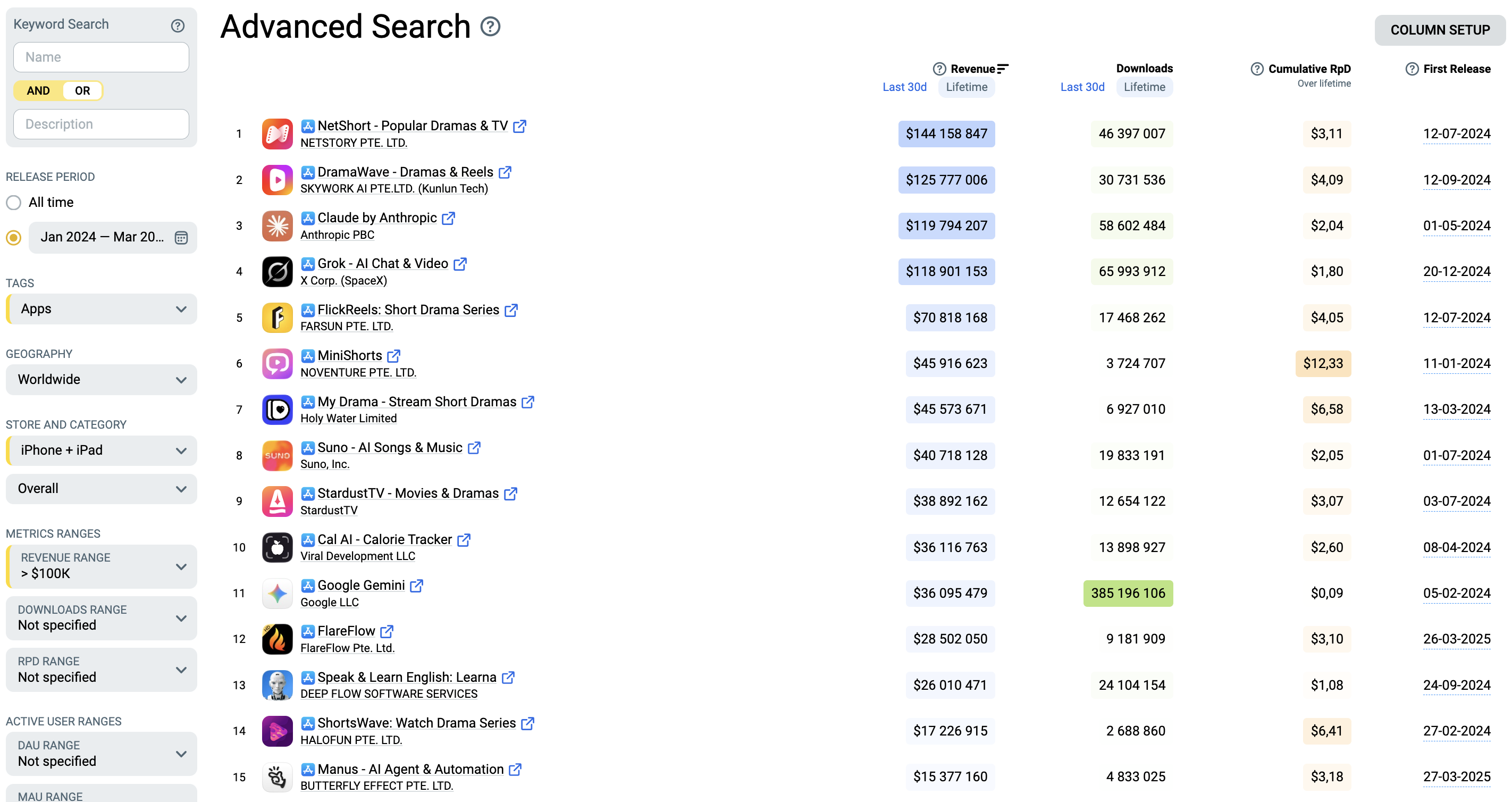
Advanced Search: top iOS apps with over $100K in revenue
Instead of asking “What performs best overall?” the question becomes “What is working right now?”
Step 2: Finding Real Demand
Once a potential idea shows up, EVADAV starts by looking at similar apps to study the competitive landscape and learn more about audience preferences.
Using the Similarity Graph, the team picks one app and looks at similar products suggested by the tool. This helps move beyond broad niche categories and focus on apps with overlapping functionality and audience. It also shows how many apps compete in the same space and how they perform. This is the first validation step.
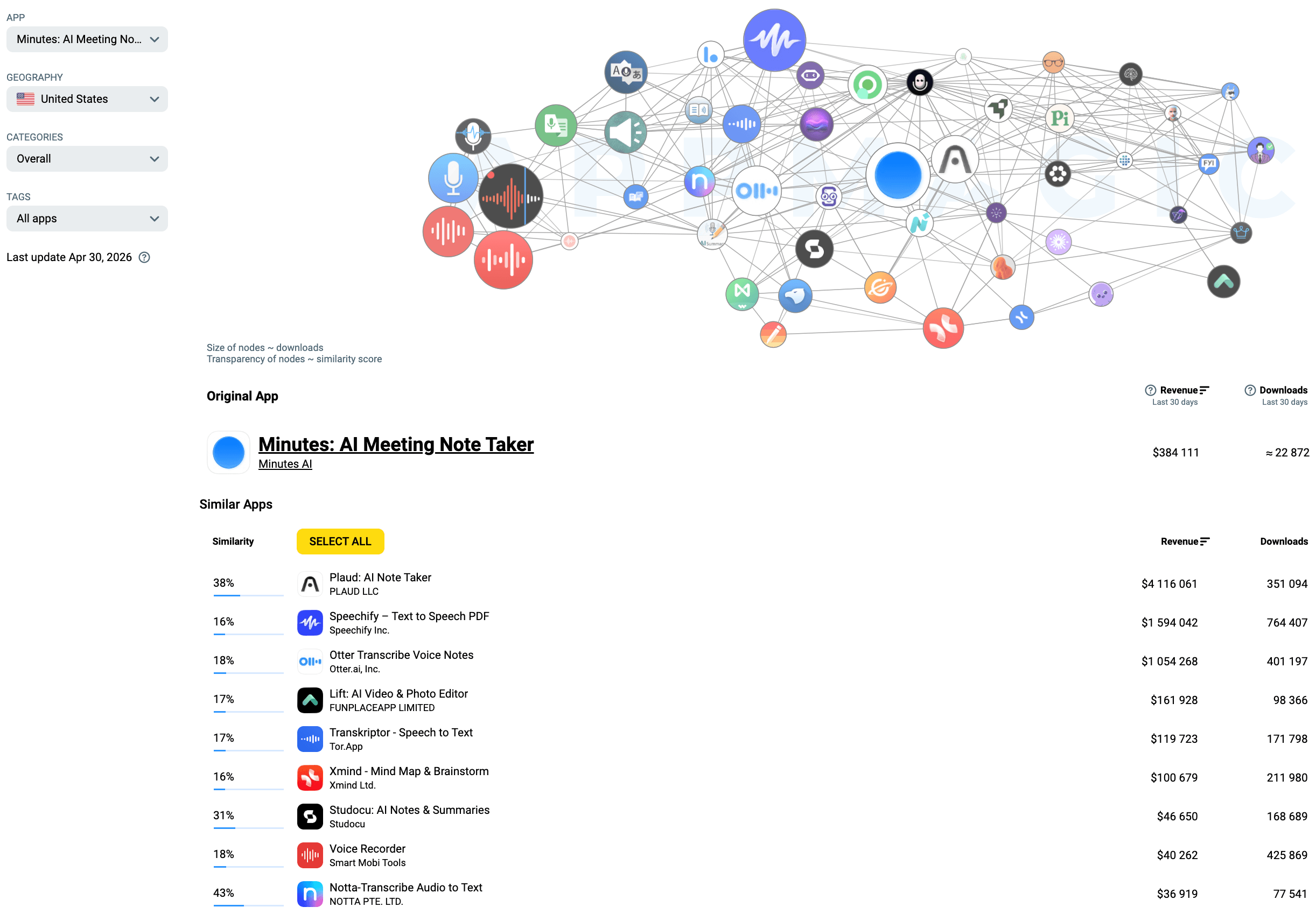
Similarity Graph: apps competing in the same niche as Minutes: AI Meeting Note Taker
If only one app is making money, it’s a risky bet. But when multiple apps generate revenue in the same niche, it’s a completely different picture.
For example, in one of the analyzed niches, one app (Plaud: AI Note Taker) had passed $4M in revenue, while a couple of others (Speechify and Otter Transcribe Voice Notes) were around the $1M mark. More importantly, revenue wasn’t tied to a single app—multiple apps in the same space were earning.
From there, the team compares these apps more closely on the App Comparison Dashboard.
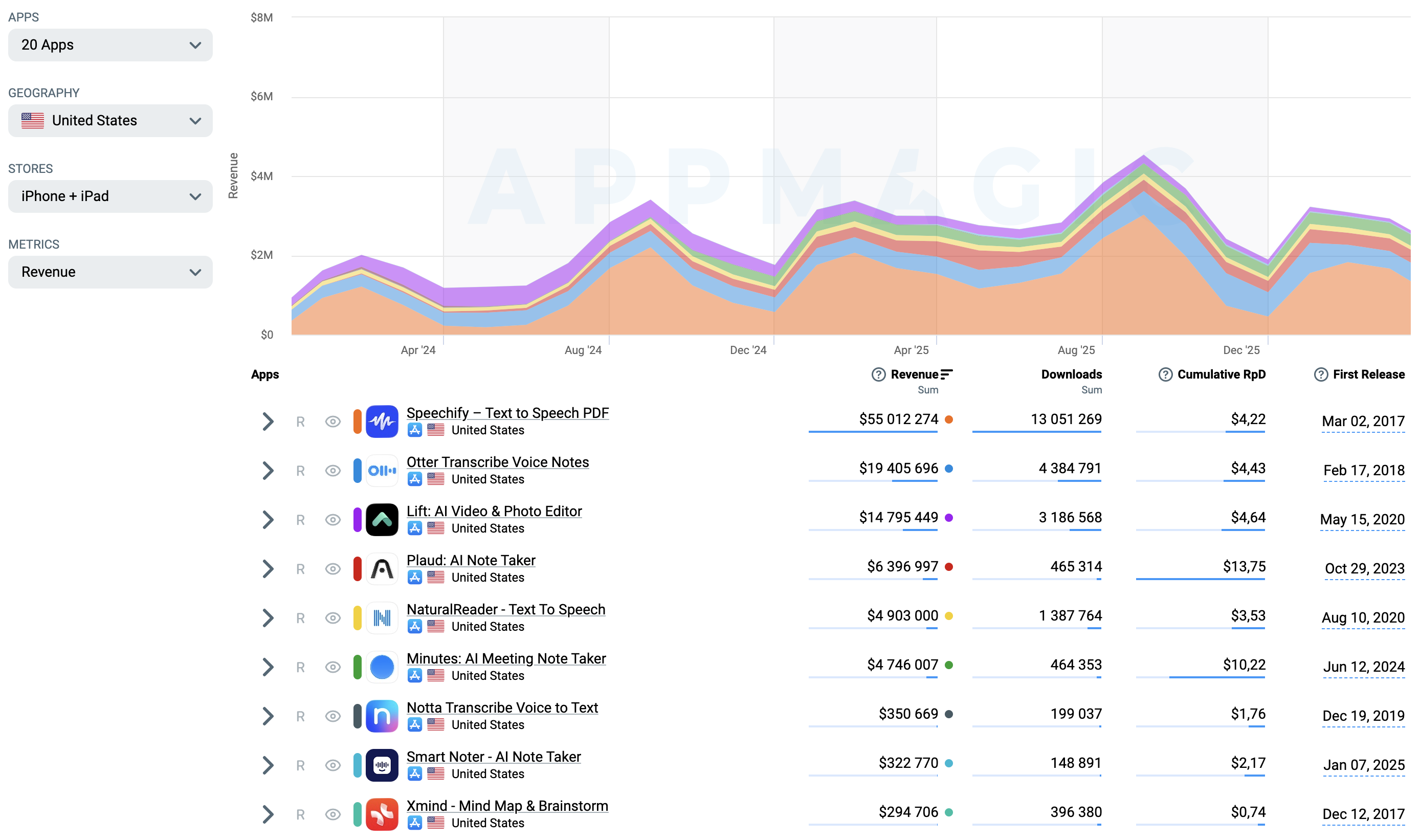
App Comparison dashboard: how similar apps perform across key metrics
The dashboard lets them benchmark selected apps against each other across revenue, downloads, RpD, and growth dynamics—and go deeper into product metrics like MAU, DAU, and retention from D1 to D365. At this stage, the question shifts from “Is there anything similar?” to “How do these apps perform side by side?”
When several comparable apps generate revenue, the demand is clearly there. But can that demand support paid acquisition?
Step 3: Checking Monetization and Traffic Fit
The next step is to determine whether that revenue can cover user acquisition costs.
To do that, the team looks at revenue and downloads together. In practice, this comes down to revenue per download. You can pick any app, open its metrics, and see the value per install. The number doesn’t need to be exact; even a rough range is enough to judge if paid acquisition is realistic.
For a more accurate view, it makes sense to look at RpD by country. With AppMagic, you can break it down by geographic region and estimate LTV in the markets where you plan to acquire traffic.
Let’s look at Minutes: AI Meeting Note Taker once again here. (Of course, you can run the same check for other apps in the category as well.)
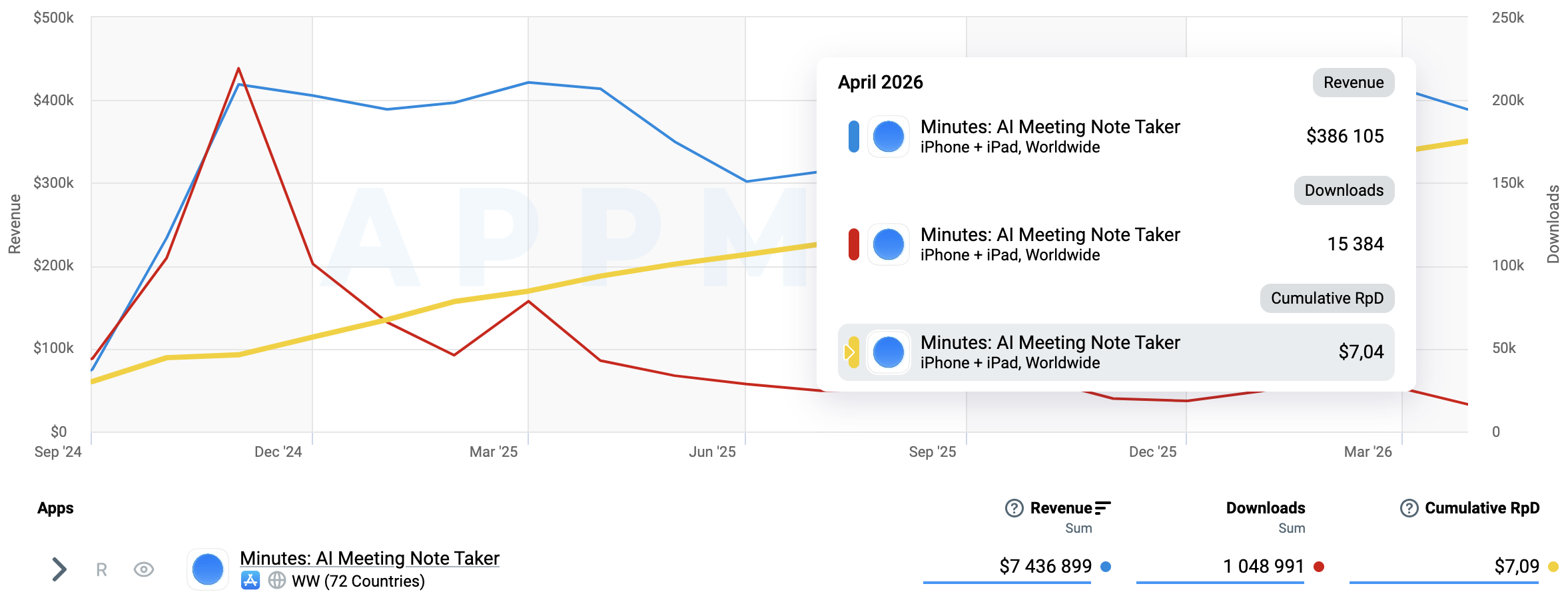
Minutes: revenue, downloads, and cumulative RpD overview
After that, the focus shifts to how these apps grow. Using Ad Intelligence, the team reviews traffic patterns: which channels are used, how often campaigns run, and how consistent that activity is.
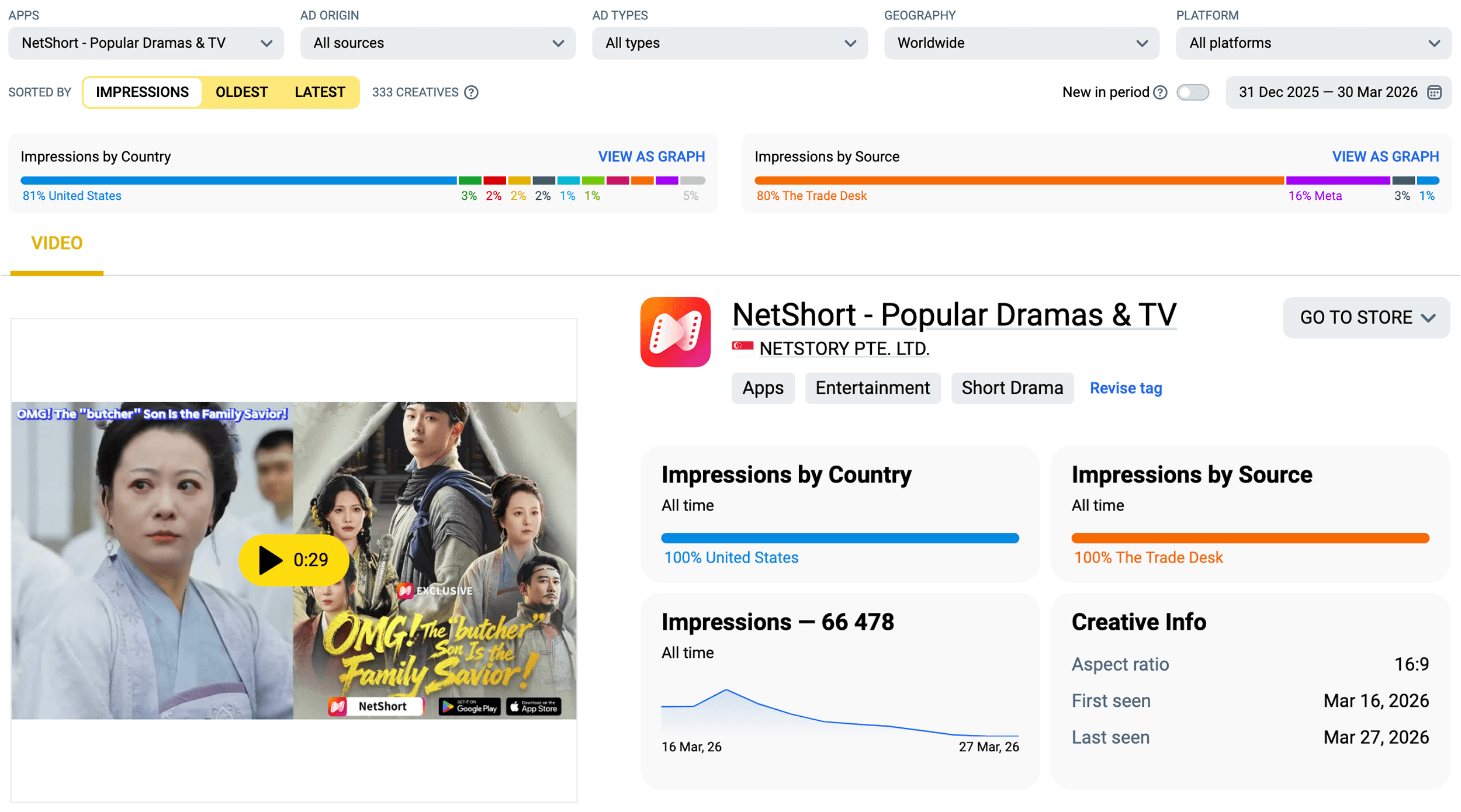
Ad Intelligence: NetShort traffic sources and an example creative
The tool covers both direct competitors and apps buying traffic from the same channels, including those from other categories. You can filter creatives by ad origin, ad type, geography, and platform to analyze how different apps run campaigns. Take NetShort, for instance. It is a good example because it runs paid campaigns at scale, giving a better sense of how competitive the space is.
If multiple apps are consistently running ads, it’s a good sign. It means the model already proves itself in practice, not just in theory. And if there’s little paid activity, the risk goes up, even if the revenue looks solid.
For EVADAV, both signals need to line up. The niche has to generate enough value per user and work with paid acquisition. Once both are in place, the team moves from analysis to building.
Step 4: Turning Insights into Products
As we’ve mentioned above, EVADAV launched two products where the starting point was the same in both cases: the team used AppMagic tools to spot niches where apps were already generating revenue, users were paying, and paid traffic could serve as a growth channel. Let’s take a look at each of them.
Pure AI Note
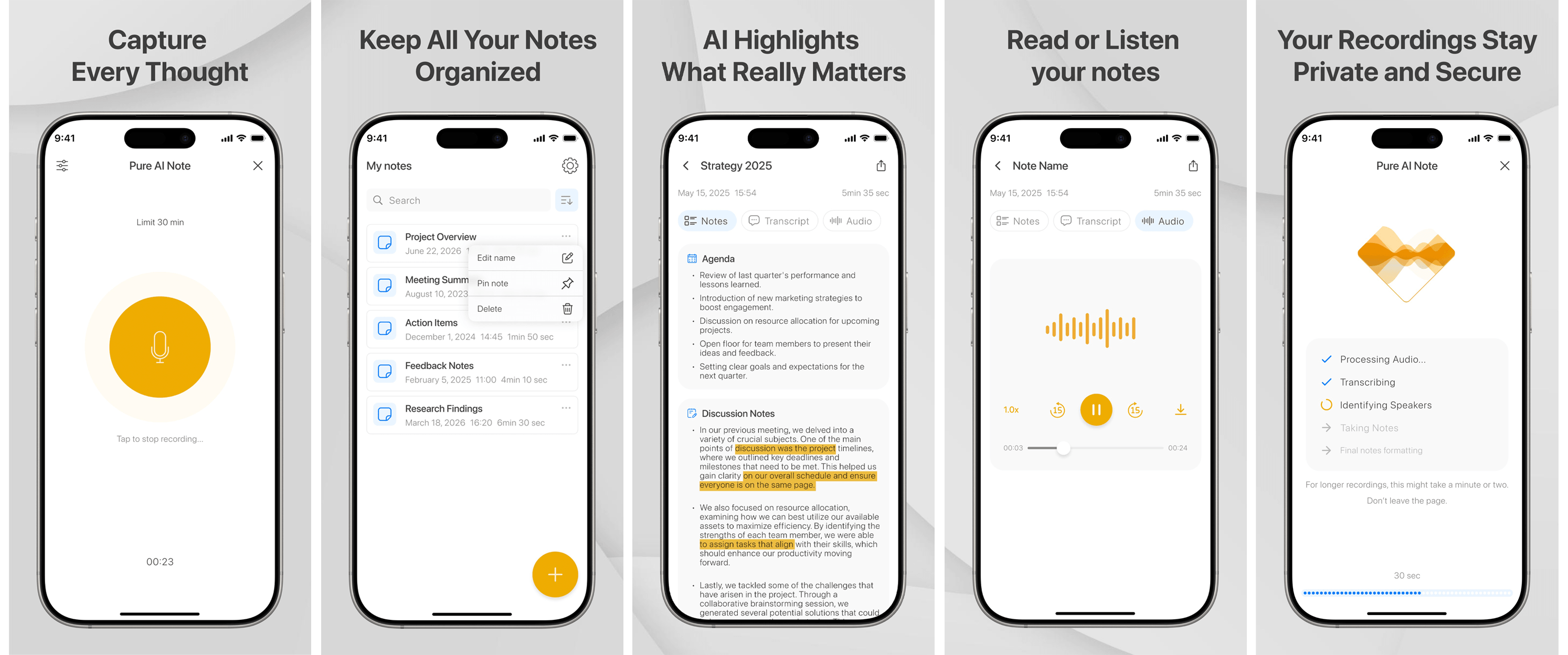
The AI note-taking category came directly from the market analysis described above. AppMagic showed a group of similar apps with stable revenue and a working monetization model. Looking at revenue alongside downloads and comparing similar apps gave enough confidence that the niche was not driven by a single product.
Based on that, EVADAV released Pure AI Note in July 2025.
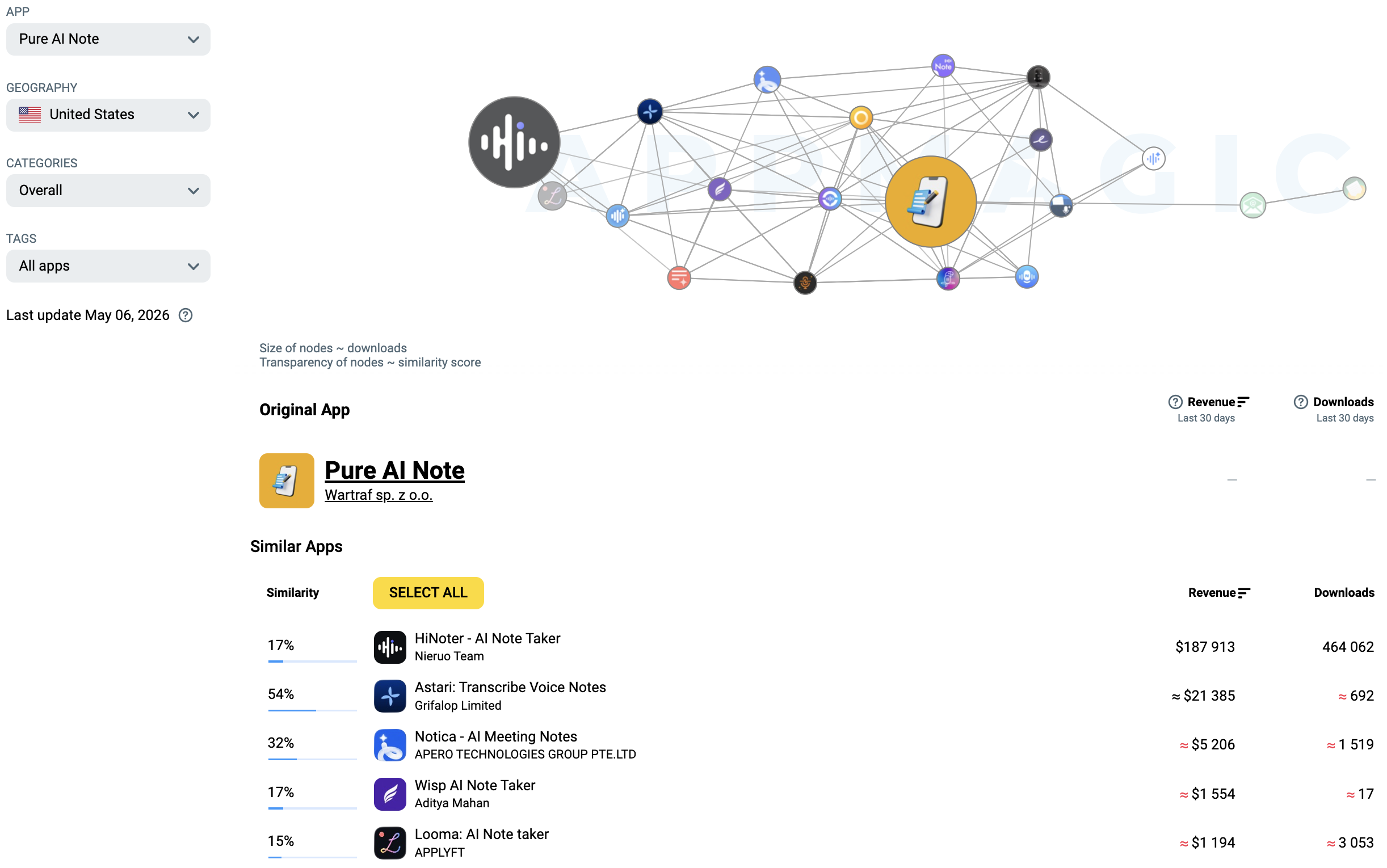
Similarity Graph: Pure AI Note
The product covers voice notes, transcription, and structured summaries. It follows the same core idea as other apps in the category, but with a cleaner UX and a more focused feature set.
Pet Coach
The pet training niche was found through the same workflow, but stood out for other reasons.
AppMagic filters revealed a small category with only a few competitors, around 2–3 apps (memory OS, Dogo, PlantSnap), each making about $100K in revenue. Demand was visible through search, and most of the traffic came from ASO.
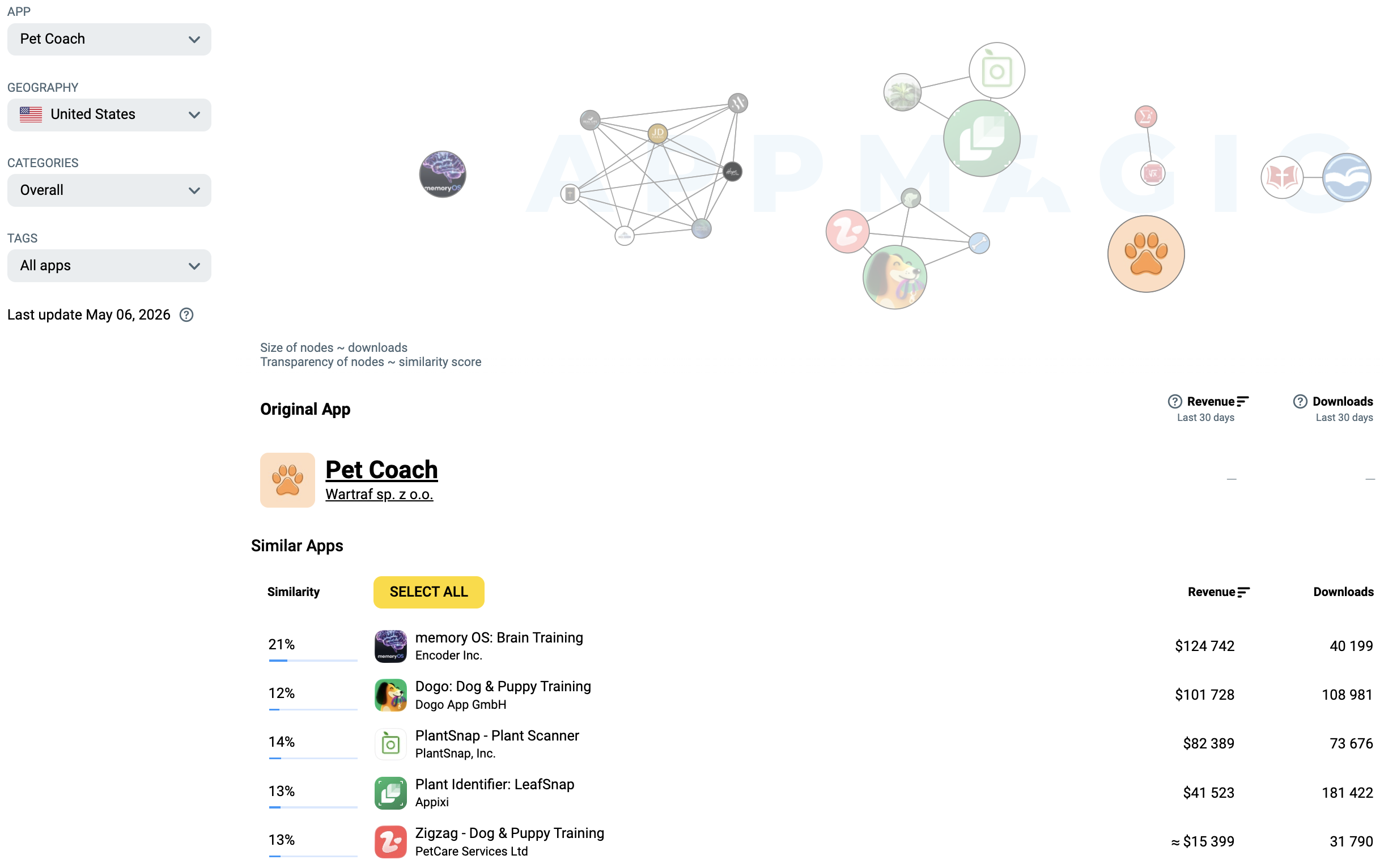
This setup opened a clear entry point: users were already looking for solutions, but acquisition was mostly organic. So instead of competing in search, they could enter through paid traffic.
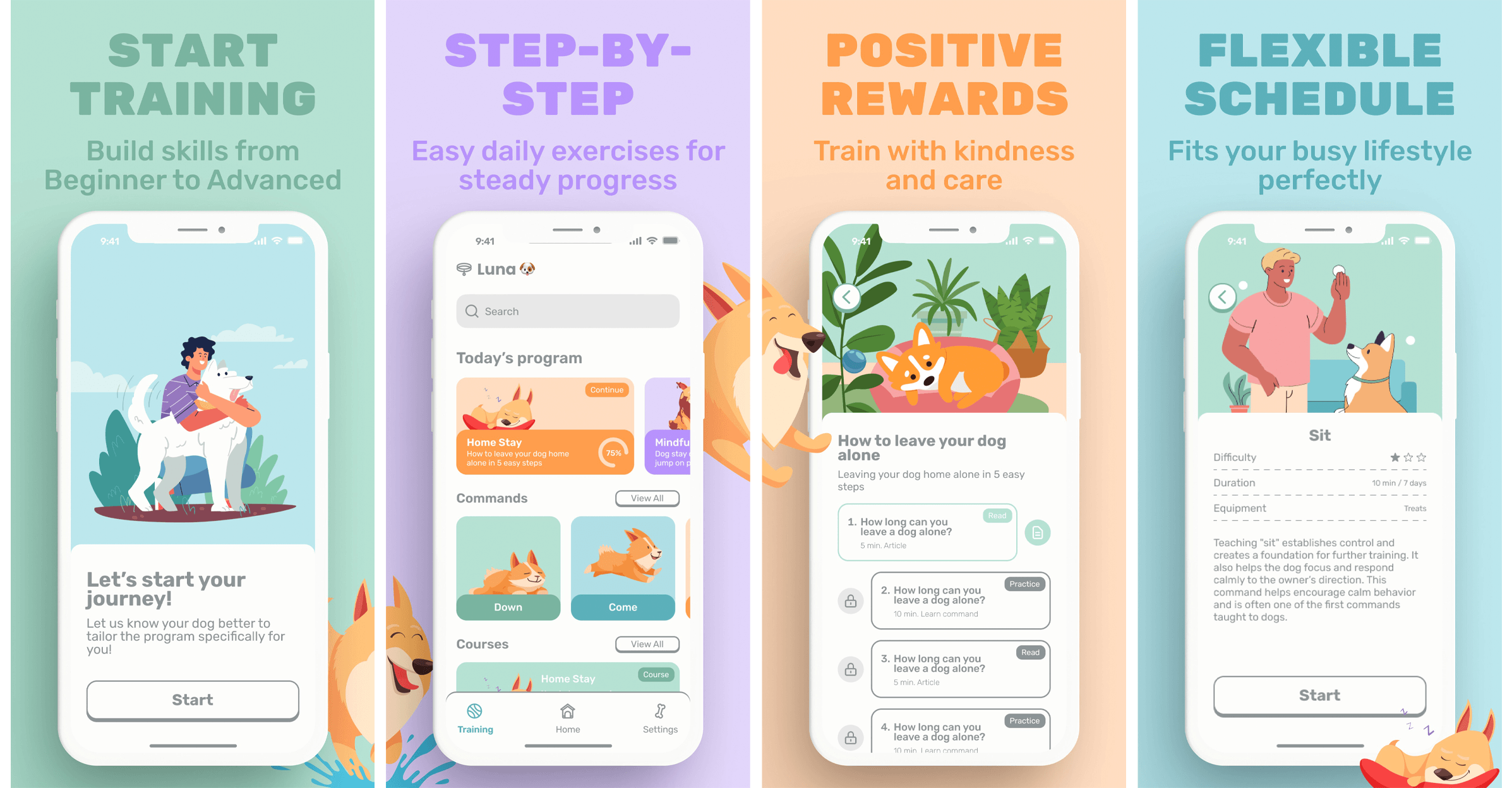
Pet Coach went tentatively live in late 2025 and is currently in active development. The app focuses on dog training, routines, and basic care. The idea was simple: take an existing product type, improve it, and approach distribution from another angle.
What AppMagic Actually Changed
Two new products, two validated niches, and a process EVADAV can now reuse without having to start from scratch. Both launched apps follow the same path:
- Find a niche where several apps are already generating revenue → Advanced Search
- Check monetization through revenue and RpD (Revenue per Download) → app metrics
- Compare similar apps instead of relying on a single example → Similarity Graph and App Comparison Dashboard
- Look at traffic sources and determine if paid acquisition is realistic → Ad Intelligence
The key outcome is beyond the launch of apps like Pure AI Note and Pet Coach: it’s the establishment of a repeatable framework that connects market intelligence with execution. By ensuring that revenue potential and traffic scalability are validated up front, EVADAV reduces risk and increases the likelihood of sustainable growth.
To sum up, a successful app development is a data-driven decision rather than a matter of guesswork.