Hybridcasual Puzzles: Turning Failure into Revenue
As the gameplay of top Hybridcasual puzzles becomes more complex, fail offers after a lost level take a central place in their monetization. This article breaks down their IAP revenue share and the design choices that make them work.
— Lera Kalashnikova
This article was featured, along with other pieces, in our biweekly AppMagic Newsletter from March 11, 2026. If you’d like to receive insights like this ahead of others, subscribe here.
In just a year, Hybridcasual puzzles have gone from an emerging idea to one of the most talked-about points in mobile gaming. Their strong potential comes from layering Hypercasual core loops with deeper Casual-like monetization, richer LiveOps, and enough complexity to sustain long-term retention.
The rise of this segment is led by Sort, Screw, and Block Puzzles, and their rapid scaling is reshaping expectations even across the broader Casual market they borrow ideas from. Just take a look at the numbers: since 2024, both Sort and Screw Puzzles have doubled their IAP revenue, while Block Puzzles delivered explosive 10x YoY growth.
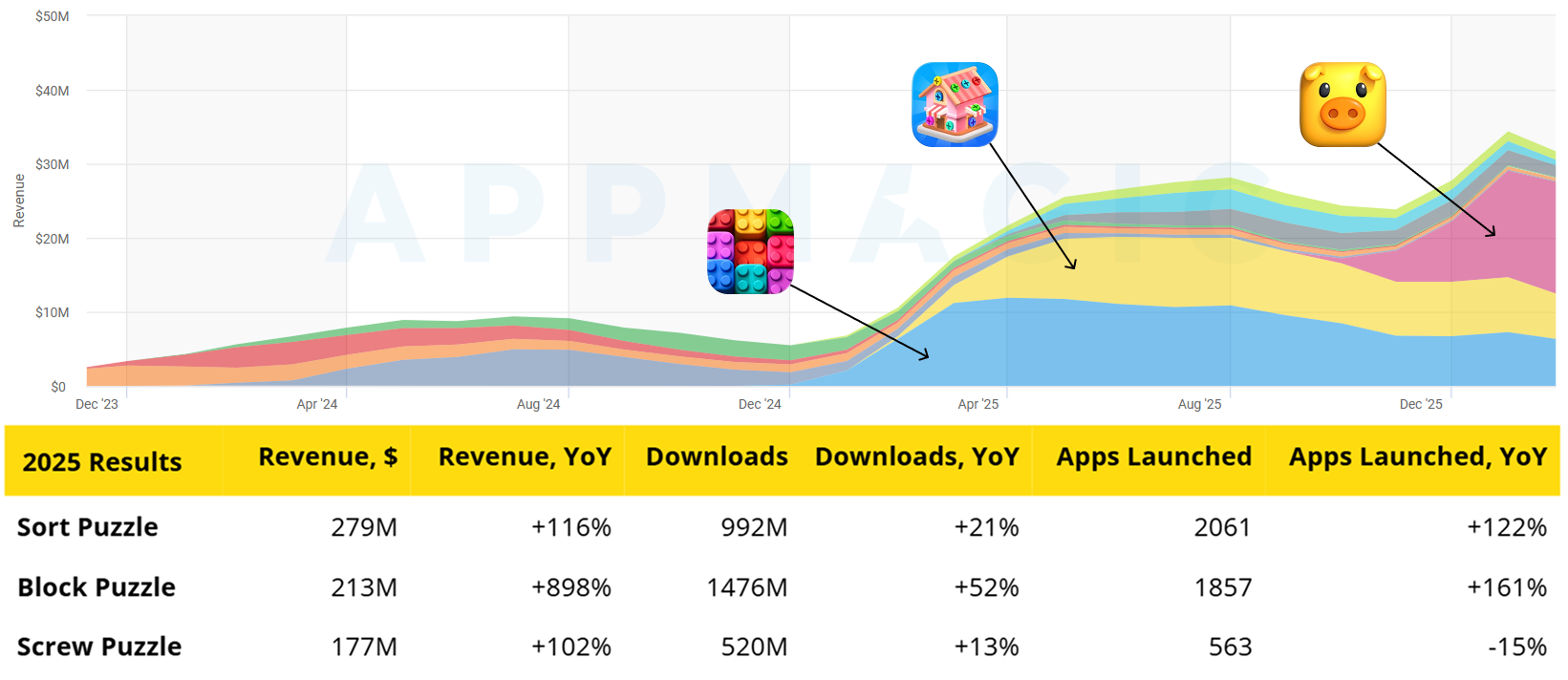 Hybridcasual puzzles revenue growth
Much of this surge comes from smart gameplay design. The core loop stays simple and intuitive, but additional Casual features add challenge, variety, and long-term goals. Monetization reflects this hybrid nature: some studios carefully balance rewarded and interstitial ads with battle passes or piggy banks, while others reduce ads almost entirely and push their games even closer to the classic Casual monetization model.
However, when you look closely at the IAP Revenue Distribution of the top Hybridcasual puzzles, one pattern is hard to miss. As their gameplay becomes more complex and engaging, fail offers triggered after losing a level take a central place in their monetization strategies.
IAP Revenue Distribution of Top-Grossing Hybridcasual Puzzles
Take Color Block Jam, Rollic’s global Block Puzzle hit that led the Hybridcasual segment for most of the past year. Its design relies on a well-calibrated difficulty curve supported by timers and a limited-lives system. Together, these mechanics naturally guide players toward the $4.99 fail offer at moments of peak frustration and motivation. As a result, this offer now generates more than 20% of the game’s total IAP revenue, making it the top-earning purchase.
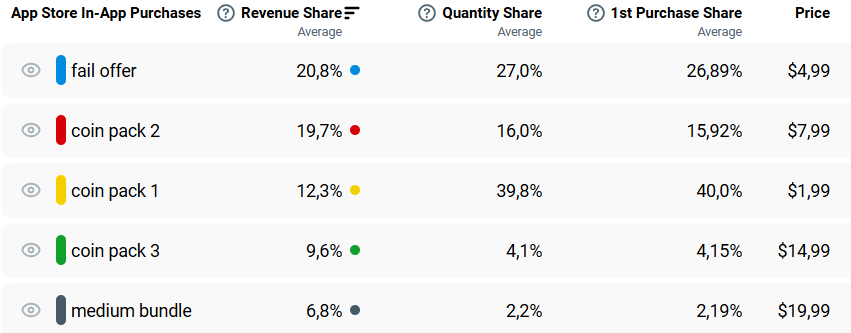 Color Block Jam’s top-grossing offers (all time, iPhone App Store, US)")
Even more importantly, the fail offer plays a key role in converting new spenders. It drives about 27% of first purchases, second only to the $1.99 coin pack, which captures around 40%. That’s how Hybridcasual gameplay design and monetization systems work in sync to push the game’s performance forward.
The model, originally borrowed from leading Casual puzzles, has proven just as effective in the Hybridcasual market, fueling the game’s long-standing leadership. And it’s surely not the only title that leveraged this approach.
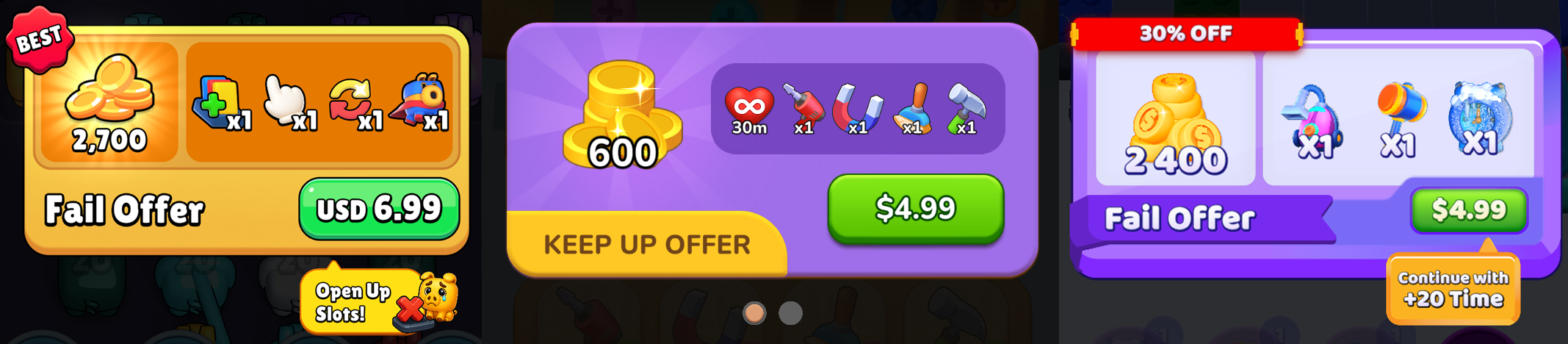 Fail offers in Pixel Flow, Screwdom and Color Block Jam
In December 2025, Pixel Flow overtook Color Block Jam as the top-grossing title in the segment by following a similar monetization path. This Sort Puzzle game by Loom scaled so quickly that it even caught the attention of Scopely, which soon acquired a majority stake in the studio behind it.
Pixel Flow also relies heavily on limited lives and increasing difficulty, creating situations where players prefer to purchase a fail offer rather than lose progress. Its $5.99 fail offer is the game’s main revenue driver, accounting for around 33% of total IAP revenue, and it also brings in 34% of all first purchases. And if it doesn’t sound impressive enough yet, here’s this: with the game already reaching more than $44.5M in global revenue, this single offer may have generated roughly $14M on its own!
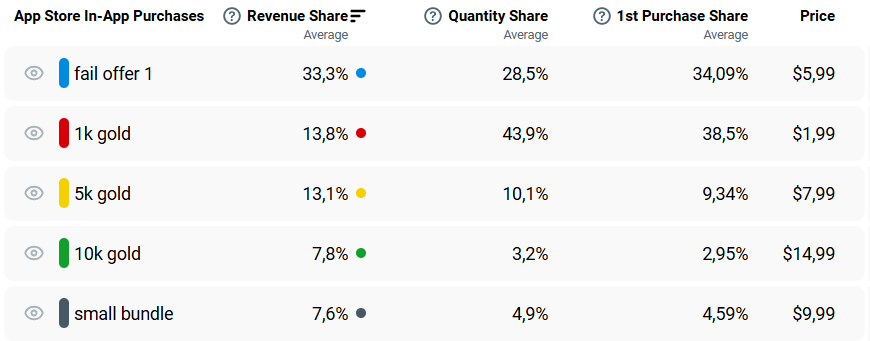 Pixel Flow’s top-grossing offers (all time, iPhone App Store, US)")
The top-grossing Screw Puzzle title Screwdom by iKame Games shows a slightly different monetization dynamic. The game once stood out by evolving the classic Screw Puzzle formula into a more tactical experience, moving from 2D to more immersive 3D gameplay. This shift toward complexity defined its IAP structure: even though the $4.99 “keep up” offer didn’t rank #1 among its purchases by revenue share, it still generates about 14.5% of its total IAP earnings.
The largest revenue shares come from the $9.99 “beginner bundle” and the $1.99 “coin pack”, and the logic behind this is clear: one contributes a big part of revenue thanks to the higher price, while the other, in contrast, generates more purchases in quantity, appealing to players with its lowest price point. However, the “keep up” offer is still crucial for conversion: it generates around 17% of all first purchases, ranking second in this category after the cheapest coin pack.
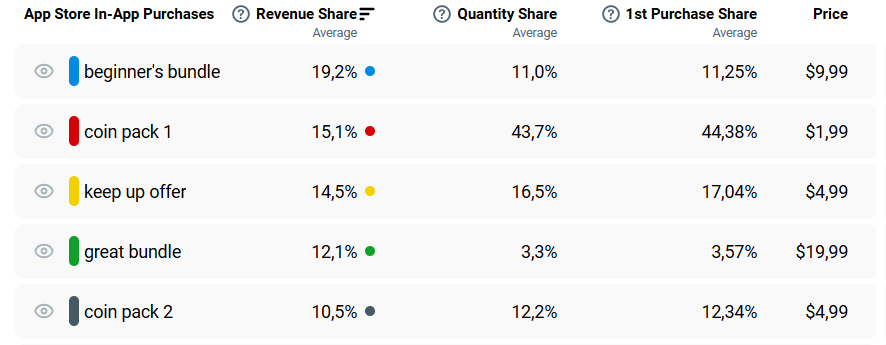 Screwdom’s top-grossing offers (all time, iPhone App Store, US)")
What this trend shows is a key principle of Hybridcasual design: revenue often comes from well-timed pressure points. Just like in leading Casual Puzzle titles, gameplay progression naturally creates moments where spending feels like the easiest option. When these moments are designed smartly, fail offers stop feeling intrusive or forced and instead become part of the player flow.
As more studios enter the niche, the ability to balance challenge, pacing, and conversion is what lets them turn the genre’s strong potential into revenue and scale fast. Many titles that landed in the top-grossing chart earned a big part of their IAP revenue from their fail offers.
Gecko Out, Knit Out, and Drop Away by Rollic follow in the footsteps of the studio’s flagship, relying on the fail offers as their core revenue engine with more than 25% of their earning coming from this purchase.
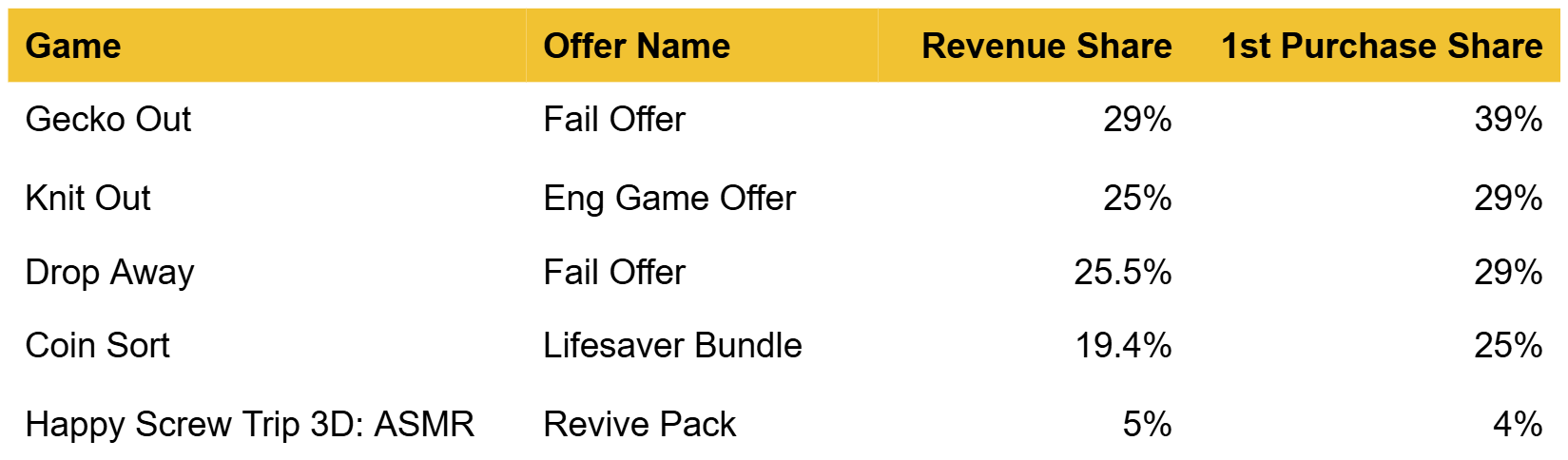 For Coin Sort, fail offers contribute a slightly smaller but still meaningful share of revenue, accounting for 19.4% of its IAP earnings. The game builds on the familiar “water sort” gameplay but deepens it with merge mechanics and endless scaling inspired by 2048. This open-ended and increasingly demanding core turns into a loop where purchasing a fail offer feels far more appealing than losing hours of progress.
At the same time, Hybridcasual remains a highly diverse segment. Not every title relies heavily on escalating difficulty and “keep up” offers triggered after a fail. Happy Screw Trip 3D: ASMR, for example, generates only about 5% of its revenue from the “revive pack,” while standard currency packs priced between $1.99 and $19.99 remain the main growth drivers.
Which IAP Strategies Actually Work In Your Niche
The Hybridcasual market gives studios plenty of room to experiment. The cases above highlight only part of the broader monetization landscape. Still, the strategies used by leading titles provide a practical framework that studios can adapt instead of spending months on trial-and-error testing.
With AppMagic’s IAP Revenue Distribution, you can explore how top titles in your niche structure their offers and where their revenue actually comes from. The tool reveals whether a game depends on a single dominant purchase or spreads earnings across multiple price tiers. It helps answer critical questions such as:
- Which offers generate the largest share of revenue?
- Which offers are purchased most frequently?
- Are high-frequency purchases also high-value?
- What price levels consistently perform in this genre?
With this level of visibility, you can benchmark competitors and refine your monetization strategies based on real market behavior. Learn more about the tool here and see how it works in practice!
This article was featured, along with other pieces, in our biweekly AppMagic Newsletter from March 11, 2026. If you’d like to receive insights like this ahead of others, subscribe via the form below 👇