Mobile Games Inspired by Social Media Trends Part 3: from Milk Crate Challenge to Save the Doge with Insights by Azur Games
Let's finish our discovery of mobile games inspired by social media trends, and find out which patterns are common for all the titles we saw in three parts of our research.
— by Diana Levintova
Executive Summary
- Social media trends covered: Milk Crate Challenge, Men’s Hairdos, Save the Doge, and Organizing (the latter split into three subgenres, such as Fridge Restocking, Lunch Box Organizers, and Closet Organization).
- Topics discussed: trends banned under TikTok policy; hairstyles that inspired mobile game developers; background on the Save the Doge trend with specific game and target market characteristics that have led the title by Azur Games to the top.
Full Article
With this piece, we’re сoncluding our series of articles about games inspired by social media trends. In the previous two parts, we looked at 11 different trends and games associated with them, identified a few similarities and also discovered a few “niche” insights. As we did in the previous articles, we will go trend by trend—from the earliest game to the latest.
Milk Crate Challenge
The first social media trend we’re going to talk about today is the Milk Crate Challenge. It started in mid-August 2021 with a video where a man was climbing a ladder made up of milk crates, until at some point he took a wrong step and fell down together with the boxes. In no time, it went viral and, one by one, others started taking part in the challenge.
As you might expect, it didn’t end too well, with many cases of injuries reported. Shortly after, TikTok banned videos of this type from its platform, and if you now search the trend’s hashtag, you will get, “No results found”.
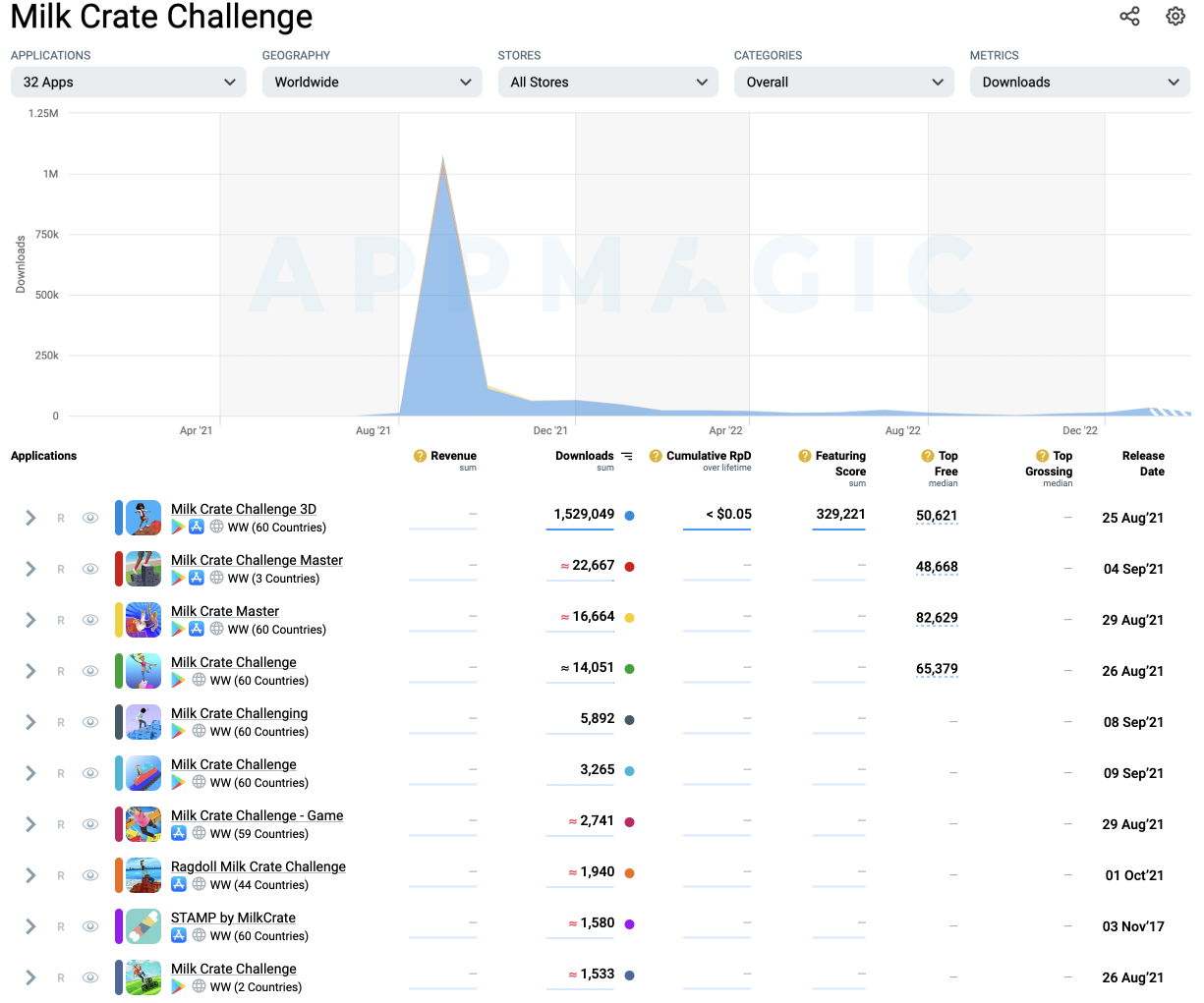
However, we wouldn’t mention it here if it wasn’t for a bunch of games nevertheless inspired by the viral videos. The one to highlight is Milk Crate Challenge 3D by Game Theory Games. This hypercasual simulator was published a couple of days before the TikTok ban and, despite the regulations, managed to gain 1.5M downloads over its lifetime, peaking in September 2021 and rolling back shortly afterwards until it reached around 110K monthly downloads, where it then settled on a very gradual downtrend.
In fact, a comparatively large number of games inspired by this trend have been released so far: we’ve found more than 30, but none of them have a noticeable number of downloads. For example, the closest competitor—Milk Crate Challenge Master—only has 22.7K installs. Chances are, it has something to do with the TikTok policy consequences.
Men’s Hairdos
We briefly mentioned this trend in one of our previous articles with quarterly hypercasual insights, but let’s dive in a bit deeper. Here are some numbers for a good perspective on just how popular it is: the TikTok query “mens hairstyles” has 1.8B views, while “barber barbershop” checks out at a whopping 10.7B. On YouTube, “men hairstyle” videos are gaining millions of views as they are uploaded. And we’ve also spotted a few subtrends for this trend!
The first one is “TikTok boy hair”: a popular hairstyle among Gen Z which has started with Darrell Jones, Tristan Harrell and Joshua Rich VII getting quite similar hairstyles of soft, fluffy, wavy hair reaching the browline on the front and with a lot of volume on the top.
Another trend is hair tattooing, where a tattoo is actually applied onto the hair slicked back, as Linda Ha did on her TikTok channel, or a particular pattern is trimmed onto short hair and possibly dyed afterwards, as Jackie Bieber does on his TikTok channel. Considering such a high acclaim on social media, no wonder this trend has found its way into the mobile games industry. We’ve put most of these games onto the dashboard. So, what do we have here?
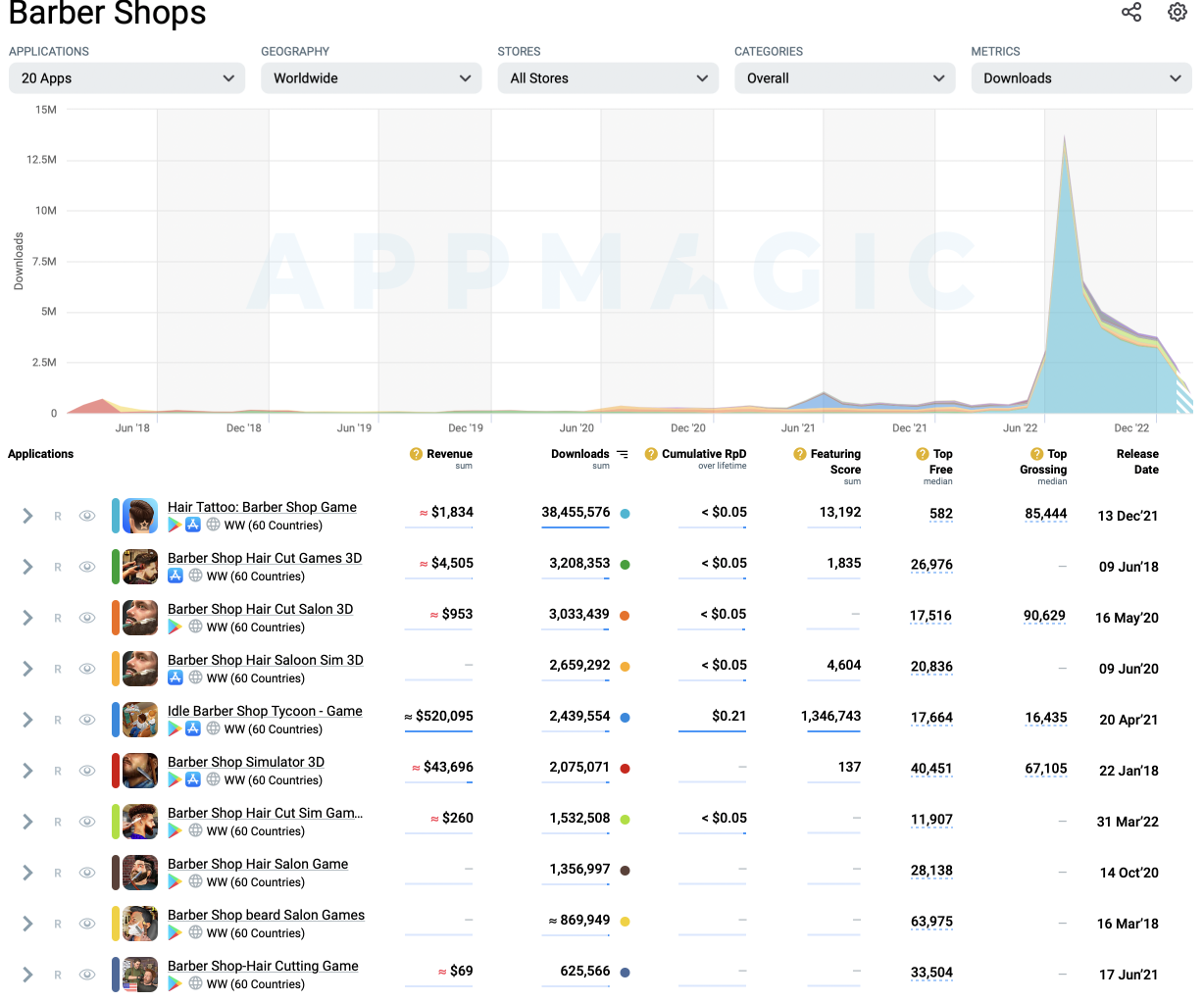
Not much of a surprise, really: there’s one leader—a hypercasual arcade by Azur Games called Hair Tattoo: Barber Shop Game, which has acquired 38.5M downloads since its release in December 2021. It started gaining visible traction in May 2022, peaked in July 2022 and has been on a downtrend since. However, the installs haven't reached their minimal numbers yet, so we suggest keeping track of this game’s performance for a couple more months. As for competitors, even though some of them have generated more than 3M downloads over their lifetimes, it’s still 10 times less than the leader of the list.
So, how did Azur Games manage to outrun their competitors? The game developer has pointed out a few factors that boosted their success, including game ideas based on real life, unique visuals, and the pursuit of hybridity through meta, in-apps and other midcore specificities that we have been increasingly seeing in hypercasual games.
A few more insights. Azur Games have told us that, looking for distinctiveness, they decided to move away from exaggerated cartoon-like characters and bright mainstream visuals towards a more casual reality with softer hues. Moving on to the marketing activities, they noticed that the game received a very warm welcome on TikTok, and its CPI turned out to be lower than on Facebook ($0.16 VS $0.31).
Moreover, the game became the most popular in the regions where barbershops are a pronounced part of historical heritage and men account for 75% of its players, which is not typical for haircutting simulators at all. After that, the Azur Games team decided to take a risk and try appealing to the women’s audience, too, introducing female characters to the game. The audience mix became more balanced out, and, at the end of the day, the game has reached its high mark.
Organizing
This article wouldn’t be fully legit without one big trend that we split into several subtrends. This time, we’re talking about Organizing. We’ve discovered two main reasons why this trend is so popular. For one thing, cleaning leads to behavioral activation which was scientifically proven to reduce depression symptoms. Behavioral activation itself suggests a completion of a particular measurable task that allows one to build momentum and confidence. Another reason is the ASMR touch to it, when certain sounds in the videos provoke a particular brain response (like tingling), which usually leads to relaxation and sometimes even has a sleep-inducing effect.
Fridge Restocking The first subtrend to cover in this segment is Fridge Restocking. Videos of it have gained 779.8M views on TikTok and were also spotted across mobile games. Our long list of titles related to the trend is led by Fill The Fridge: a hypercasual puzzle by Rollic Games.
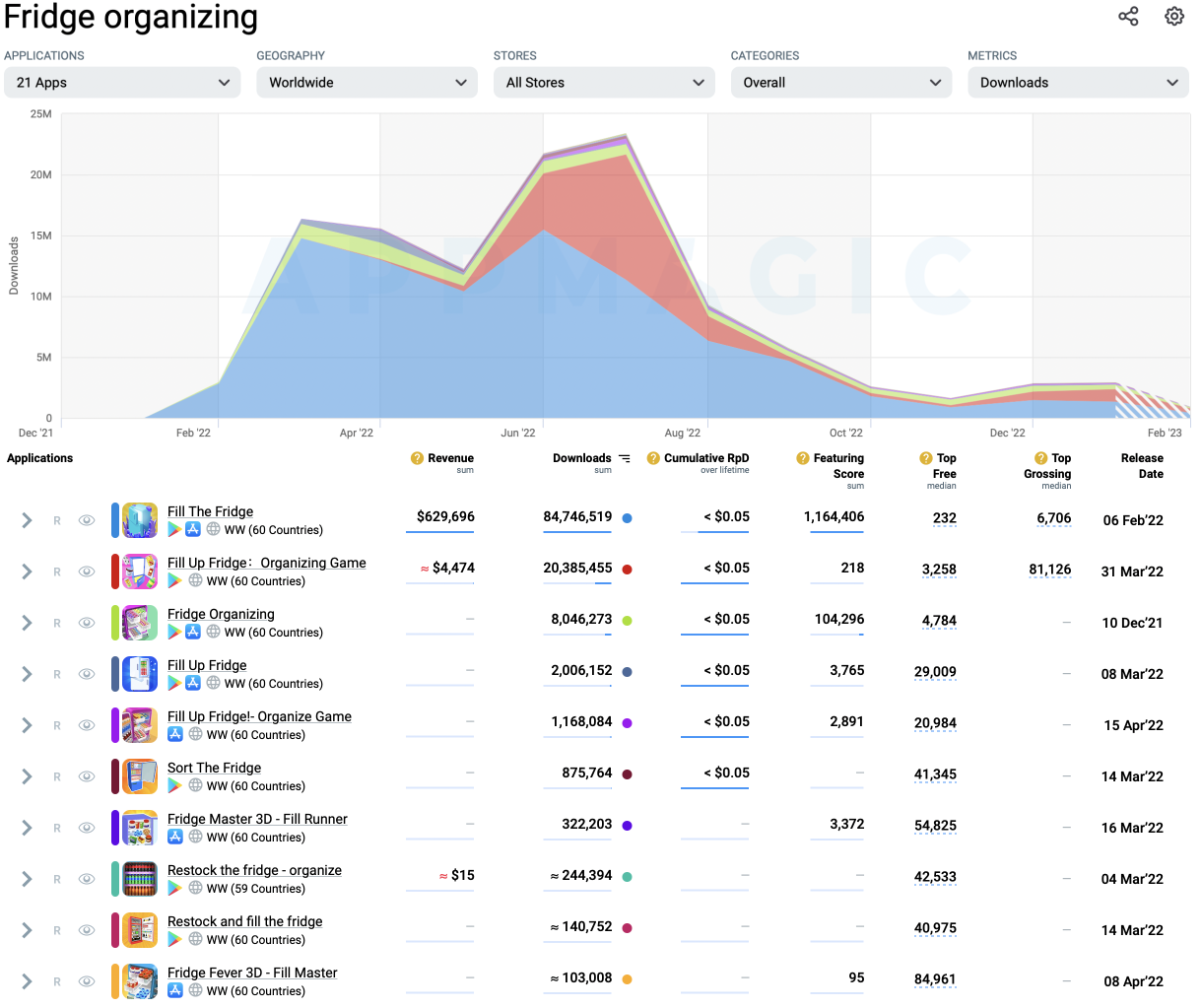
It has been on the market since February 2022 and has generated 84.7M downloads, peaking twice in March and June 2022; it then faced a downtrend which hasn’t reached a full recession yet.
Its closest competitor Fill Up Fridge: Organizing Game by GameLord 3D is at 20.4M installs as of today (released at the end of March 2022). Crazy Labs didn’t skip the trend as well, offering the market its Fridge Organizing which started grabbing installs in February 2022 but wasn’t as popular compared to the two previous titles and ended up with only 8M downloads. It is worth mentioning that, while all these games are currently facing a downtrend, Fill The Fridge is still generating about 1.3M monthly downloads.
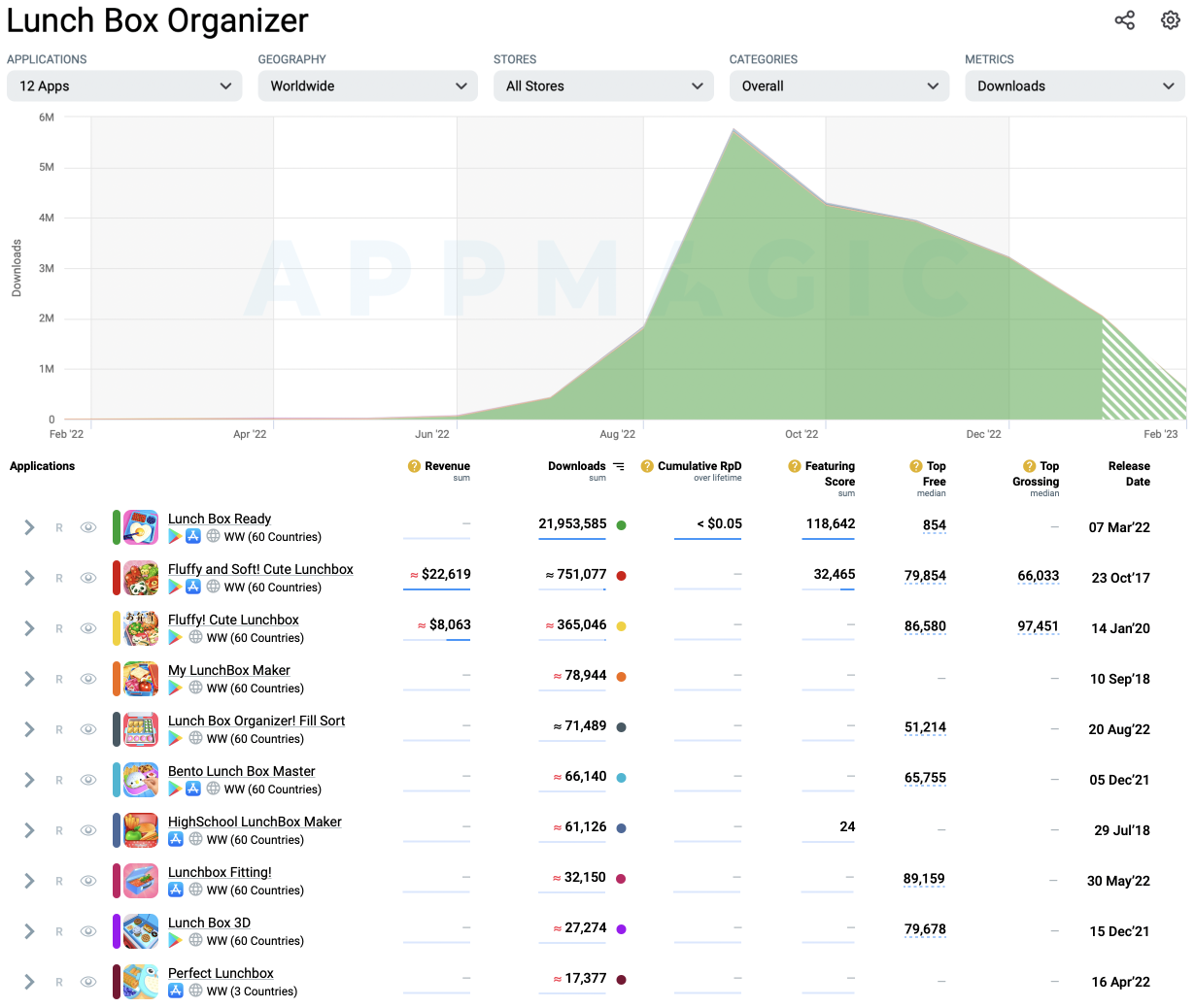
Lunch Box Organizers The next subtrend on the line is Lunch Box Organizers. As you may have noticed, the boxes are usually bentos, meaning that they have more than two compartments. Bento boxes originate from Japan, where it has long been a norm to eat outside of home or on the go.
However, bento boxes became extremely popular when we started to watch parents creating food art for their kids’ lunch boxes. Just look at this perfection on Instagram or Pinterest. While the trend emerged more than ten years ago, it still hasn’t lost its pizzazz. Thus, the “lunchbox organizing” query has already hit 7.2B views on TikTok.
When it comes to mobile games, it’s Crazy Labs’ time to shine yet again. The studio released its hypercasual puzzle title Lunch Box Ready in March 2022, and it has since generated 21.9M downloads, peaking in September 2022 and rolling back afterwards. There are quite a lot of other titles inspired by the trend; however, none come anywhere near close to generating at least 1M installs over lifetime.
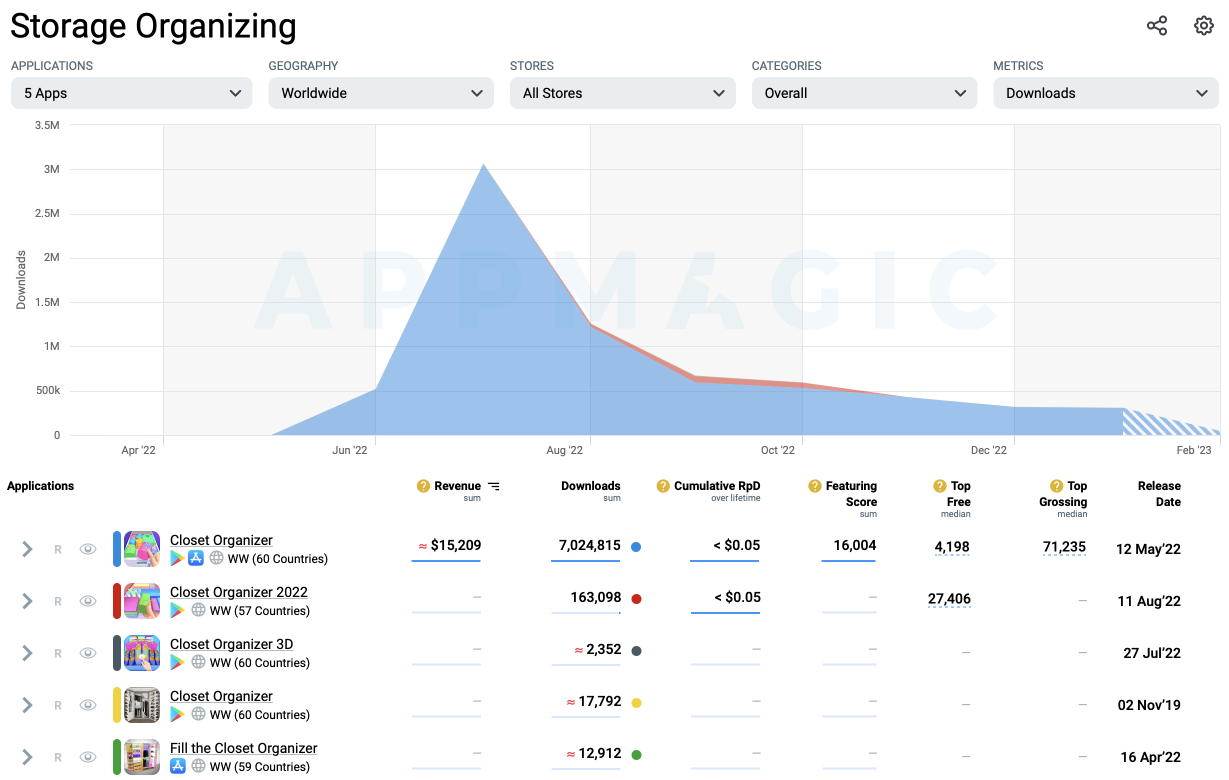
Closet Organization Another subtrend to talk about is Closet Organization with its 474.1M views on TikTok. Sure, we expected to see games inspired by it, and so we did. Our list might be rather short, but we can still see the typical situation with one leader, Closet Organizer, which is a hypercasual puzzle by Lion Studios with 7M downloads. Other titles generate 100 times fewer installs. The dynamics are quite familiar, too: Closet Organizer peaked 2 months after the release, then went down quickly until it reached 700K monthly downloads and has been on a steady decline since.
Save the Doge
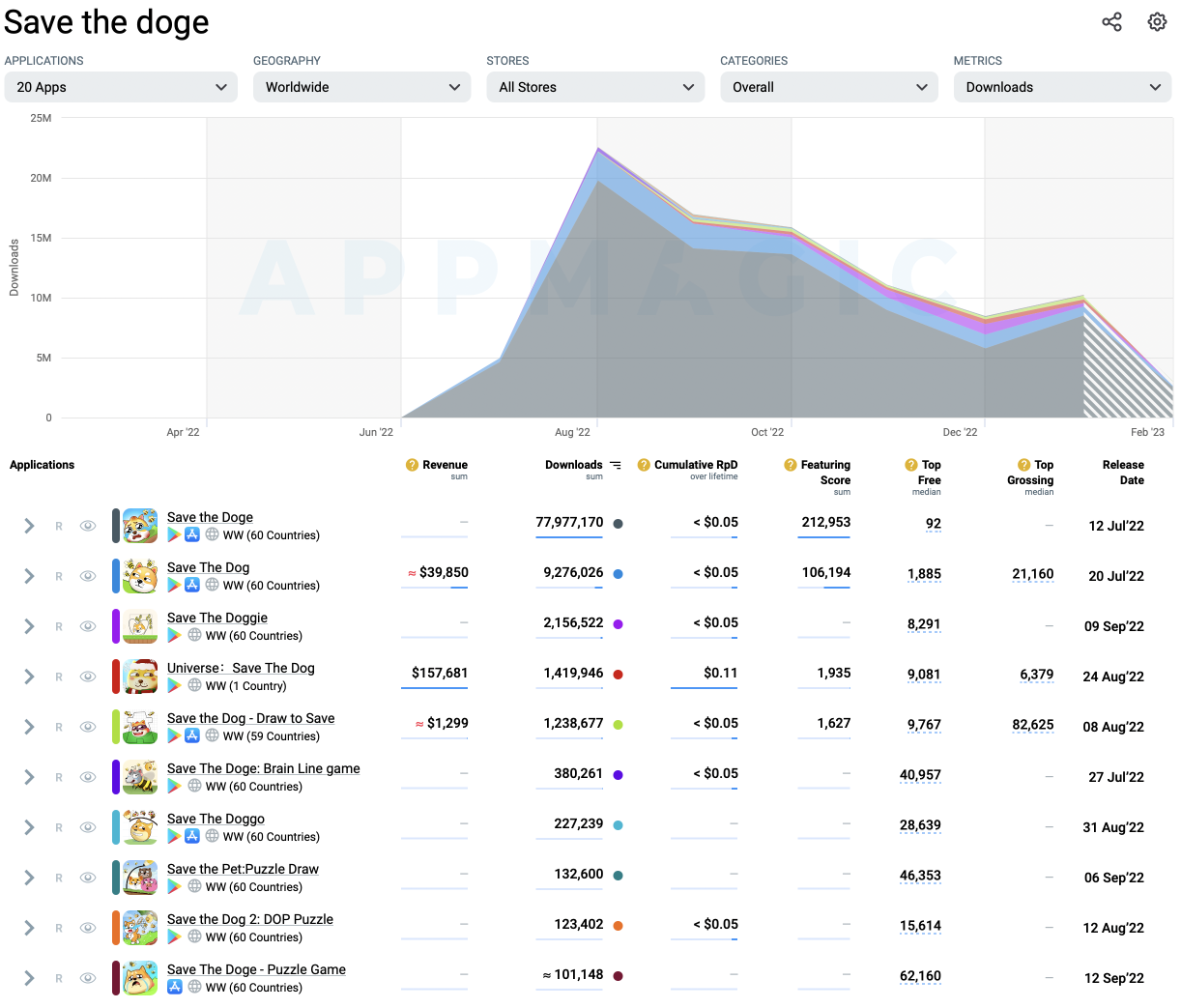
The final trend to wrap up our series of articles is Save the Dog. There are a bunch of videos about people saving dogs from different life-threatening situations. To put a number to it, TikTok’s “Save dogs” query has 769M views. This trend has mixed splendidly with the viral doge meme, which found its reflection in Wonder Group’s game Save the Doge.
The title was released not that long ago—in July 2022, peaking in August 2022 and downtrending slowly and steadily ever since. As of today, the game has generated an average of 14.4M monthly downloads, with its total installs for the 7 months on the market at 78M. It is yet another hypercasual puzzle, and here is an awesome article with its deconstruction by our partners. As for competitors, the closest one was able to reach 9M installs 6 months after its release, while others didn’t even get past 2M So, yet again there is one solid leader.
Conclusion
To summarize what went down in this article, we have covered 4 different social media trends and identified quite the same similarities as in the previous articles in terms of chosen trends, types of games, their dynamics, and competitors’ performance.
Hence our final conclusion regarding social media trends. When studying trends to pinpoint one that can become a promising inspiration for a mobile game, it is better to focus on trends with more than 1B views on TikTok. There’s also a possibility to focus on trends with a more narrowly defined audience and a smaller number of query views (200-400K), but it’s important in this case to have a very good understanding of your audience.
As for the games themselves, most of them are hypercasual in the arcade, simulator, or puzzle genre. Their dynamics demonstrate a certain pattern: typically, the games reach their peak installs 2 or 3 months after release and then experience a quick drop until they reach a particular level at which they either stagnate or continue on a slow and steady downtrend.
In terms of competitors, there’s often one leader on the list that beats all others by at least 10 times more downloads than the runner-up. However, if the trend is booming and there’s a star game with significantly more downloads than anyone else, there is still a chance to make it to the top. Think about Fidget Toys Trading: Pop It 3D with its additional feature of collecting and trading toys and Hair Tattoo: Barber Shop Game with its midcore elements mixed with hypercasual ones. They have one thing in common: both titles added some unique solutions to the basic game formula used by their competitors—and were absolutely right to do so.
Turns out, the practice of tracking social media trends has already become a routine for many studios. For example, FreePlay shared with us that they used a top-to-bottom approach to the analysis of “trending” updates: news & culture, arts & mechanics, interesting games and games based on trends, and performance analytics. Besides, they do weekly “treasure hunt” meetings dedicated to identifying patterns, predicting virality, and picking trends or elements for future games.
Another general insight courtesy of the developers is that games inspired by social media require similar human and money resources to a typical hypercasual game. Just like with all hypercasual mobile titles, studios have to act fast if they want to jump on the trend bandwagon with their game, but they also need to be thorough to make sure they release a high quality product. According to FreePlay, it always comes down to the ultimate mix of motivation, experience, resources, and process alignment.
As for the social media platforms targeted most for inspiration, TikTok proves to really stand out, not in the least because its content is somewhat similar to the content we’re used to seeing in hypercasual games: it’s fun, relaxing and fast-paced. So, if you’re looking for inspiration, you can now be sure what to do and where to go!