Huggy Wuggy: Yet Another Viral Trend
Do you remember a blue monster from Poppy Playtime? It is appeared that it has created a real media boom that has already reached the gaming industry. Let's find out together who is this Huggy Wuggy and what the fuss is all about.
— by Diana Levintova
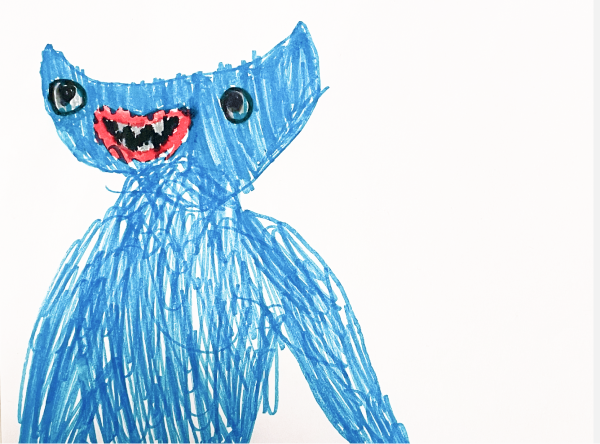
In October 2021, the world was introduced to the rather cute furry blue monster, Huggy Wuggy, that gamers first saw in the survival horror game Poppy Playtime created by the MOB Games indie developer.
The character became viral, and very soon it could be found all over YouTube and TikTok, generating millions of views. Huggy Wuggy won the hearts of numerous kids, much to the dismay of their parents: the contents of the videos are rather disturbing, showing the character in compromising scenarios that ultimately result in gory endings.
So, why are we putting this blue guy in the spotlight exactly? Well, earlier research into the Squid Game phenomenon helped reveal that, when something goes viral, it is hard to stop, and it’s only a matter of time until it permeates many more spheres and markets, including the mobile games industry. However, let’s not jump right into the Huggy Wuggy trend analysis but instead brush up on the background of the furry creature.
The game lore has it that, initially, Huggy Wuggy was not intended as a horrifying monster: it was created by the Playtime Co. Toy Factory in 1984 and quickly became the best-selling toy and mascot of the plant, mostly because of its lovely feature: it could hug its owner. However, producers tried to make their toys even more life-like, carrying out some illegal and unethical experiments, and after one of them this kids’ ultimate buddy turned into their worst nightmare. We know that horror stories and conspiracy theories are exciting, so we’ll let you learn more of the mysterious Experiment 1006 that wiped out the entire staff of Playtime Co. on your own.
Alright, so the recap is done. Moving on to something more quantitative! To conduct our research, we started off by drawing a list of all the games featuring Huggy Wuggy in any way: overall, there were 1,935 games, however, only 322 of them continue to generate downloads. The apps can be split into several categories: mods, tips, guides, wallpapers, fake calls, coloring books, drawing, walkthroughs, and games. The latter can be further divided into several sub-segments: games inspired by Poppy Playtime; games of various genres where Huggy Wuggy is one of the main characters (hero games, hide & seek, and escape); and games inspired by well-known titles with the addition of Huggy Wuggy’s character (Minecraft, FNF, Squid Game, Granny, Tiles Hop).
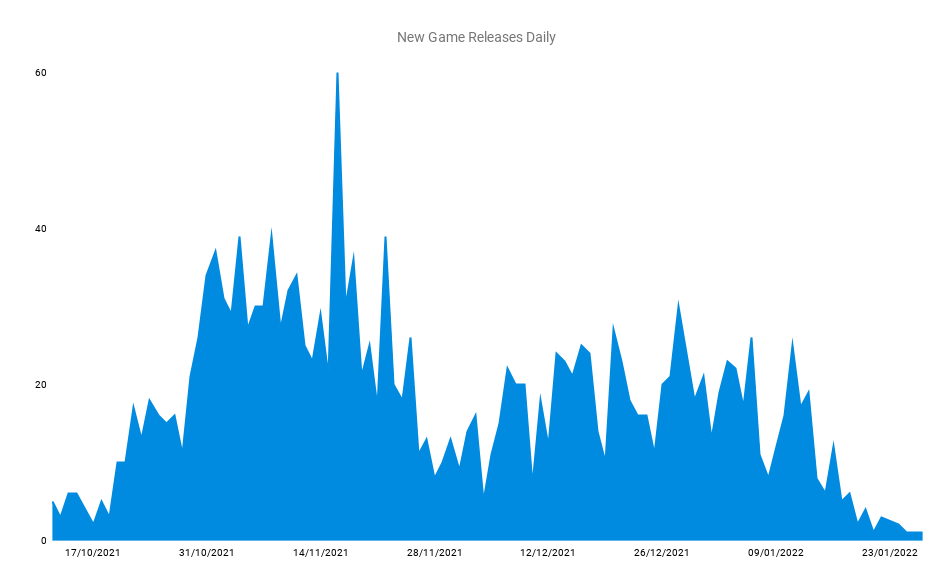
After reviewing the data in a generalized way, we decided to look at the number of new releases and find out if there was still a boom for producing yet more new titles with this blue monster. We analyzed games that were released after the debut of Poppy Playtime, which was October 12, 2021. In the graph, you can see that the largest number of games released in one day was recorded on November 16, 2021—almost a month after the original faced the music. However, from January 10, 2022, the number of new titles released has steadily been approaching 0.
Having confirmed that releasing new games featuring Huggy Wuggy was not that hot anymore, we decided to have a look at the current performance of a few apps released earlier to find out if people were still interested in this character.
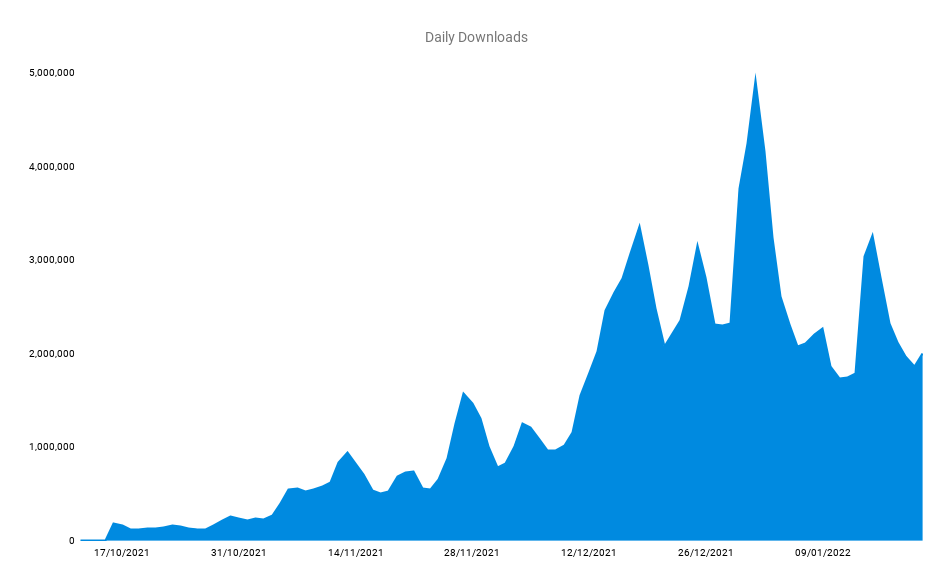
From the graph, you can see that they are! We’ve documented the largest number of cumulative downloads on January 1, 2022, and, even though the trend has since gone down, the popularity of Huggy Wuggy apps among users is still there. So, let’s find out which apps are downloaded the most!

Here, we have created an App Comparison Dashboard in order to see the dynamics and the cumulative number of downloads for the 5 most popular apps with Huggy Wuggy.
The leader of the trend is Poppy Rope Game by Zego Global Publishing with cumulative downloads over its lifetime so far at 24.9M. It is an action-adventure game with an open world and stylized 3D graphics, where the user plays as a character inspired by Huggy Wuggy with several superpowers. The player is expected to explore the city, destroying all the enemies as they do (GTA-style). By the way, a user can also choose different means of transport such as tanks and helicopters.
The second position is held by Poppy: Hide and Seek Playtime by the same publisher with 13M cumulative downloads. It is a hypercasual arcade game with low-detail 3D graphics, where the player’s main goal is to survive and not get caught by Huggy Wuggy. Or, if a player feels a bit bloodthirsty, they can play as a furry monster themselves, trying to catch all the victims.
Next one on is Poppy Horror: Chapter One created by ABI Global LTD, which was released on January 4, 2022, and has already gained 12.59M downloads. The game is a first-person adventure quest with the player solving puzzles in order to get out of the abandoned factory where Huggy Wuggy is lurking, waiting for them—alive. Poppy Horror: Chapter One, too, has stylized low-detail 3D graphics and is presented in the horror setting.
At position four sits Poppy Stickman Fighting developed (again!) by Zego Global Publishing with 8M downloads. The game is a hypercasual arcade fighter where the user plays for Huggy Wuggy himself, combating varios superheroes with different weapons, their selection rather large. Keep in mind that the levels are pretty short and fast. Poppy Stickman Fighting is a low-detail stylized 2D-graphics offering for the fans.
Last but not least, our top wraps up with Huggy Stretch Game by Azura Global with 6M downloads. The game is a hypercasual puzzle with 2D graphics where the user plays for Huggy Wuggy, and the main goal is to reach some designated destination by stretching his limbs and working around different obstacles.
Key takeaways
As previously demonstrated in the Squid Game market madness overview, we can see again that a good many hypercasual game developers manage to ride the hype wave of global media phenomena rather successfully. Seems like this approach is actually quite justified and, given the right conditions and circumstances, is certainly worth considering.