Inside SayGames’ Little Farm Story Monetization
Little Farm Story: Idle Tycoon by SayGames reached a record $1.2M in monthly revenue in October. And in this breakdown, we’ll look at the game’s key offers and highlight which of them bring in most of its revenue.
— by Lera Kalashnikova and Alina Zlotnik
This article was featured, along with other pieces, in our biweekly AppMagic Newsletter from November 19, 2025. If you’d like to receive insights like this ahead of others, subscribe here.
Can a little farm make you a big profit? Sure, if you’re SayGames. The studio’s fresh hit Little Farm Story: Idle Tycoon has been steadily scaling revenue since December 2024, reaching a record $1.2M in October.
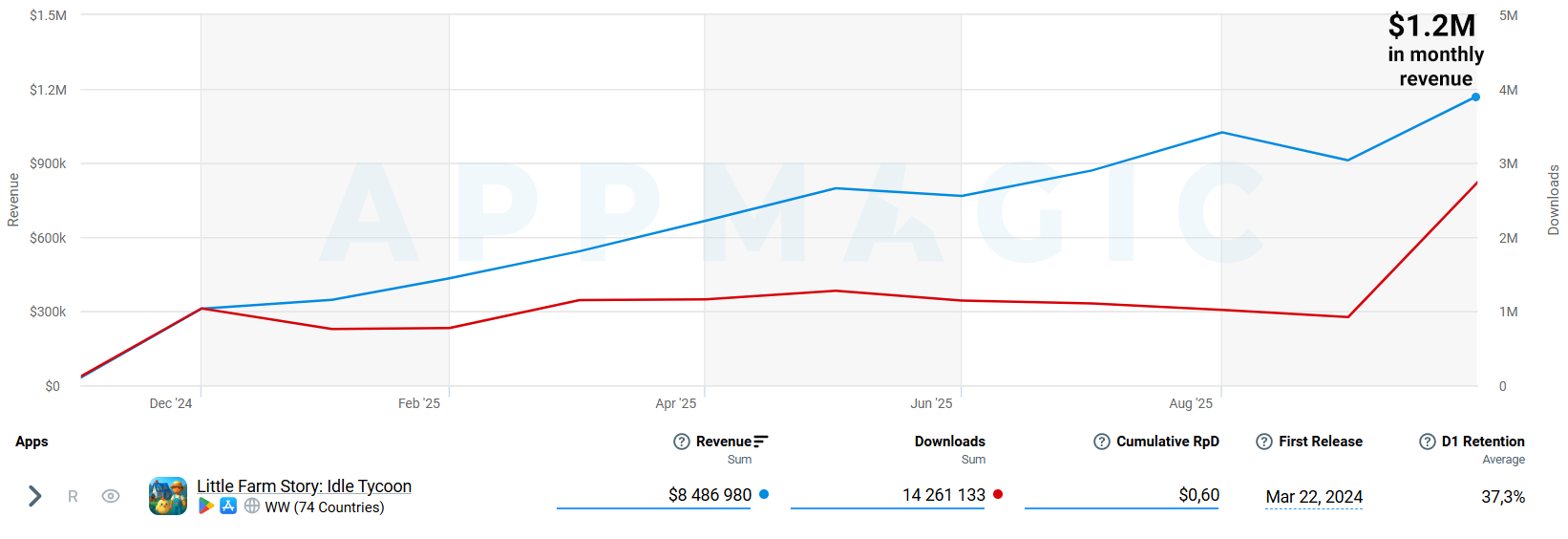 Little Farm Story revenue & downloads
A big part of this surge likely came from new players: installs tripled month over month, jumping from 919K in September to about 2.8M in October, so smart UA certainly pulled its weight. However, the real engine behind the game’s growth is its well-calibrated Hybridcasual design.
The studio that once helped shape the segment with hits like Tower War and My Perfect Hotel now keeps refining its proven frameworks to scale new hits. With that foundation in place, Little Farm Story went global in December 2024 and has already become the studio’s top-grossing game in the last 30 days.
And in this breakdown, we’ll look at the game’s key offers and highlight which of them bring in most of its revenue.
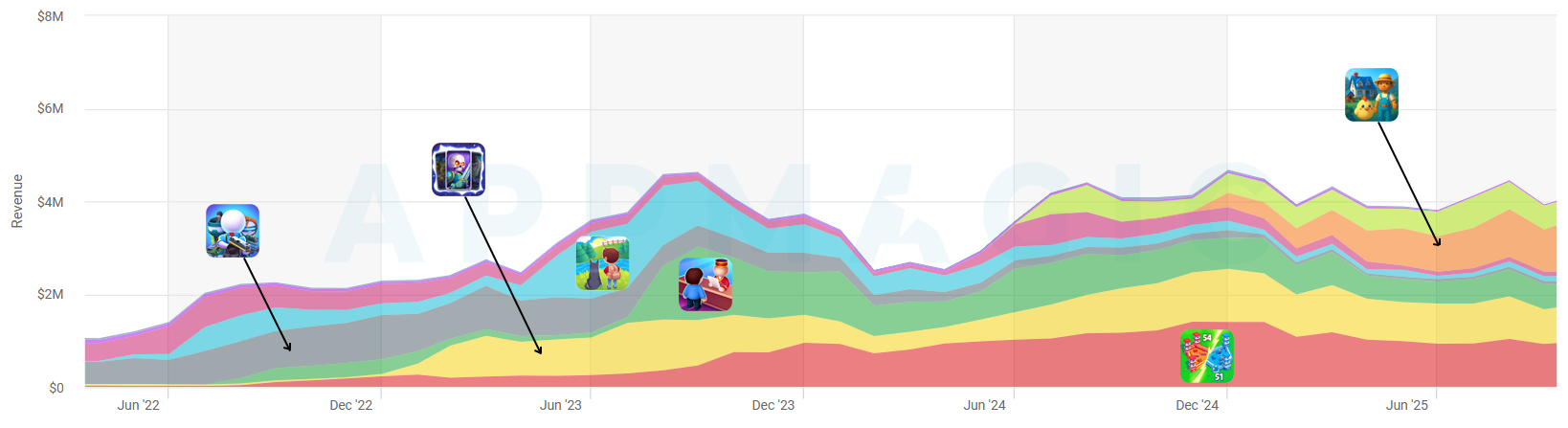 SayGames top 10 games by revenue
And before we dive deeper, let’s make it clear: regardless of its full title, the game is actually not an Idle Tycoon. Rather, it is an Arcade, where players actively control a character who collects resources and upgrades the farm, with its core focused on manual, real-time actions.
For players, the main challenge revolves around managing time and resources. Growing ingredients or producing goods often requires waiting, and the higher the resource value, the longer the cycle. SayGames tunes this progression carefully: players always have something to do, yet always wish things moved just a bit faster. That tension is exactly what fuels the game’s monetization.
Where Conversion Starts: Top 10 First Purchases
The game uses classic Arcade monetization principles: ads help players skip wait times or speed up the acquisition of “cash” (soft currency). Most ad placements sit right on the main gameplay screen, and additional prompts appear whenever resources run low. No matter what slows the player down, there’s almost always an ad-powered solution.
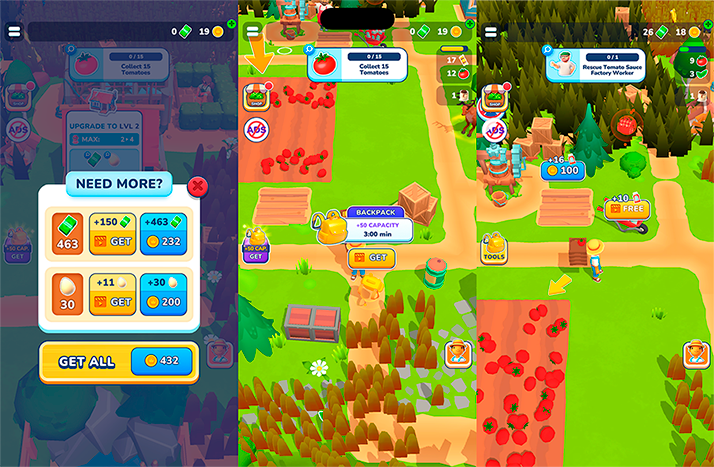
Besides rewarded ads, the game also relies on interstitial and banner ads that appear within minutes of onboarding and maintain a steady presence throughout the session. Meanwhile, Little Farm Story also features a well-structured IAP system, which doesn’t cannibalize ad revenue. Players can choose between two No Ads offers, which only remove forced ads:
- No Ads Pack at $7.99, which holds a solid 61% of all first purchases,
- VIP Pack at $14.99, including recurring rewards of tools and coins. All perks except ad removal are valid for only 7 days after purchase.
The pricing strategy is tightly aligned with users’ ad-based LTV. Up until late 2024, the No Ads Pack on Google Play cost $5.99, notably lower than the App Store’s $7.99, but the price was bumped up at the end of the year. This change may well indicate that the team recalculated the metrics and discovered that an average paying user brought in more revenue via ads, which made the $5.99 price point unprofitable.
Even so, No Ads offers account for more than half of first purchases, yet they bring in only 14% of total revenue, signaling that monetization runs far deeper than simply removing frustrations. And this is where the game’s hard-currency economy steps in.
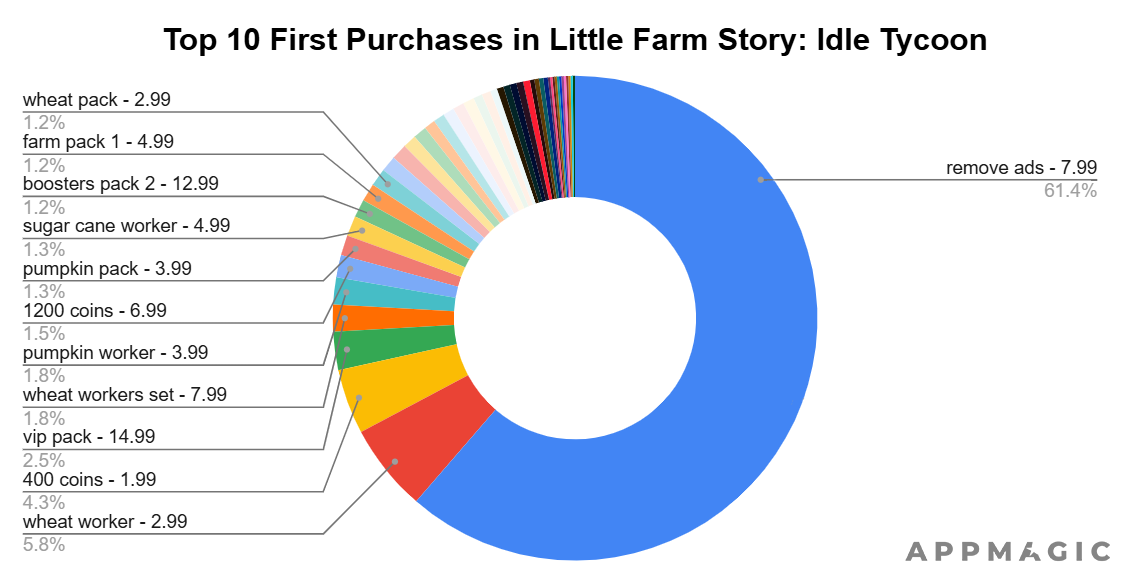
Almost every resource in the game can be obtained—directly or indirectly—through hard currency (coins). In most cases, players choose between spending coins and watching ads. This constant trade-off works: around 17–18% of all purchases come from coin packs.
Location-Based Offers: Driving Over 50% of Revenue
While No Ads and Coins are the most common purchases, the biggest share of the game’s revenue comes from location-based offers that sharply speed up progress (such as a horse that boosts movement speed or tool bundles that simplify interactions).
These quick-impact offers are usually priced under $3, and their value is exhausted within mere minutes. They don’t truly affect long-term progress, but create a strong sense of moving faster. Such emotional payoff makes them extremely effective. Notably, most of these IAPs were added in November and December 2024, right when revenue began to grow rapidly.
🎯 Overall, Little Farm Story shows a well-balanced Hybridcasual monetization model. A broad mix of timely, context-sensitive micro-offers drives purchases, while a lightweight meta and early LiveOps kept to a minimum have players locked into a fast, satisfying core loop.
This article was featured, along with other pieces, in our biweekly AppMagic Newsletter from Nov 19, 2025. If you’d like to receive insights like this ahead of others, subscribe via the form below 👇