Ad Creatives Analysis with Mobile Game Doctor: Why It’s Important and How To Do It
In this article, together with Mobile Game Doctor, we talk about the importance of analyzing ad creatives for the effective advertising process and budget management, discussing how to approach and structure it.
— by Diana Levintova

In this article, we explore the topic of ad creatives analysis, a step of the creation process frequently mishandled, leading to drained budgets and disappointing outcomes. To help those new to the field understand why ad creatives are a useful marketing tool and how to amplify their potential advantages, we invited Mike Kanarek, General Manager of Mobile Game Doctor—a free-to-play games consulting agency, providing guidance to developers across the globe through a network of over 40 domain experts. They offer expertise in game design, product management, portfolio strategy, marketing approach, and team building for free-to-play games on all platforms.
Why is ad creatives analysis an essential step for User Acquisition (UA) teams?
The main objectives of ad creatives are to decrease the Cost Per Install (CPI), making your app more affordable for users to install, and to increase the Lifetime Value (LTV) of users, encouraging them to get back to your app for a longer period.
Marketing visuals, videos, and text often get created based on a gut feeling, with little to no research into the target audience, location, competitor's methods, or market trends. This approach can result in a higher budget and lower results, which might discourage the team from investing more time into ad creative in the future. However, when used correctly, this advertisement tool can actually be very helpful.
So, to make sure ad creatives do their job, it's important to do thorough research beforehand. This won't guarantee a perfect match with your audience, but it will increase your chances of success.
Direct marketing platforms like Unity, Iron Source, and Meta can only offer a certain amount of audience data and insights into competitors' ad performance. However, business intelligence tools, like the one you offer, can provide a deeper, more comprehensive analysis for those who are ready to invest in better results.
What's the best starting point for someone new to the realm of ad creatives?
Firstly, I’d say, it's crucial to pick the tools you plan to use. You could start with basic tools from Facebook or Meta, which are free. They may not provide a wealth of data, but you can observe your competitors' ads and try to deduce which ones have been the most successful.
If you find these resources lacking, you can always upgrade to paid tools like the AppMagic platform. It offers additional insights into competitors' ads analysis, such as impressions per ad, network, geographical distribution, trends, and so on.
The key idea here is that if your competitors are consistently investing in a certain type of ad, it's likely because it's performing well in terms of CPI, user install quality, IPMs, and other KPIs.
In addition to using ad intelligence to gauge your competitors ads’ performance, you can also use it to see how other factors have worked for them. Factors like product pillars, pop culture references, audience feedback, or even a spontaneous idea from an artist. Knowing how these elements fared in the past can save you time and money on testing when deciding on the foundation for your ad creative.
Assuming a studio decides to use paid solutions, how would you advise them to structure their analysis?
I think the top-down approach is very effective. Start by examining successful practices in your chosen genre, noting industry leaders. What works for them may work for your audience too. However, remember your limitations, especially if you're budget-constrained, as certain ad formats may be beyond your reach.
For instance, Merge Mansion dominates the 'merge 2' genre. It's evident that these games use original 3D animations, a costly ad format.
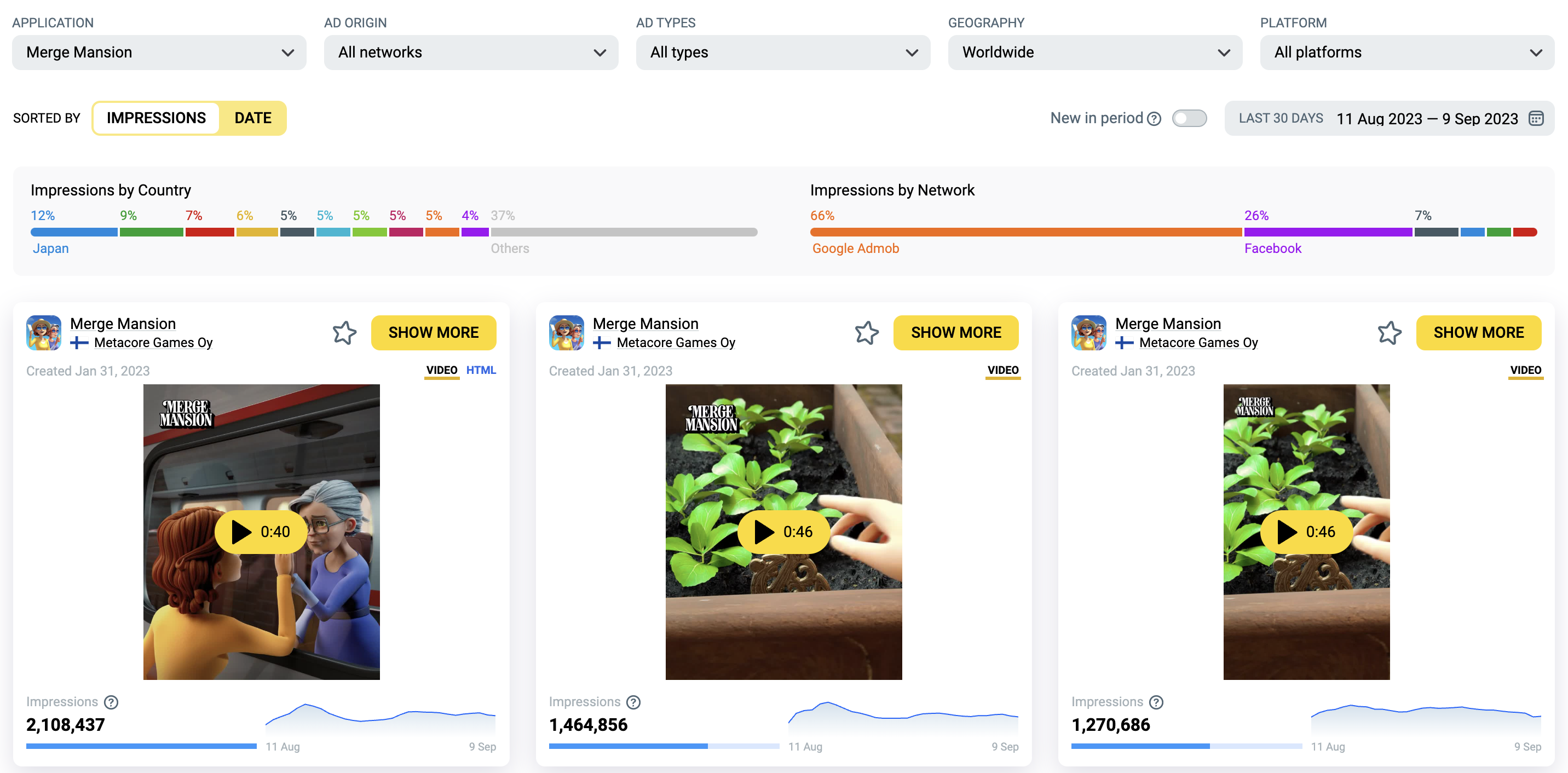
If you can't afford it, despite its proven success for competitors, you'll need to identify other strategies. This requires a broad view of the entire genre.
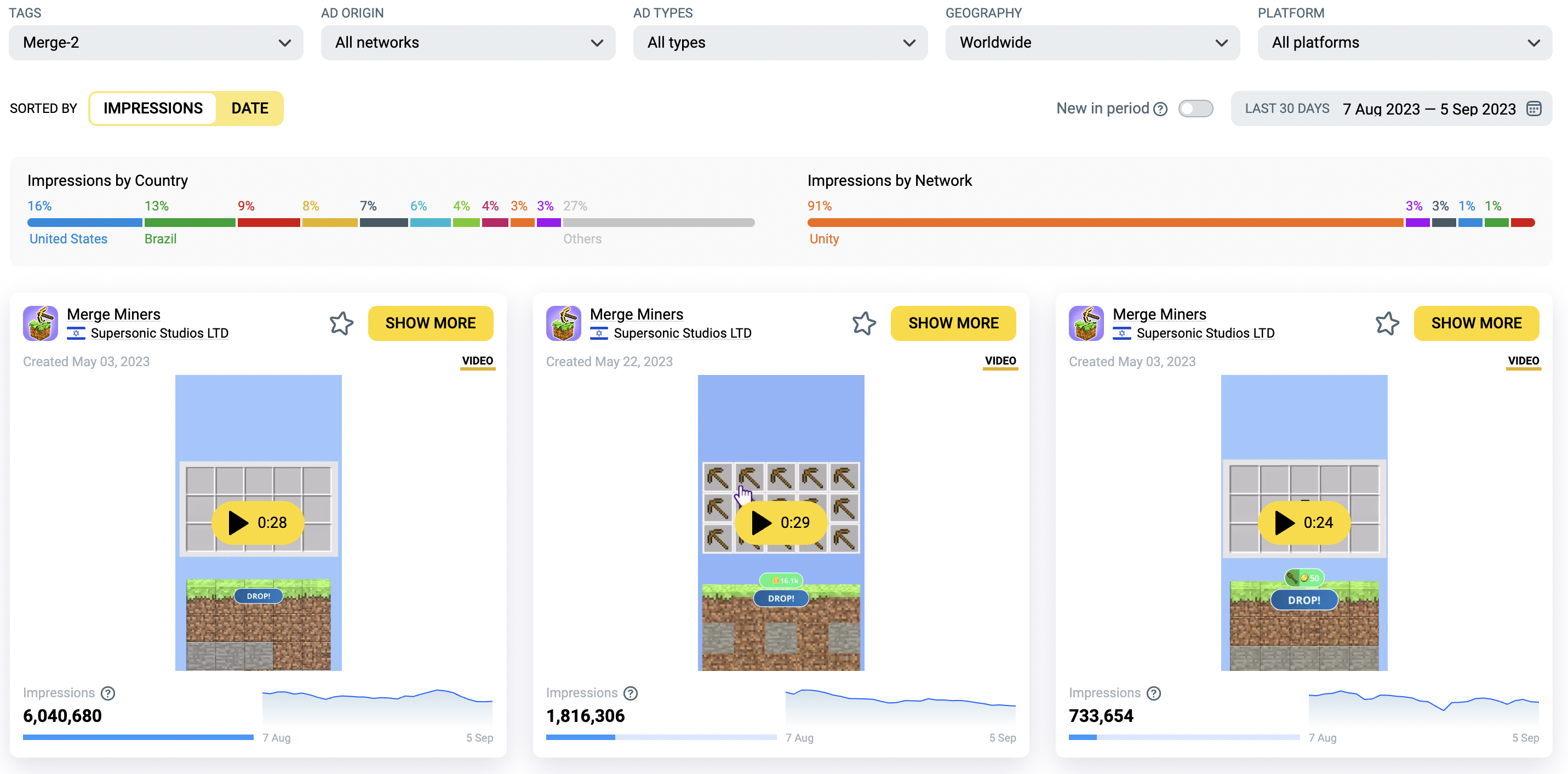
Then, I’d say it’s time to outline your competitors. Tools like AppMagic's Similarity Graph can help. Picking the right competitors is complex, but a few guidelines simplify the task. Typically, three or four competitors suffice for a solid analysis of their ad creatives. But specificity is key - avoid comparing apples to oranges.
If you're unsure about the competitors choice, you can search app stores by genre. Mobile intelligence services often suggest app categorizations as well. Here, AppMagic can be handy too since they have an extensive market classification.
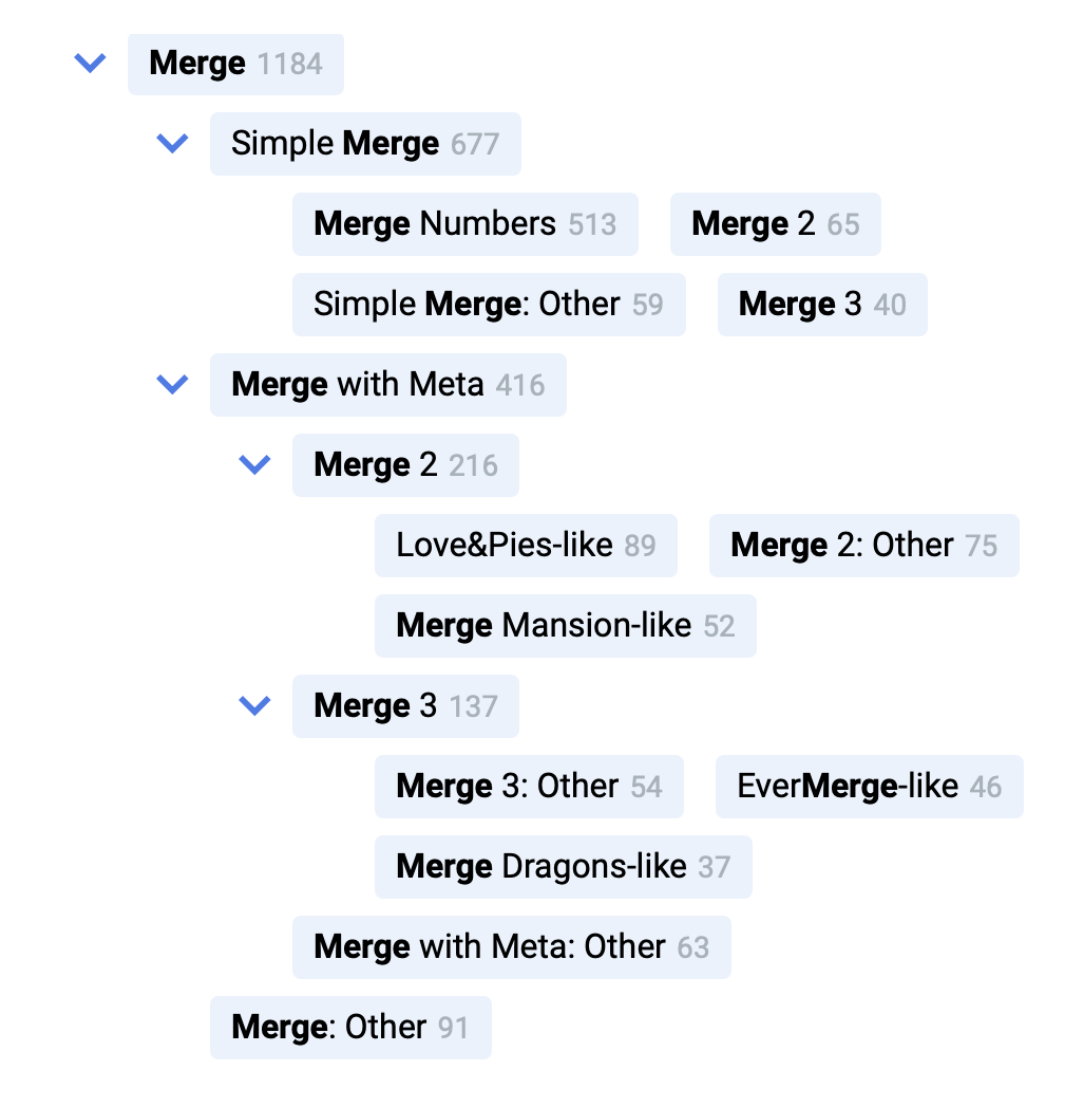
Also, it's beneficial to update your competitor list periodically. Choose games that are dominant in your genre or have similar value propositions to yours. Top-ranking games from AppMagic Top Apps can provide insights into your wider audience's preferences. On the other hand, lower-ranked games with similarities to yours can reveal potential reactions to your game and its ad creatives.
After competitors list is outlined, try to answer this questions that will help you structure your analysis and discover the insights:
- How long have the ads been running
- How much traffic are they getting?
- Are multiple versions of very similar ads being made?
- What networks and geographies are different ads running in?
- Do ad creatives show gameplay?
- What’s the call to action?
- Do the studios use 3d animated characters?
- Is there a lot of text or VFX?
At this stage, avoid going too deep into the analysis. Keep an open mind and make brief observations. Write down bullet points for each ad. If you notice a feature in one ad after reviewing others, revisit them to check for its presence or absence. If time allows, spend a few hours on each competitor, watching their ads and spotting trends.
Are there any other things to look at during analysis that a person new to the ad creatives might miss?
Besides competitors, try to consider your 'neighbors' - related genres outside your niche. Audience research should guide you towards genres with crossover potential. Apply the same process as above but examine these other genres to find creatives that could inspire and resonate with your audience. Within your ad ecosystem or genre niche, unique ads based on concepts vetted in similar games might help you stand out.
When a studio is done with the analysis and ready to start testing - are there any secrets how to approach it?
After completing the steps above, you should have one or two insights to guide your ad creation process. These might include statements like: "gameplay-focused ads are more popular than 3D animations in this market," "ads featuring characters early perform well," or from an artist's perspective, "ads with predominantly warm colors do well."
Once you have these insights, it's time to share them with an artist or creative lead to devise ad concepts that test these hypotheses. Creative testing is an art itself and worth a whole other discussion, but make sure you produce multiple ad versions that follow a strong hypothesis.
Determining which aspects of your ads genuinely appeal to your audience or deter them can be challenging. You wouldn't want to lose an opportunity to create compelling ads simply because, for example, the appearance of a character in the first few seconds turned off your audience. So, as always, it’s all about analyzing, creating, testing and adapting.
In conclusion, do you have any advice for the ad creators new to this field?
I’d say, first of all, cloning ads is still a bit of a gray zone. Studios often mimic successful ads when conducting competitive ad analysis. It's a decent strategy as long as the quality matches or surpasses the original. However, be prepared to compete in a bidding war with the original ad's creator, since you're targeting the same game audience via the same channels.
Ads creation is an iterative process during which you should return to each step periodically to stay on top. High-performing creatives have a lifespan and eventually will be replaced by some other style of creative, making new opportunities for you to learn on your competitors' UA expenditures. While you’re waiting on new competitor ads don’t forget to look at your successful ads. Frequently work on their improvement and try out original concepts on a regular basis using whatever inspiration you can find.