How to Detect Mobile App Trends: 5 Data-Driven Ways for Games & Apps
Learn to identify mobile app trends early by understanding the key peculiarities of app market analysis. This article breaks down how to analyze market structure and competition, track trend-setting titles that reshape segments or form new subgenres, as well as validate IP-based opportunities and choose the most effective formats—all using mobile app analytics tools and app performance data.
— Diana Levintova

Hunting for mobile app trends is one of the key steps to building a scalable, monetizable product. At first, the process might seem rather straightforward—that is, until it starts costing you money. That’s usually when it becomes clear that a few key peculiarities of app trend analysis were overlooked.
For example, a category might be skyrocketing, leading you to enter it without checking if a specific sub-segment is driving most of the growth and, as a result, missing the right angle. Alternatively, the market may show strong growth yet turn out to be highly saturated and difficult to enter: something you only realize after investing significant (yet still insufficient) resources into your product and user acquisition. You might also spot a promising trend, but enter too late, having missed its early signals or failed to acknowledge that it was already losing momentum.
In this article, we explore how to approach mobile app trend analysis more efficiently by taking these key peculiarities into account…and using the AppMagic mobile market intelligence platform.
Spot Categories That Drive Segment Growth
When choosing which app to build or how to adjust an existing one, it’s important to understand which categories are growing—and whether that growth is evenly distributed. In some cases, the overall niche might be expanding, but the growth is driven by a specific segment.
One of the easiest ways to approach this is through mobile app analytics tools like AppMagic, which reduce dataset search and analysis to mere minutes. Using features like Market Segment Comparison, you can analyze different niches by revenue and downloads over time.
For example, in 2025, Generative AI apps showed +274% YoY revenue growth and +178% YoY download growth.
Looking deeper into the category, AI chatbots grew +281% YoY in revenue and +173% YoY in downloads, remaining the largest contributor to the Generative AI market, accounting for 93% of revenue and 83% of downloads.
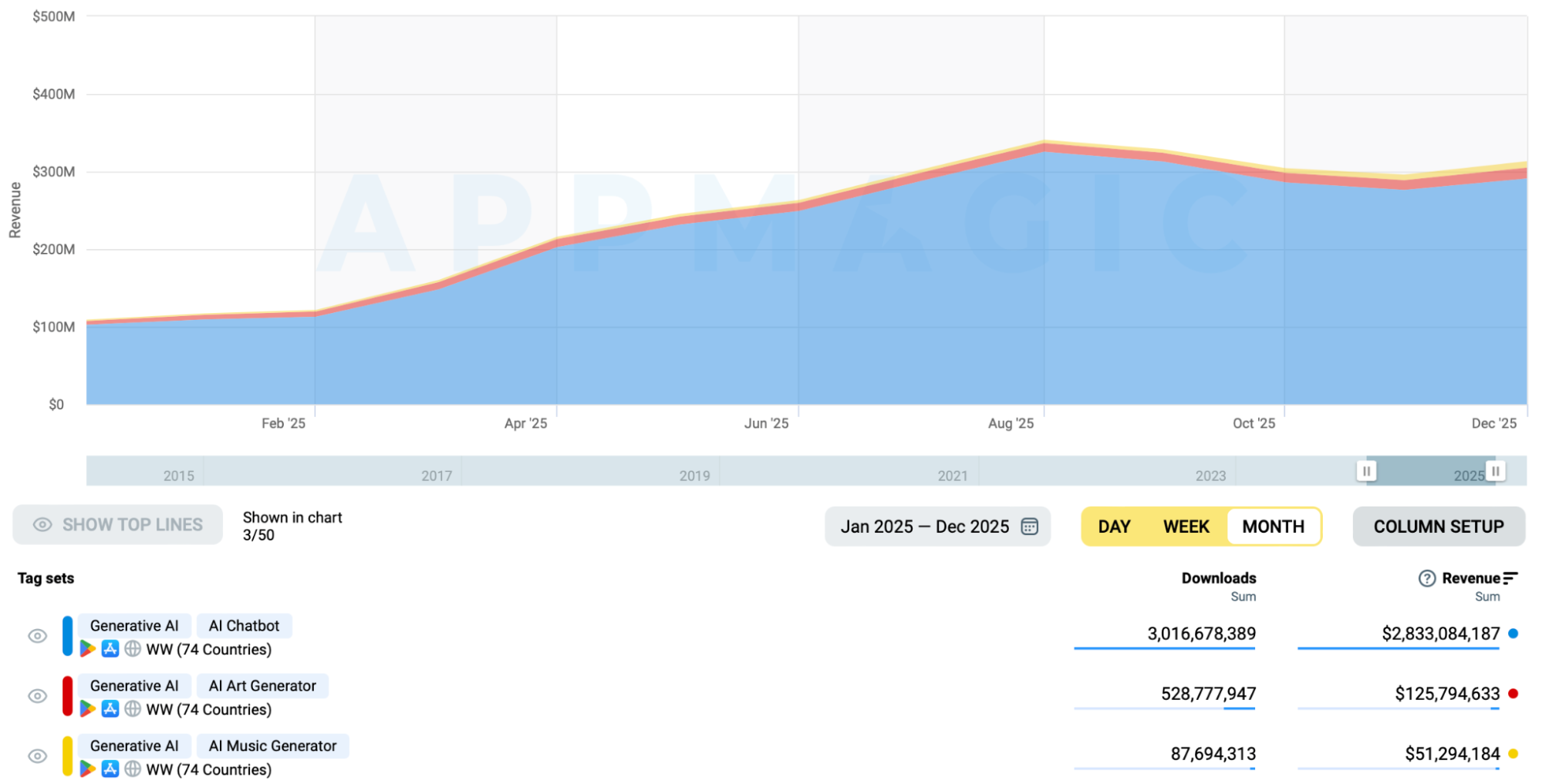 Generative AI subcategories on the Market Segment Comparison dashboard
At the same time, other segments remain smaller in absolute size but are growing faster. AI Music Generators saw +410% YoY revenue growth, with downloads up +418% YoY, while AI Art Generators grew +100% YoY in revenue and +236% YoY in downloads.
This suggests that, while chatbots continue to anchor the market, growth is gradually extending to the more specialized creative tools.
Learn more about Generative AI and other quickly growing mobile app segments from our Mobile Market Landscape 2026 report.
Analyze Market Structure and Growth Distribution Across Competitors
After identifying a growing category, the next step is to understand how it is structured—and whether growth is driven by a single dominant player or shared across multiple apps.
One of the most useful app analytics tools for this is Market Segment, which lets you analyze revenue and download distribution across leading apps in a category.
In the Generative AI market, ChatGPT currently accounts for 77% of total revenue, indicating a high level of concentration. At the same time, several players have shown strong growth. In 2025, Grok became the second-largest app by revenue, while in February 2026, Claude by Anthropic nearly doubled its figures from the previous month, approaching *Grok*’s scale. Google Gemini has also been expanding steadily since late 2025, with revenue increasing by 120% over four months.
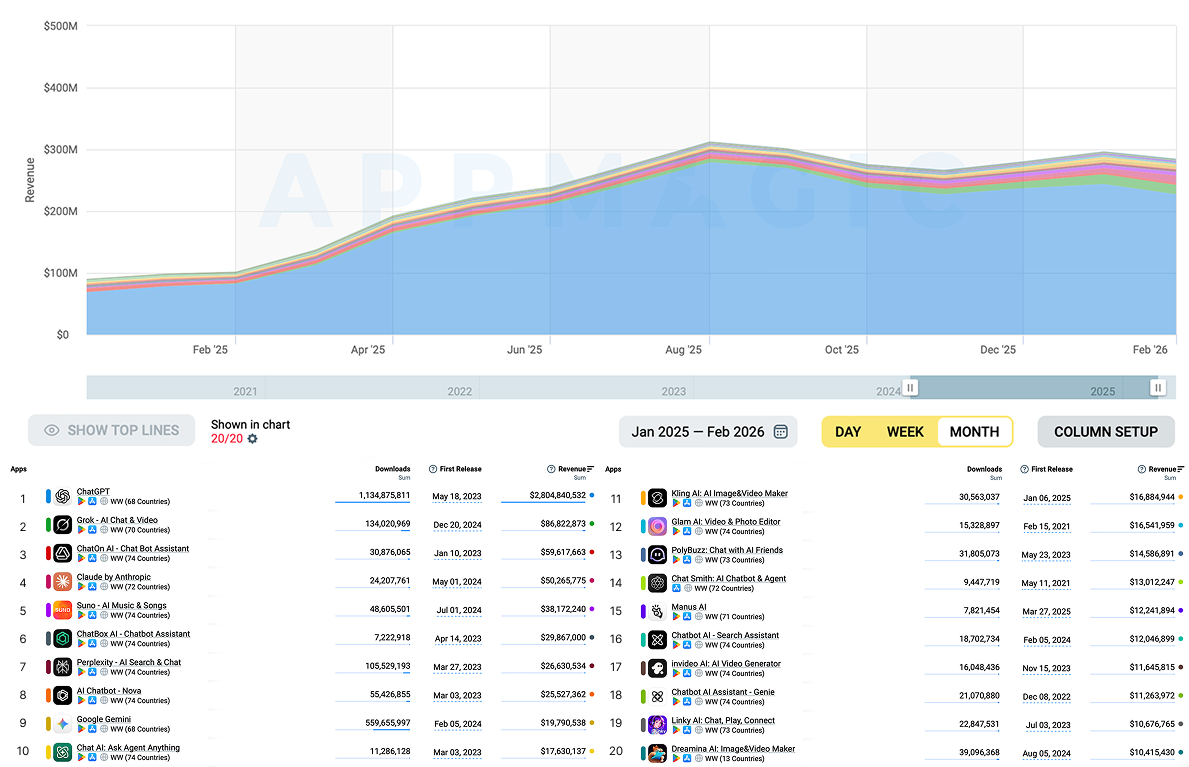
Top 20 Generative AI apps by revenue on the Market Segment Dashboard
In terms of downloads, ChatGPT holds a smaller share (~32%), with Gemini outperforming it in growth during certain periods.
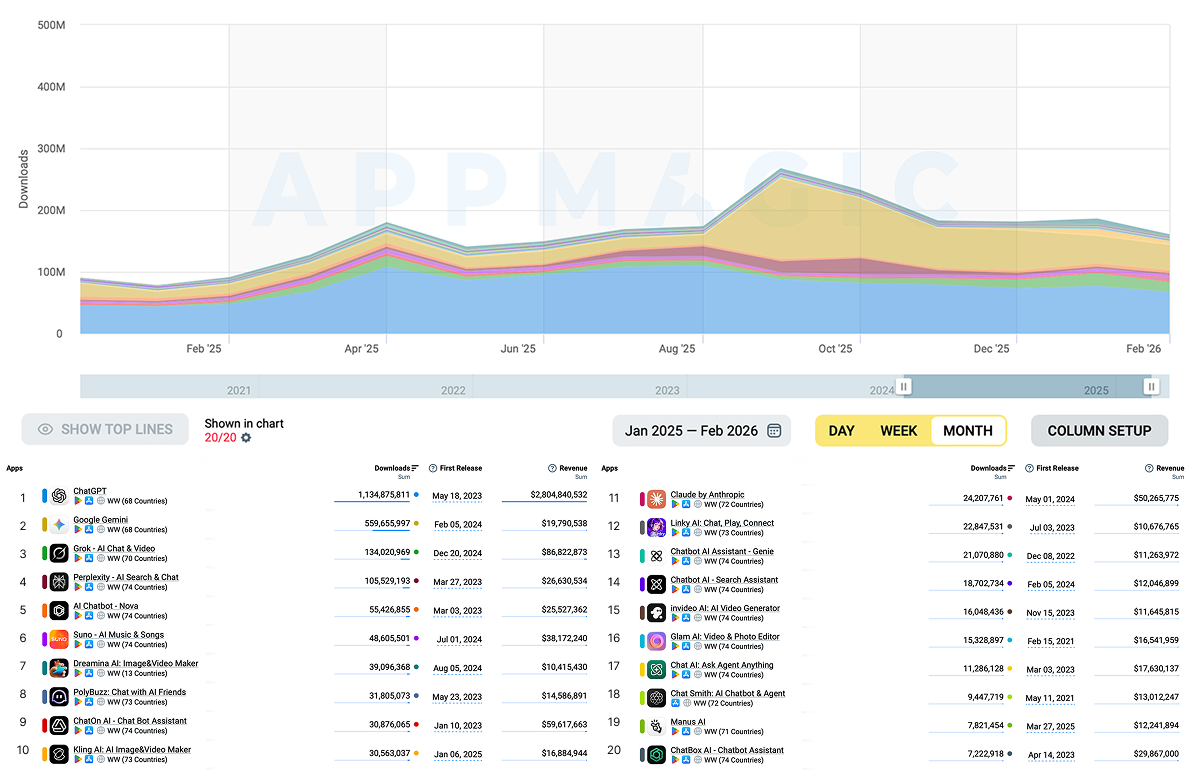
Top 20 Generative AI apps by downloads on the Market Segment Dashboard
Looking at rankings, no 2025 releases have entered the Top 10 by revenue yet, although newer apps such as Kling AI and Manus AI have already reached the Top 20.
Overall, while the market is relatively concentrated, it is not fully closed—new entrants can still gain traction, although reaching the scale of its market leaders will be quite a challenge.
Track Fast-Growing Apps to Identify New Trendsetter Titles
Another useful approach to spotting mobile game trends is tracking apps that are growing quickly within a specific genre.
For example, if you’re developing a Hybridcasual Puzzle game, you might want to follow the lead of dominant titles like Color Block Jam and Screwdom, analyzing their mechanics and updates. At the same time, new titles can begin gaining traction much earlier, before they become widely recognized. Pixel Flow is one such example—it started climbing the charts before any substantially broad coverage by the media or influencers.
As one of the most versatile game analytics tools, AppMagic makes it easy to track these early signals. Its Period Comparison feature allows you to analyze changes in absolute numbers and growth rates over a selected time frame, across the segment and its top performers—by revenue, downloads, DAU, and MAU—all in one place.
Thus, if we set the period for October 2025 to January 2026, select the Puzzle and Hybridcasual tags, and sort by absolute revenue growth, we can see that Pixel Flow clearly dominates the chart. Sorting by release date also shows that it is one of the newest titles in the segment.
At the same time, the top-line metrics show the segment’s overall revenue growth, while the breakdown below reflects how each title grew over the same period. Comparing these figures, we can see that, in absolute terms, Pixel Flow accounted for around 90% of the total segment revenue growth during this period.
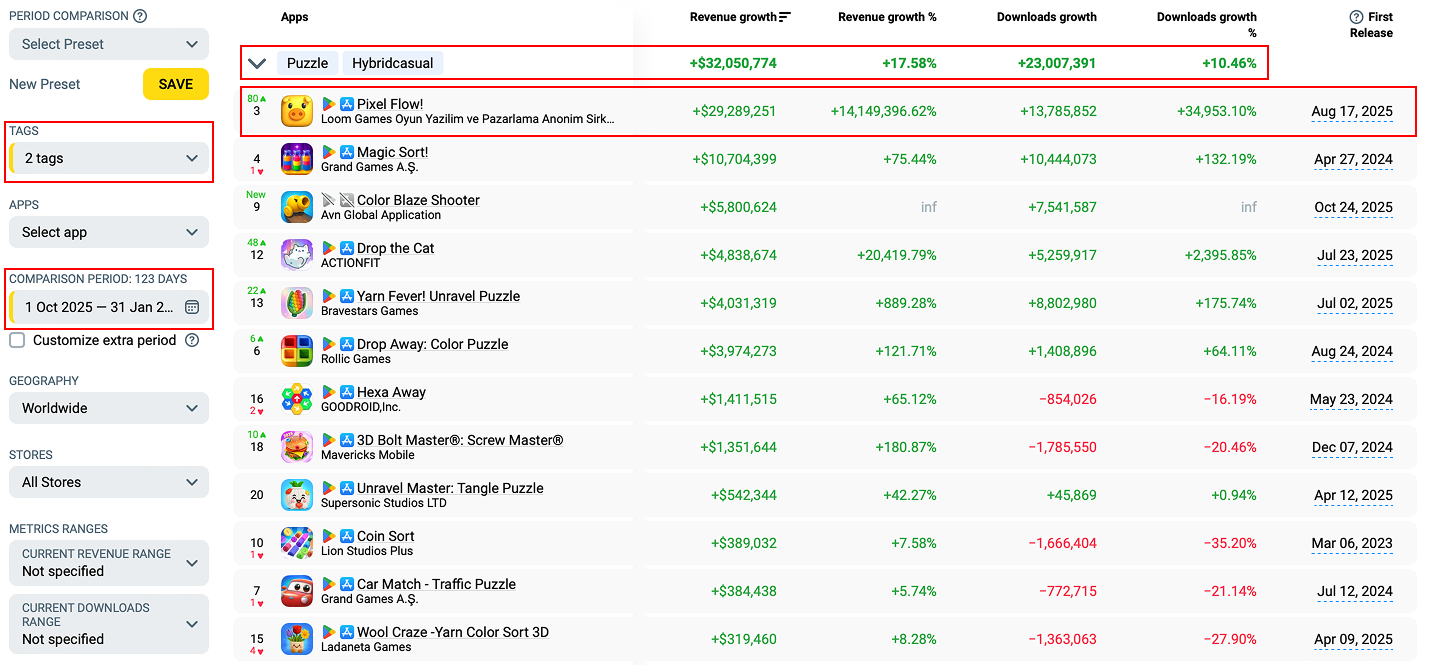
Hybridcasual Puzzles from October 2025 to January 2026 in Period Comparison
To see game trends more precisely, you can go further and use the App Comparison Dashboard. Has Pixel Flow ever surpassed the top leaders in monthly revenue? Yes: in December 2025, it overtook Color Block Jam and Screwdom and has continued to grow since, generating more than twice the monthly revenue of each title in March 2026.
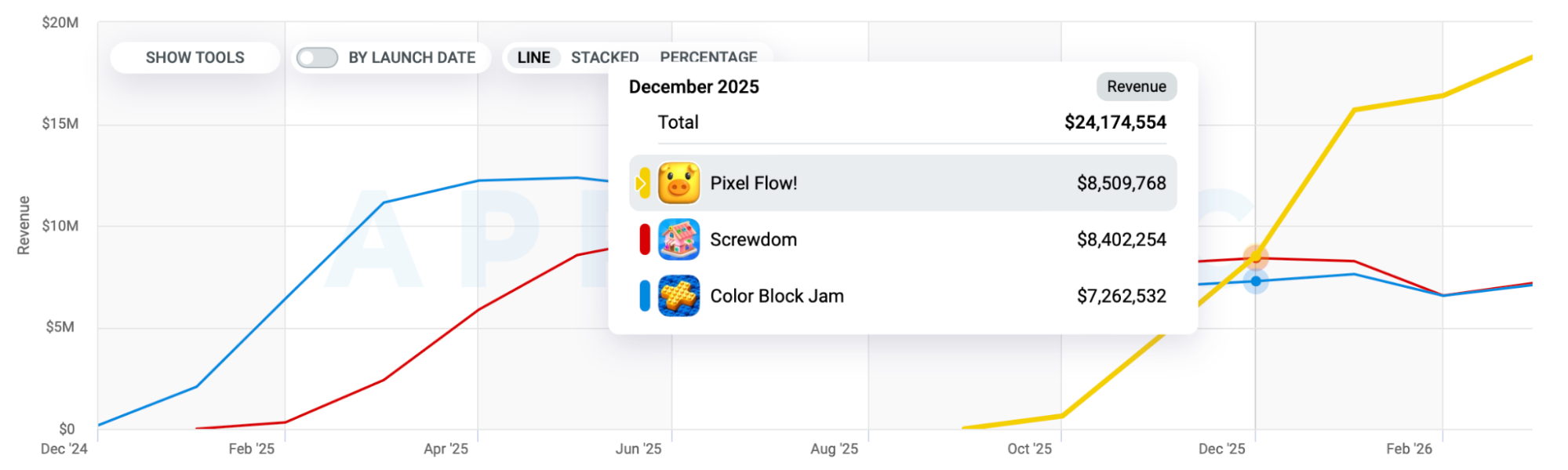
Revenue trends of Hybridcasual Puzzle leaders on the App Comparison Dashboard
Observing these shifts helps identify early growtObserving these shifts helps identify early growth patterns and emerging titles before they become widely visible in the market.
Validate IP-Based App Opportunities Beyond the Hype
Another angle in mobile app market analysis is to examine whether a popular IP translates into a real product opportunity and influences the market.
For instance, it’s tempting to assume that releasing an app inspired by a well-known show, especially around a new season, will help capture demand. But in practice, many developers tend to have the same idea at the same time, so it’s worth checking market reaction in advance.
You can do that with AppMagic’s Advanced Search, learning how many apps were released around a specific IP or a keyword to see how they performed.
For example, after the release of Squid Game Season 1 in 2021, the market saw a surge in activity, with over 2,500 apps sporting the keyword “squid” in their title launching in one year. (Many of them were eventually removed from the stores.)
It would be reasonable to expect a similar wave after Season 2. However, the data paints a different picture: only 65 apps with “squid” in the title or description were released, and most didn’t reach any meaningful scale. The leading title, Squid Game: Unleashed by Netflix, significantly outperformed the rest, though its metrics quickly declined a few weeks after the TV series’ final episode.
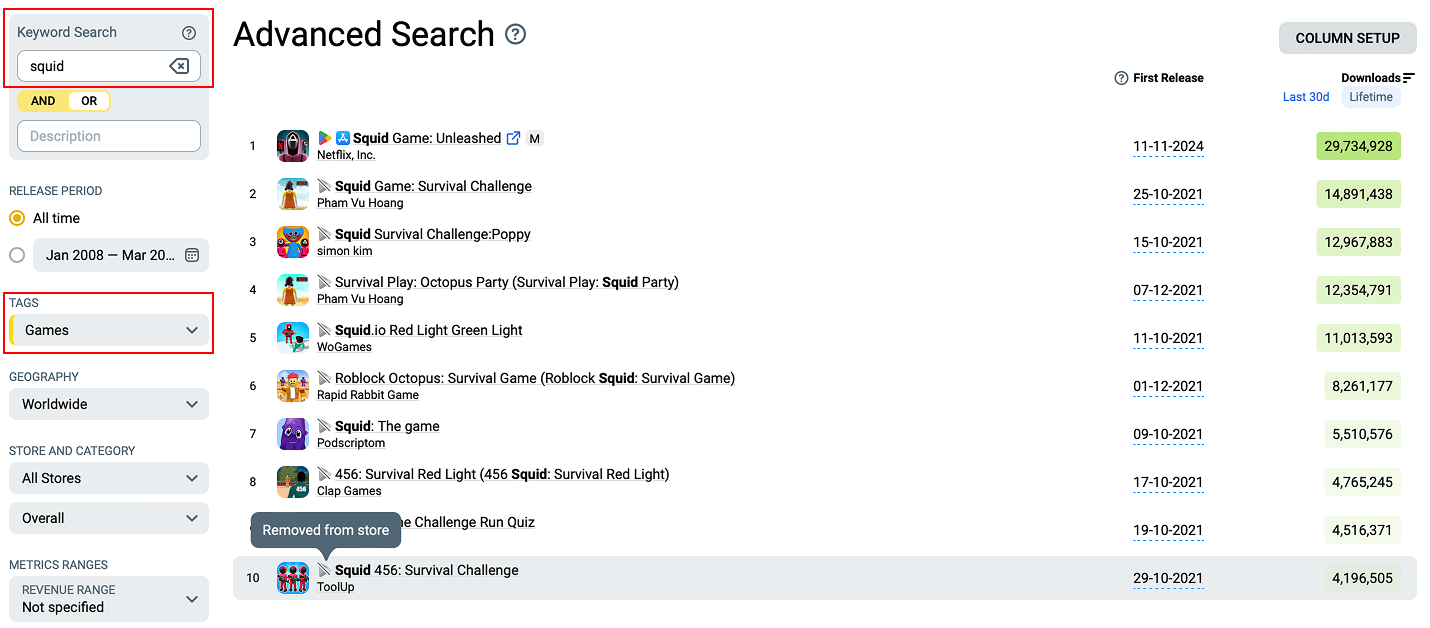
Top games with “squid” in their titles by downloads in Advanced Search
However, if your budget is smaller than Netflix’s, you can still ride the franchise hype wave; you just need to shift your focus. Looking at the second wave of Squid Game-inspired titles, we saw that many games leaned into the trend by incorporating show-inspired content across their ASO, ad creatives, and LiveOps.
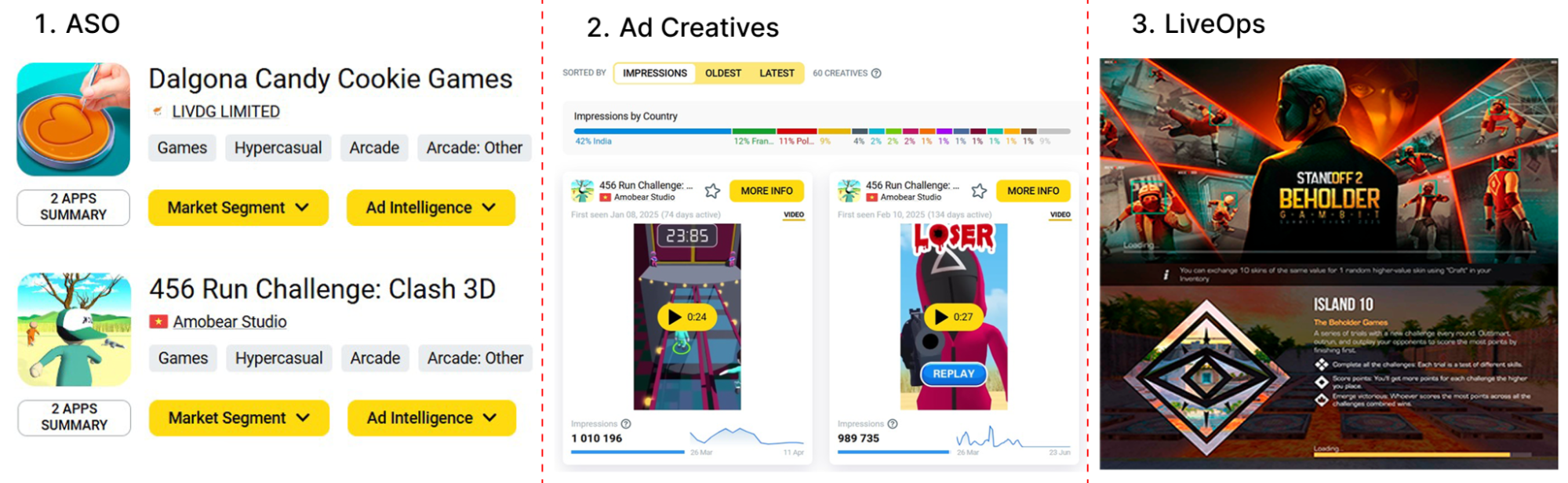
These approaches can be analyzed using AppMagic tools, allowing you to evaluate how competitors incorporate IP-driven elements before finalizing your own approach. In our analysis of Squid Game mobile releases, we break this down using ASO Intelligence, Ad Intelligence, and the LiveOps & Updates Calendar.
Overall, this shows that while IP-driven ideas can create short-term opportunities, their success depends heavily on the chosen format, timing, market saturation, app quality, and publisher scale.
Identify Emerging App Subgenres Early
The last aspect of thorough mobile game trend analysis on the radar today is identifying emerging subgenres before they fully form. These shifts are usually less visible at the category level and tend to manifest via smaller signals, such as changes in top charts, early performance spikes, or clusters of similar releases.
For example, in April 2025, Wool Sort began its rapid ascent up the Top Free chart within the growing Screw Puzzle genre. By May 2025, it had already reached #2 among subgenre leaders, approaching Screw Jam, which was dominating the niche at the time.
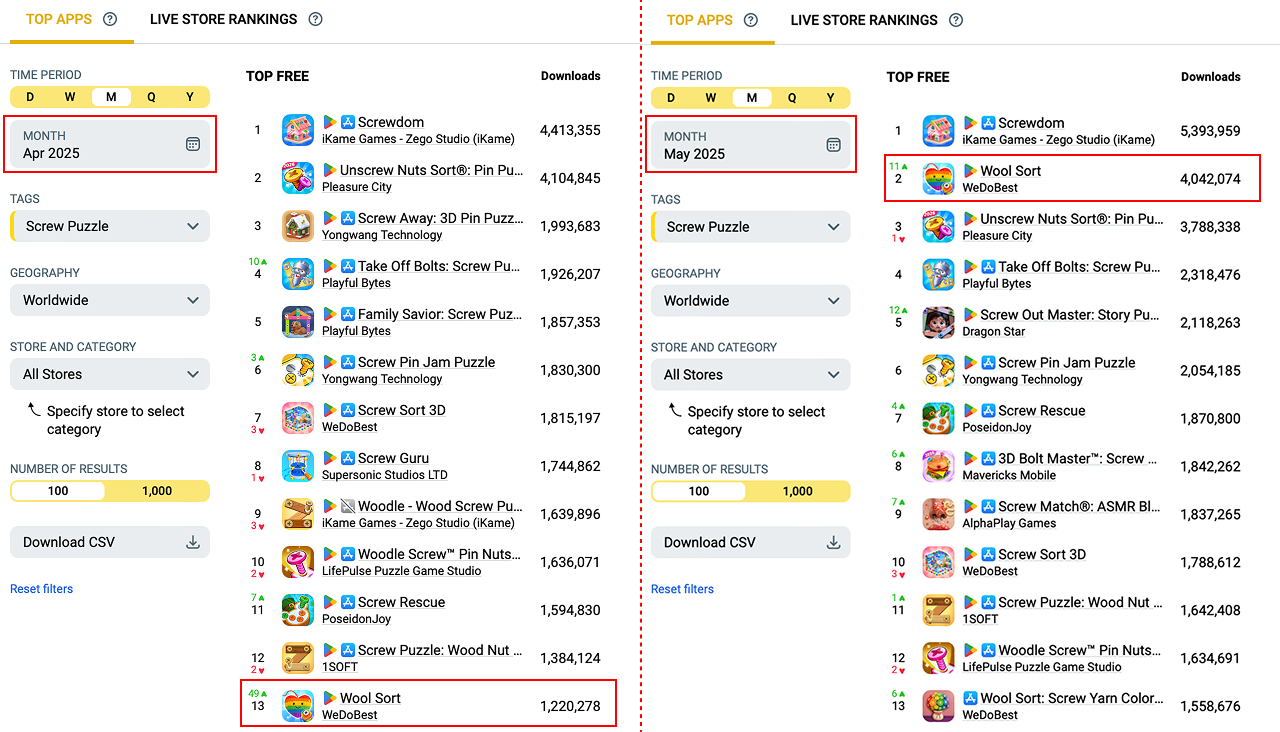
Top Screw Puzzles by downloads in April 2025 and May 2025 in the Top Apps
Judging by the market response through Advanced Search, it becomes clear that developers reacted quickly: using the keyword “wool”, you can see that 14 new titles were released in April and May alone. Most of these games reinterpreted mechanics already established by existing leaders, such as Screw Jam, adapting them to a new theme. Read the full analysis of this trend in our article here.
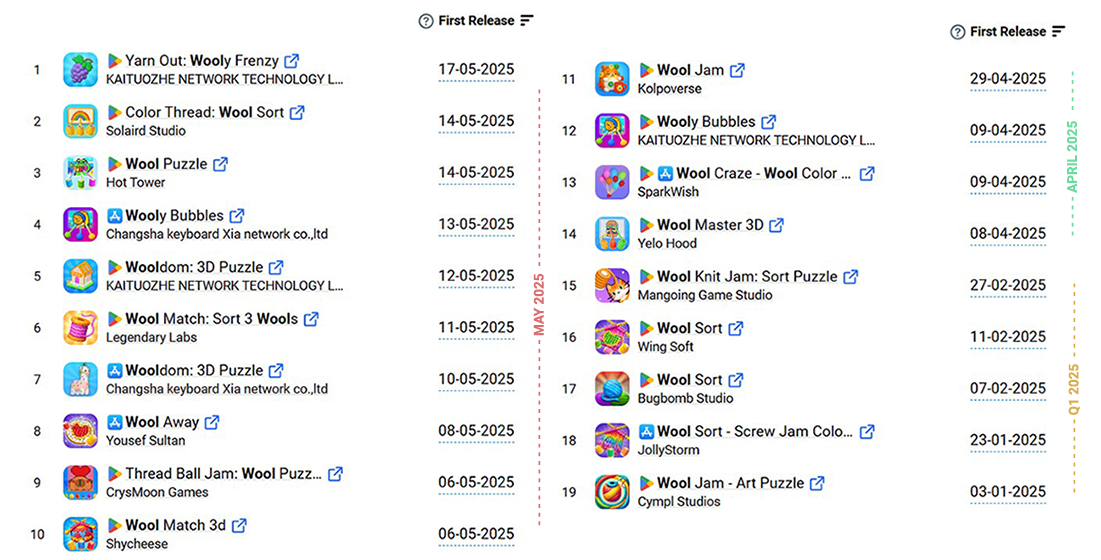
New “wool” games released in April and May 2025 from the Advanced Search
Overall, spotting emerging genres often requires combining multiple approaches and datasets. This becomes significantly more efficient with mobile market intelligence platforms like AppMagic, where these signals can be analyzed together in one place.
Conclusion: How to Analyze App Market Trends More Effectively
Effective mobile app trend analysis is not just about spotting growth; it is about interpreting app market trends correctly.
In practice, this means that the following steps should make up the very basis of your market research and analysis (and you can always build on top of them to cater to your specific case and ultimate goal):
- Break down growing categories into segments and identify which ones actually drive growth
- Analyze market structure by evaluating saturation levels and the presence of dominant players
- Continuously track fast-growing apps to spot emerging trendsetters that reshape segment dynamics early
- Validate IP-based ideas against real market performance and consider scaling through alternative IP-driven formats beyond new app development
- Identify emerging subgenres using multiple datasets to enter the segment before trends become widely visible
This approach helps turn fragmented market signals into structured insights and makes it easier to act on real opportunities early, rather than grasping at them a little too late. Once a worthy trend is in the public eye, it’s a mass race after what will most likely end up as slim pickings. Do your due diligence, analyze the market, and get a nice head start!