Winning Creatives: A Framework for Ideation and Testing in Mobile UA
A steady flow of winning creatives starts with a structured process. We look at how to build one, from ideation and competitor research to testing and iteration.
— Ramiz Trtovac

Anyone who has run UA at any real scale has the same folder on their desktop. What’s in it? For one thing, a polished, high-production video that flopped on launch day. For another, a rough cut of sorts, shot in under two hours, that went on to overdeliver for a month. The concept everyone in the room loved—killed by day three—versus the throwaway version your editor made because she had time before lunch, quietly scaling to seven figures…
The stories are different every time, but the questions that come out of that folder never change:
- What actually makes a creative win?
- Why do creatives that worked stop working?
- And how do you produce new winners on a predictable cadence, instead of waiting for one to fall out of the sky?
The answer isn't a hook formula or a creative person who happens to be hot this quarter. It's a system. For this piece, AppMagic joined forces with Ramiz Trtovac from GameBiz Consulting to provide you with a clear step-by-step guide on how to take your creative pipeline to the next level.
Below is the guide built on testing hundreds of creatives a year and rebuilt for the 2026 market, which has gotten meaningfully harder than the one most playbooks are currently written for.
1. Ideation: Building a Creative Engine, Not a Brainstorm
Most teams treat ideation as a meeting where people share ideas and hope one sticks. That scales to maybe ten creatives a quarter before it collapses under its own weight. That’s why the output is inconsistent; there's no underlying logic to what gets made.
The goal of ideation isn't creativity for its own sake. It's structured hypothesis generation built on patterns that already work.
Safe vs. Experimental Concepts
A scalable pipeline runs two tracks at once. Safe concepts are built on proven patterns: fast to produce, lower-risk, and ready-to-scale. Experimental concepts are slower, more expensive, and far more likely to fail. But they're the only way to find the next pattern your competitors haven't priced into the auction yet!
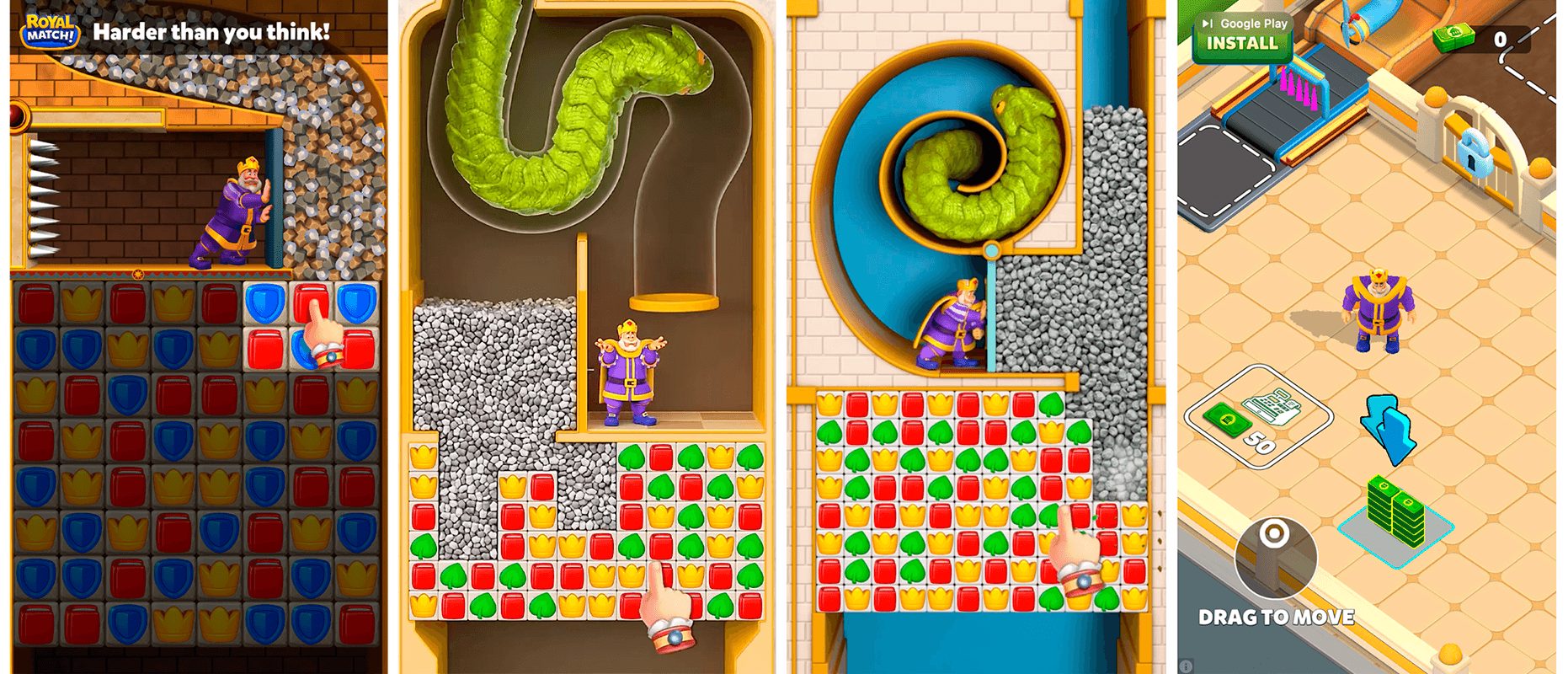
Royal Match is famously known for its “Save the King” concept, but they also use other formats and variants, e.g., tycoon playables when you control the king and sell donuts.
Ship only safe concepts—and you plateau and then decline as the patterns fatigue. Run only experiments—and you burn money chasing breakthroughs while your workhorses quietly stop performing. The right ratio depends on your spend level and risk tolerance, but you need both—running concurrently—all the time.
Speaking of experimentation. Plenty of teams lean hard on memes, pop culture, and viral formats. In practice, these tend to underperform: the hype is short, production and testing take time, and by the time you launch, the moment has usually already passed.
Where Good Ideas Actually Come From
1. Your Own Data and Previous Winners
The single most valuable source of ideas is your own performance data. Winning creatives are full of patterns: specific hooks, gameplay framing, emotional triggers, visual pacing. Pull those apart, recombine them into new variations, and you'll consistently beat going back to a blank page.
The teams that do this well share one habit—they hand their creative people data and freedom, not specs and instructions. When a strategist understands why a hook worked, they'll reinterpret it in ways a brief never could.
2. External Signals and Industry Research
The second source is everything working outside your own portfolio: competitor creatives, genre trends, cross-category patterns, etc. Not to copy, but to spot which structures are scaling and translate them into your product's context.
And this is exactly where market intelligence earns its keep. Instead of scrolling feeds and screenshotting ads by hand, you can see what's actually running and, more importantly, scaling.
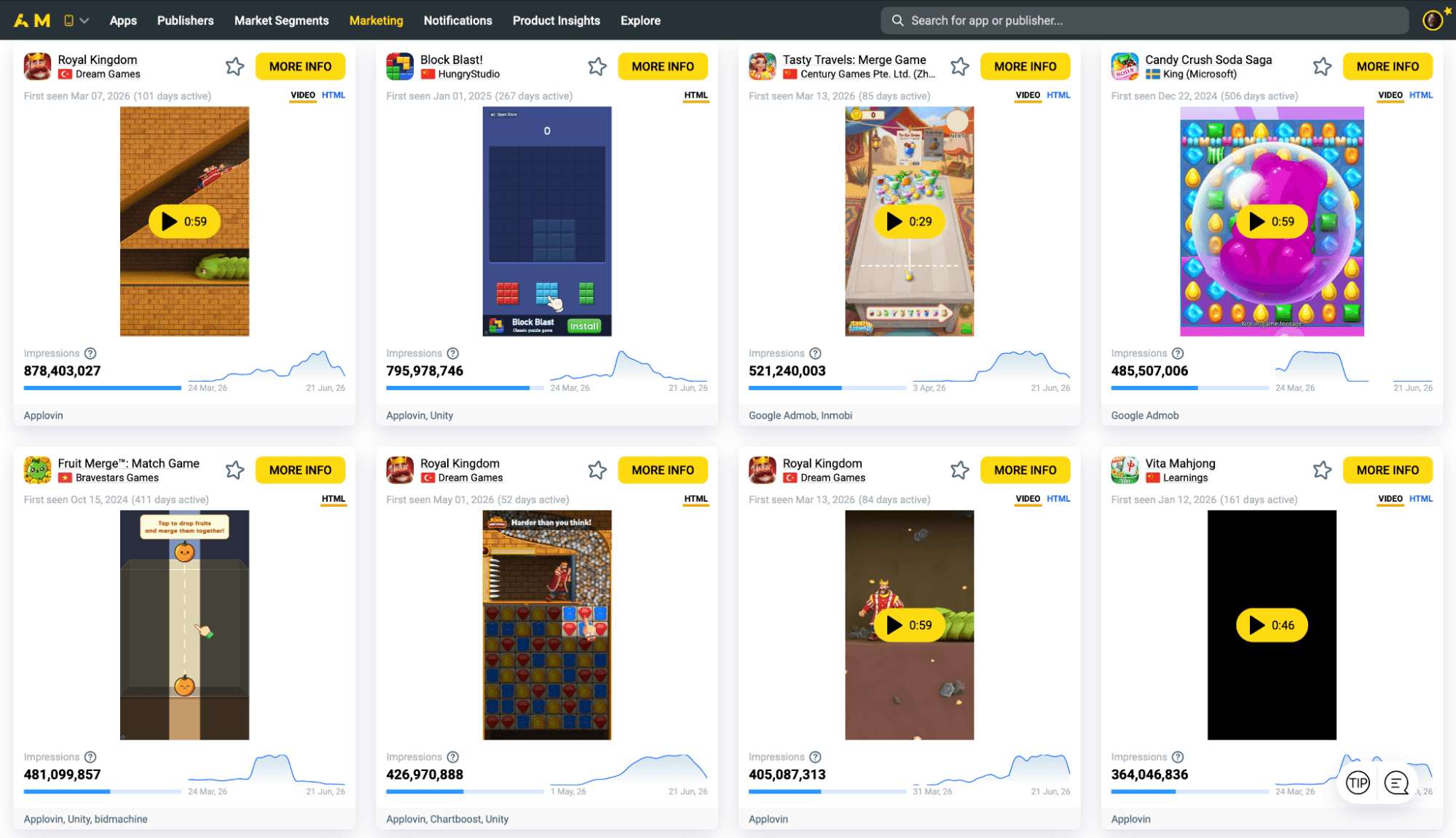
One of the easiest ways is to go to your competitor’s page and browse through all the creatives they’ve been running in the Ad Intelligence. Those with more impressions are clearly performing better, and concepts like these are definitely worth using or at least testing.
But what do you do when you have no idea where to start?
For a quick, basic analysis of competitors’ creatives, two steps in AppMagic are really all you need:
- Head to Top Apps for the genre you’re interested in. It’s also important to factor in whether it’s Casual, Midcore, or Hypercasual, and then look at the top performers by revenue. For your first basic analysis, pick the top 15 of 2026.
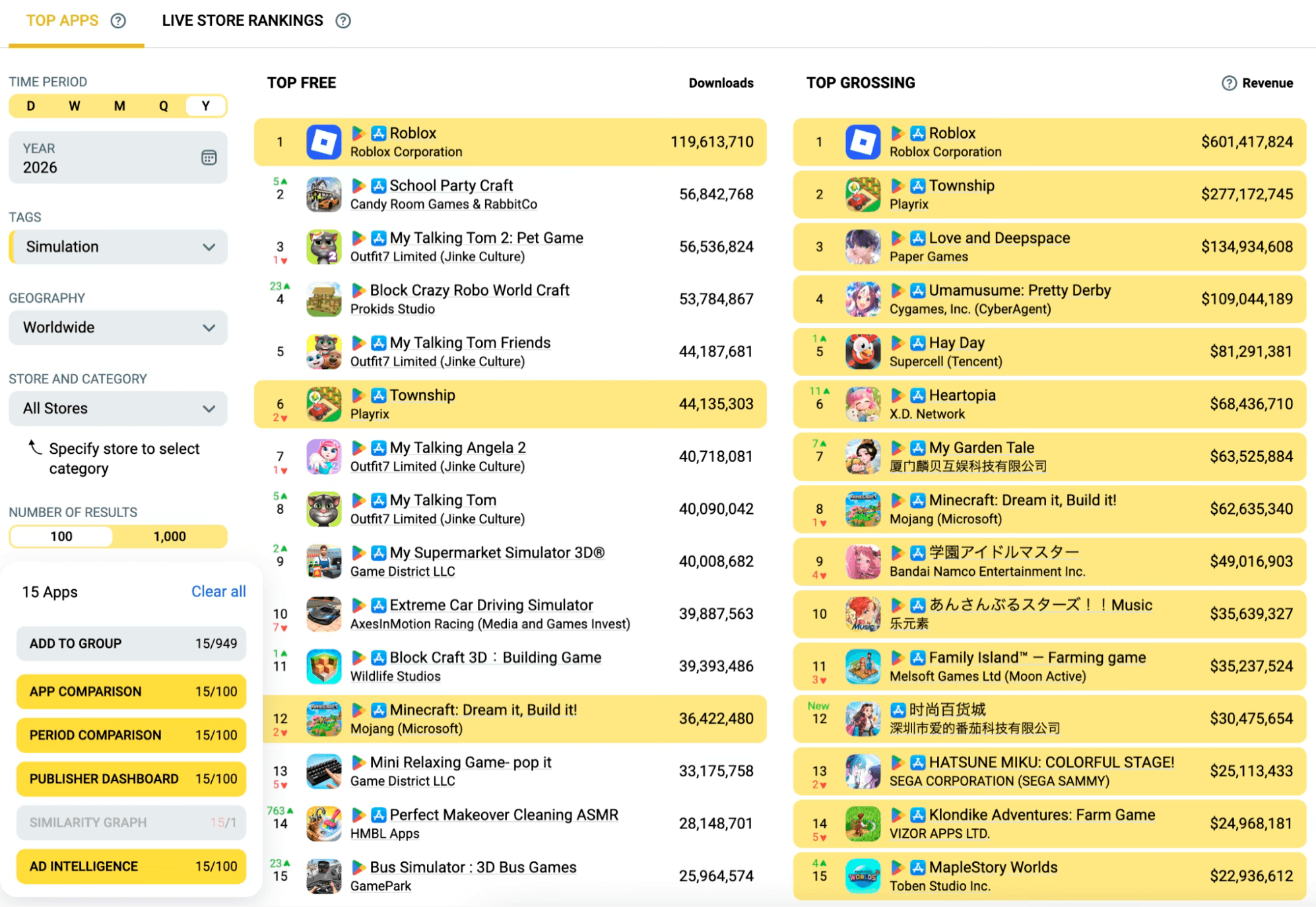
- Once you’ve picked your top 15, move over to Ad Intelligence.
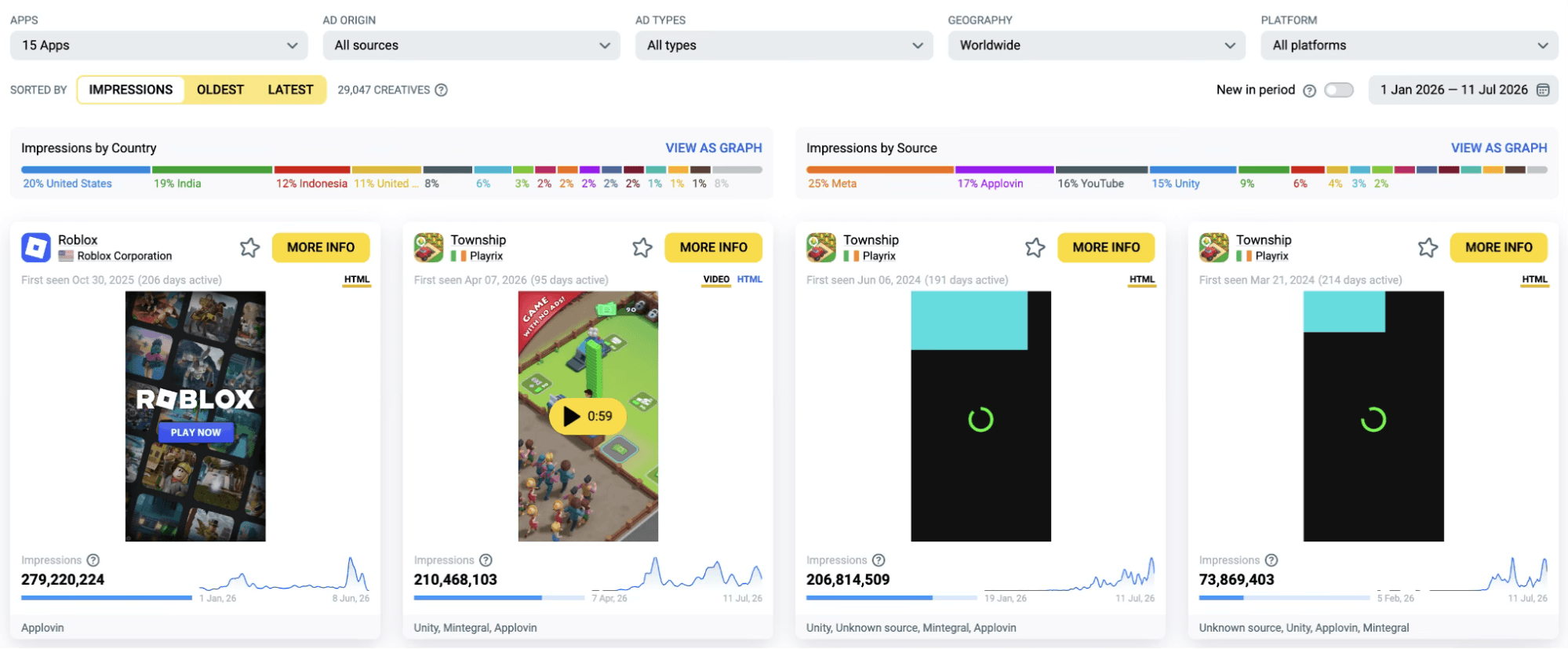
Ad Intelligence already gives you plenty of useful info to work with: the networks where creatives are most widely distributed, countries, and dates. Naturally, the most important metric for finding successful concepts is impressions. The more impressions, the more likely the creative or concept is popular and performing well. Keep in mind that more impressions doesn’t necessarily mean the most profitable creative, but these types of creatives are still definitely worth your attention.

It’s also important to keep in mind that the top creative by impressions might be somewhat outdated, even if it’s successful. Within Ad Intelligence, you can also filter whether a creative is new or not within a given time period. It’s important to look not only at older successful concepts, but also to keep an eye on new ones: both new variations of older concepts and completely fresh concepts.
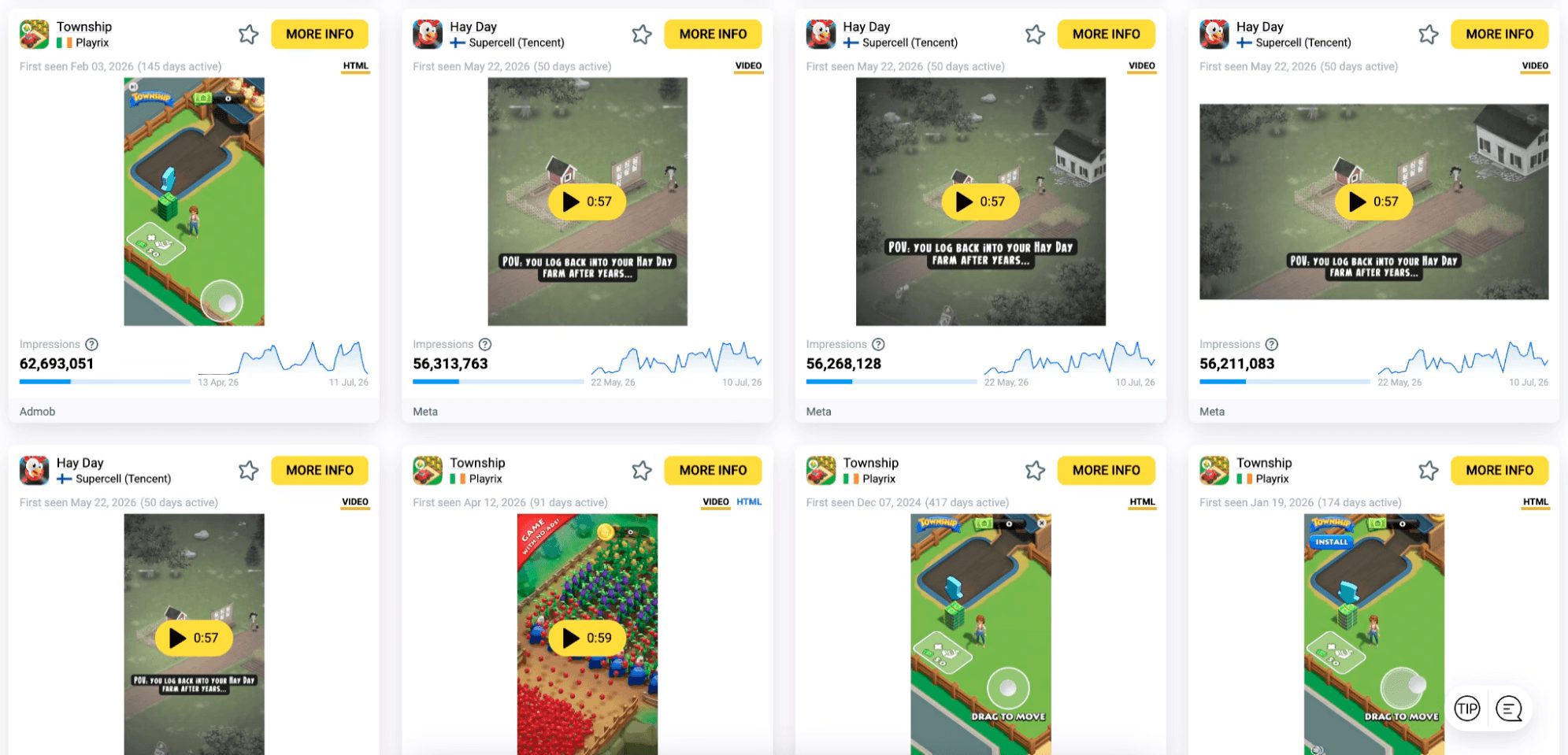
Ad Intelligence also helps you spot creatives that failed or burned out. If a competitor tests a concept in Tier 2 or Tier 3 markets and never runs it again, it likely didn’t perform well. Similarly, if a once-dominant mechanic gradually disappears despite previously generating high impression figures, the concept may have reached saturation and stopped delivering results.
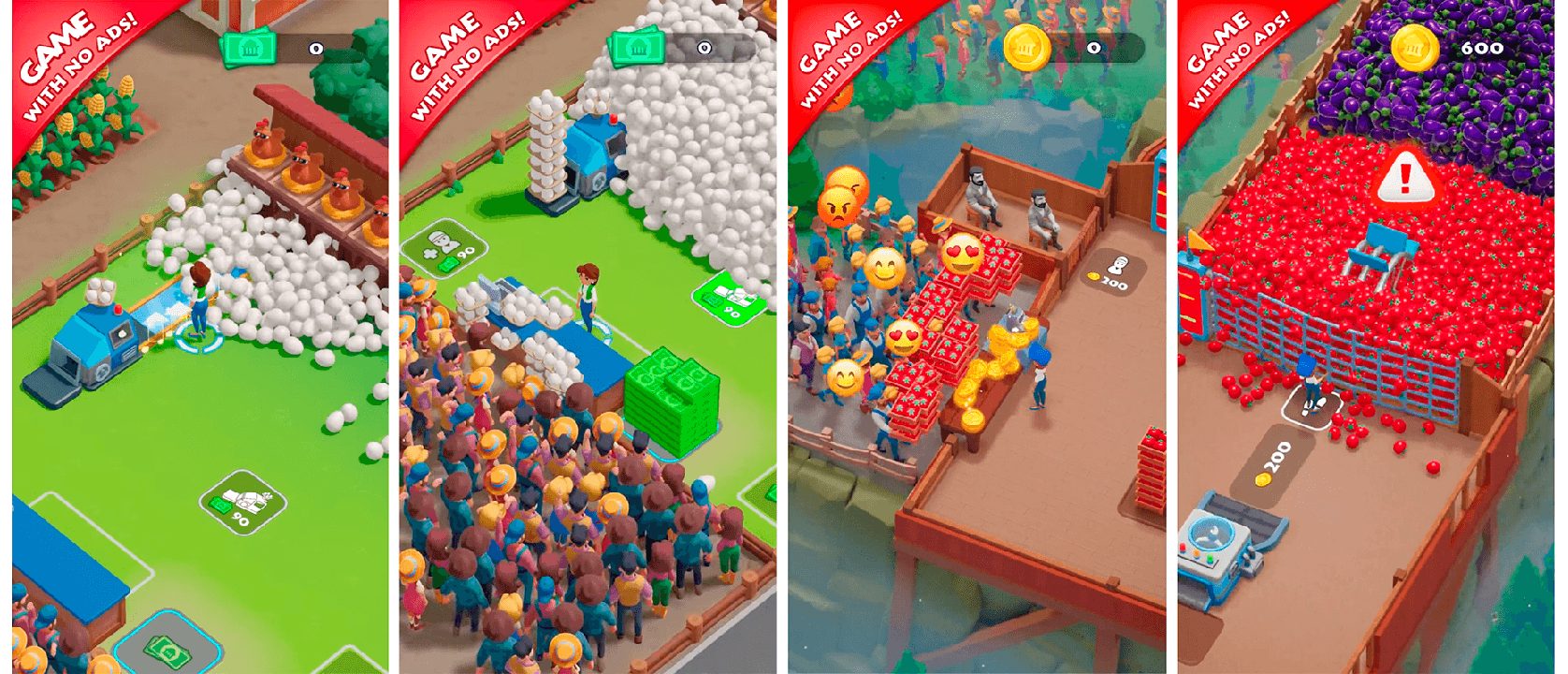
Examples of successful creative concepts: one of the most popular creative formats in Simulation right now is based on tycoon gameplay—simply think Township.
2. Testing: Speed Over Perfection
Now that you have researched and prepared a batch of safe and experimental concepts, it is time to test. But testing is not just buying traffic and waiting for the result (although, in a sense, it is): it’s a system of defined criteria, approach, and reiteration.
Define Success Before You Test
Before you launch anything, you need written-down success criteria. It sounds obvious, but in reality, it’s the single most-skipped step in the entire process!
Without it, every result turns into a debate. A creative pulls 80 installs at a CPI 15% above target: is that a winner, a kill, or a re-test? You can argue all three plausibly. Pre-committed criteria remove the argument before it starts.
The metrics that usually matter:
- IPM (installs per 1,000 impressions): your early signal, used for fast filtering. Kill or proceed within days.
- CPI (cost per install): efficiency.
- Purchase/conversion rate: quality, used for validation. Does the user this creative attracts actually convert?
Here's the catch with volume-only kill criteria: some creatives lose on IPM but bring in meaningfully higher-value users. Fewer installs, but they convert better and retain longer. If you kill on volume alone, you'll throw these out in week one and never learn what they would have done at scale.
To illustrate the point with a few examples:
Simulation Game Example (for privacy reasons, we’re not sharing the game title)
For this game, we have prepared 4 different concepts. While the first one delivered the most installs, the concept called “Nostalgic” has the strongest CPI and IPM across all 4, making it a perfect candidate for iteration, despite not being the best one volume-wise.
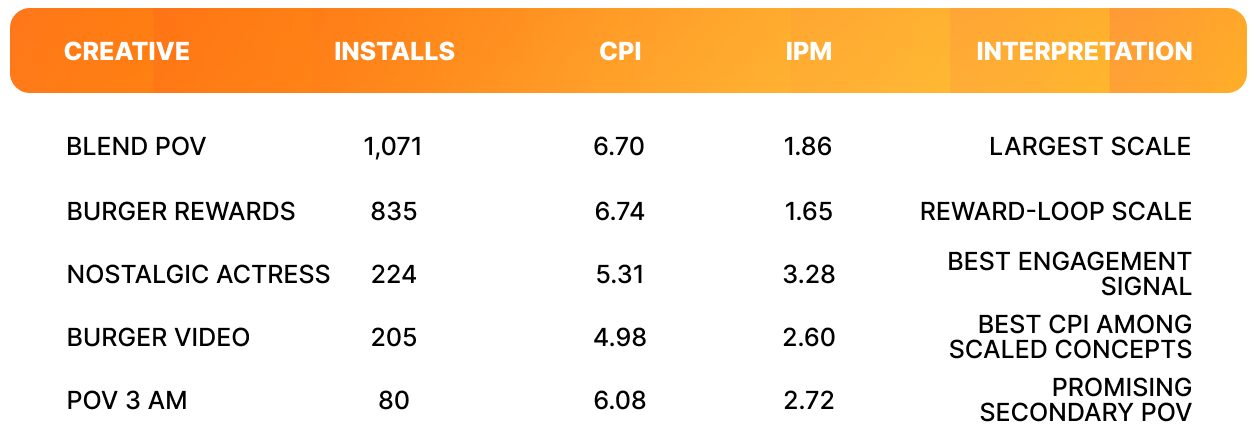
This is where second-tier winners matter. The biggest spend winner is not always the only creative worth iterating. A smaller concept with stronger IPM or CPI can become the next iteration path once the main scaling angle starts to fatigue.
Interactive Story Game Example
In this test, GameBiz produced creatives in different formats: static and video. While both static images under the “SerenadeByTheSea” codename generated a good number of installs, the CPI and IPM were strongest for the video.
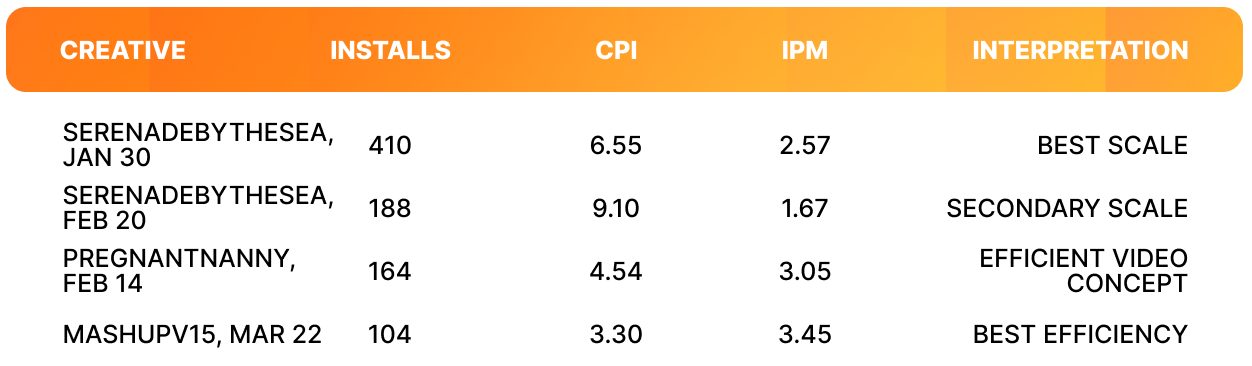
The takeaway is not that one format always beats the other. The better read is that images can explore story hooks quickly, while videos can become stronger once the hook needs emotional buildup, pacing, and a clearer interactive narrative.
A Practical Testing Loop
A scalable testing process tends to look like this:
- Test 3–5 new creatives per batch
- Run on a weekly cadence
- Always compare against a control creative (one that was running for a long period as a best performer)
That last point isn't optional. Without a control, you're measuring against a moving baseline of platform conditions, seasonality, and audience saturation—and you'll over- and under-credit creatives at random.
The testing environment must also match your live campaigns. If you test on install optimization but scale on value optimization, the results can be misleading: each setup speaks to a different type of user, so a creative that wins in one may fall apart in the other.
The principle is simple: use the same optimization and campaign conditions in testing and at scale. That makes your results more reliable and your winners more likely to hold up as your spend increases.
Why Speed Wins
Different platforms test differently. Meta is fast and cheap; others (Google, for one) need more data and more time. But for testing, the priority is learning speed, not perfect accuracy. A 90%-confidence read in three days beats a 99%-confidence read in three weeks—because by week three, you've already lost the iteration cycle.
A small but telling data point: a team that needed 100 installs to call a winner two years ago can often do it at 50 today, simply because they've calibrated to their own data and variance over time. Lower thresholds mean faster decisions, lower testing cost, and higher iteration velocity.
And one structural shift worth factoring into where your marginal test dollar goes: Meta now accounts for over 69% of global social gaming impressions share, up from 54% the year before, while TikTok and YouTube have roughly halved over the same period. If you built your testing infrastructure around a more diversified social mix back in 2023, it's worth a fresh look.
Key Takeaway: Testing Isn't the Finish Line, It's Just the Start
A winner in testing is step one, not the destination. The full lifecycle:
- Test → identify the winner
- Launch in live campaigns
- Monitor performance over time
- Feed the learnings back into ideation
That last point is fundamental. It's the closed loop that makes the system compound. Treat testing as a finish line instead of a feeder, and you'll end up with a graveyard of validated winners that never made it to scaled spend—which is a strange and expensive place for a creative to die.