New Puzzle Order: The Rise of Sort, Block, and Screw
Together with Ahmetcan Demirel, we took a closer look at how Sort, Block, and Screw are reshaping the Puzzle market, what is driving their growth, and which of them could become the next major force in the genre.
— Ahmetcan Demirel
For many years, the Puzzle genre was defined by three major flavors: Match-3, Merge-2, and Blast. And today, they still command attention that no recent subgenre comes close to matching. Match-3 and Merge alone account for roughly 75% of the Puzzle market in IAP revenue. Add Blast to the mix, and you are above 80%.
However, current numbers only tell half the story. Step back and look at the trend underneath, and a very different picture emerges. Of the old trio, Merge is the only subgenre actually growing its market share. Match-3 and Blast have been losing ground, and the old puzzle trio, as a whole, has been in steady decline over the past three years.
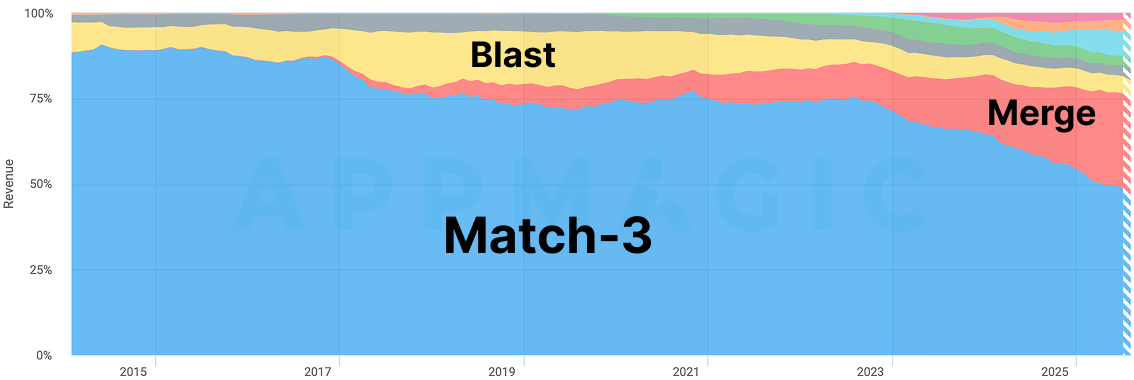 Match-3, Merge, and Blast combined have dropped from 95% to 80% of the market’s total Puzzle IAP revenue in a decade despite Merge's incredible growth. Source.
The download picture is even starker. Match-3, Merge, and Blast together accounted for over 75% of Puzzle install volume a decade ago. Today, that number has dropped below 25%. The old trio is not just losing its revenue share. It is losing its very audience.
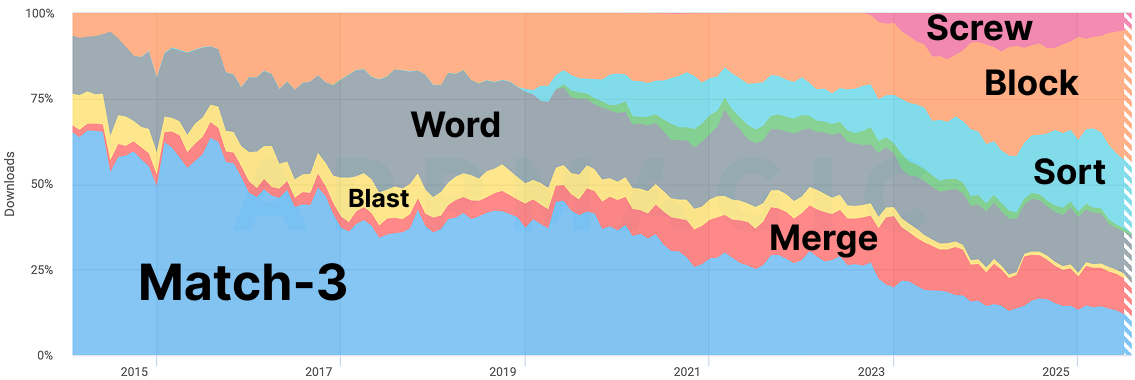 Losing install share to new subgenres is expected, but getting cut by more than two-thirds is not something you shrug off easily. Source.
The subgenres snatching that share are not the ones most of us would have predicted a few years ago. There is no new mega challenger riding a gloriously fresh mechanic to the top of the charts. Instead, the market share is flowing toward Hybridcasual Puzzles: Sort, Block, and Screw.
And this shift is exactly what this article is all about: what has actually been happening in Puzzles over the last few years, why it is the case, and what the trajectory looks like from here.
Sort Puzzle
Sort has been the darling of the Hybridcasual Puzzle space for the last few years. That said, it was not always obvious it would get here. Compared to most subgenres in this article, Sort was a relatively small market segment for a rather long time. Then, at the beginning of 2026, Pixel Flow's arrival pushed Sort above Blast to become the third-largest Puzzle subgenre by IAP revenue. And if you factor in ad monetization, which most Sort games rely on heavily, Sort had actually crossed that threshold much earlier.
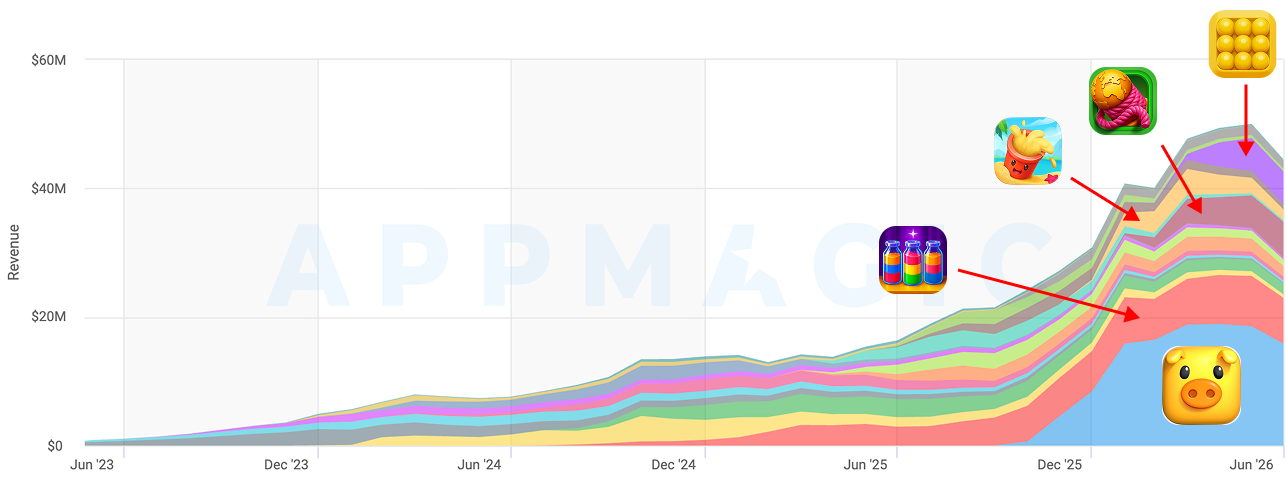 Everybody thought 2025 was a great year for Sort Puzzles, but they were just getting started… Source.
Sort Puzzles spent years as a one-trick pony built almost entirely around Water Sort games. Move colored water or balls between containers, group by color, repeat. The production values were bare-bones, the business model was ad-heavy, and the ceiling was low. That changed in 2023 when Block Jam 3D proved Sort could support real IAP by combining a two-dimensional board with a limited dock borrowed from Match 3D. It turned a simple cleanup loop into a planning Puzzle with genuine tension.
Hexa Sort took it further with three compounding advantages: a hexagonal board that maximized adjacency without visual chaos, an auto-sort system that removed friction, and a spawn loop that turned a static genre into a dynamic, board-management experience. This combination made Hexa Sort the dominant Sort title of 2024.
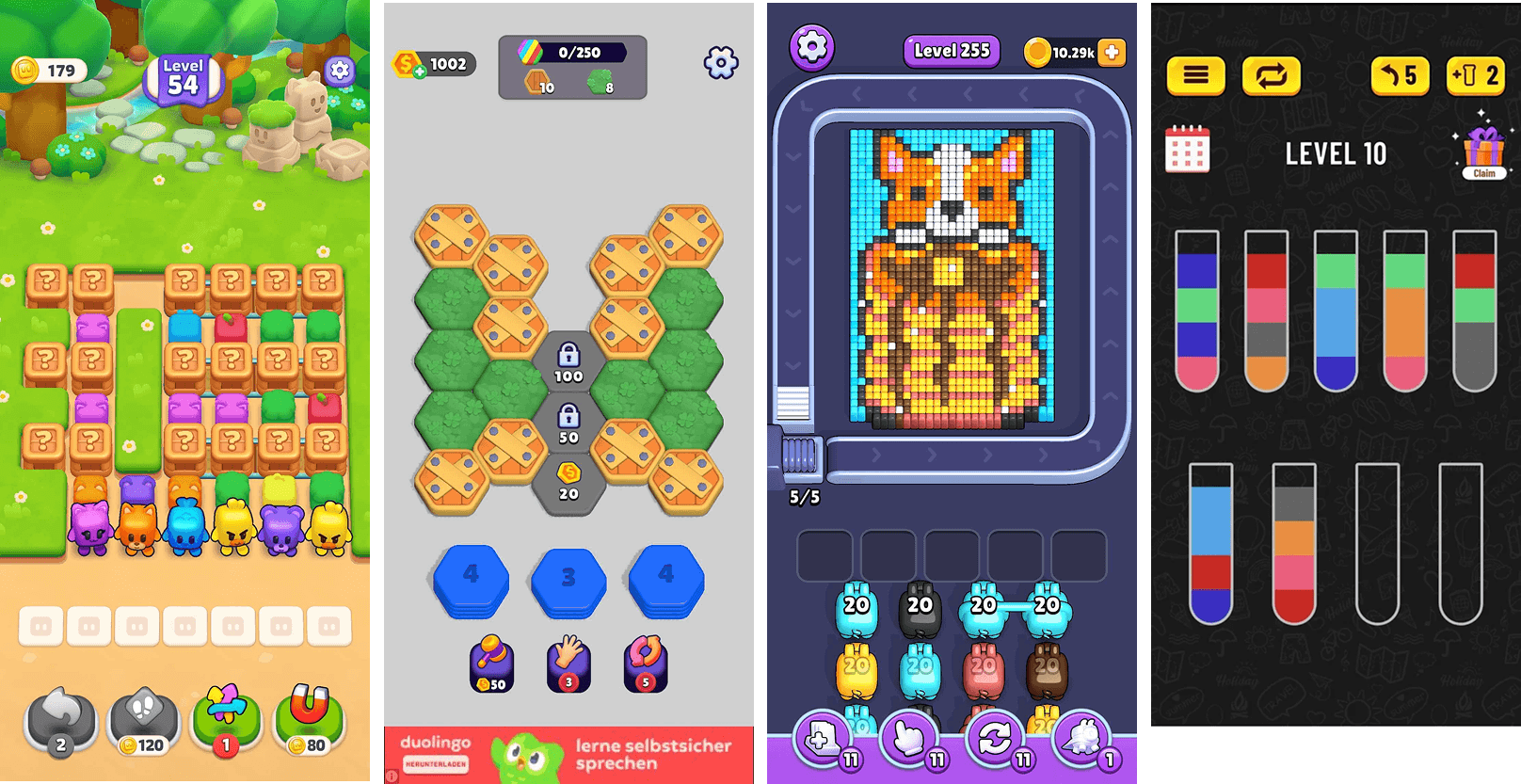 Block Jam 3D (left), Hexa Sort (middle left), and Pixel Flow (middle right), showing the evolution of the Sort subgenre.
Then came Magic Sort, which rewrote the expectations for what a Sort game could be commercially. It took a Water Sort core, wrapped it in a premium Casual Puzzle presentation, and ran it like a pure-IAP product. With its business model, it actually is a Casual Puzzle rather than a Hybridcasual one, and it proved the mechanic could scale in either direction.
Pixel Flow added another dimension entirely: a conveyor loop wrapped around a pixel artwork, with an auto-resolve system that keeps the board alive while the player focuses on blaster selection. Fast, visually distinct, and packed with UA creative potential.
What makes Sort different from almost every other subgenre discussed in this article is how much design space it still has. Each new Sort mechanic tends to create its own market opportunity rather than cannibalize the ones before it. Block Jam 3D, Hexa Sort, and Pixel Flow are not competing for the same players. They are each pulling from different parts of the audience. Compare that to Merge—the second-largest Puzzle subgenre—where the market is increasingly consolidated around a shrinking set of dominant titles. Given the choice, I would bet on the subgenre that keeps generating variety.
Block Puzzle
Among the subgenres covered in this piece, Block is the oldest. It has been around for more than a decade through numerous different games, which is not surprising given that its core mechanic is essentially Tetris adapted into a proper Hybridcasual Puzzle format. A mechanic that recognizable does not need to invent an audience. It already has one. When you look at IAP revenue performance, though, a very clear trend emerges.
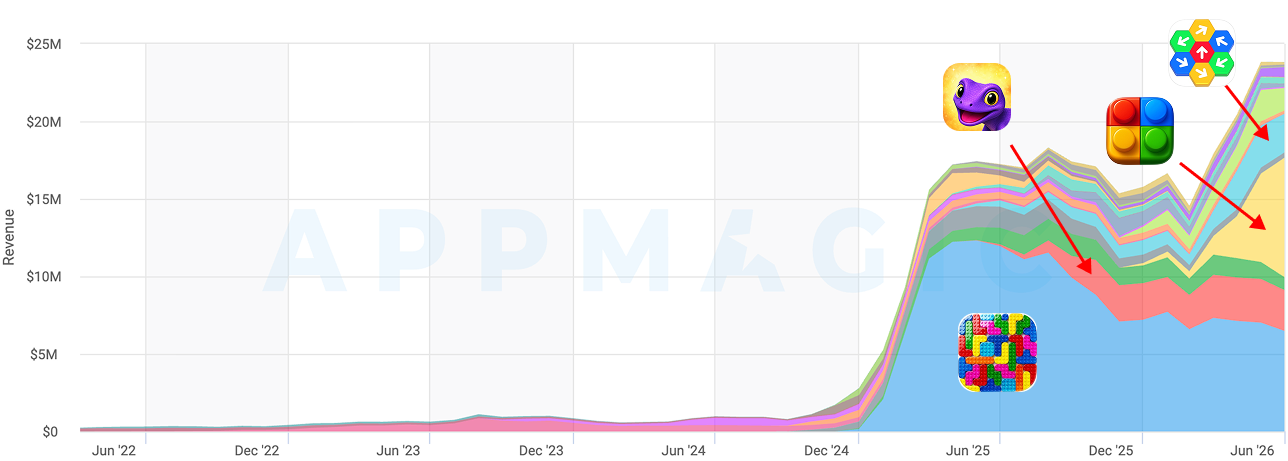 Block market turned from a pure Hypercasual subgenre to a proper Hybridcasual one almost overnight. Source.
Block’s origin is Tetris, and that lineage is the subgenre's biggest structural advantage. Games like Block Blast leaned into that familiarity hard, using Tetris-like visuals as a UA superpower: Instant comprehension, instant comfort, low barrier to install. Block Blast built the first-generation formula into a machine while running on pure ad monetization. No IAP. It proved that a clean level experience built on a genuinely satisfying placement loop could be financially serious on ads alone.
Then came Color Block Jam, which flipped the framing entirely. Instead of surviving as long as possible, players now solved a designed, static board with intentional constraints and obstacles. That shift created clearer pressure points and a far more natural foundation for IAP. The level is the Puzzle, not just a container for a high score run.
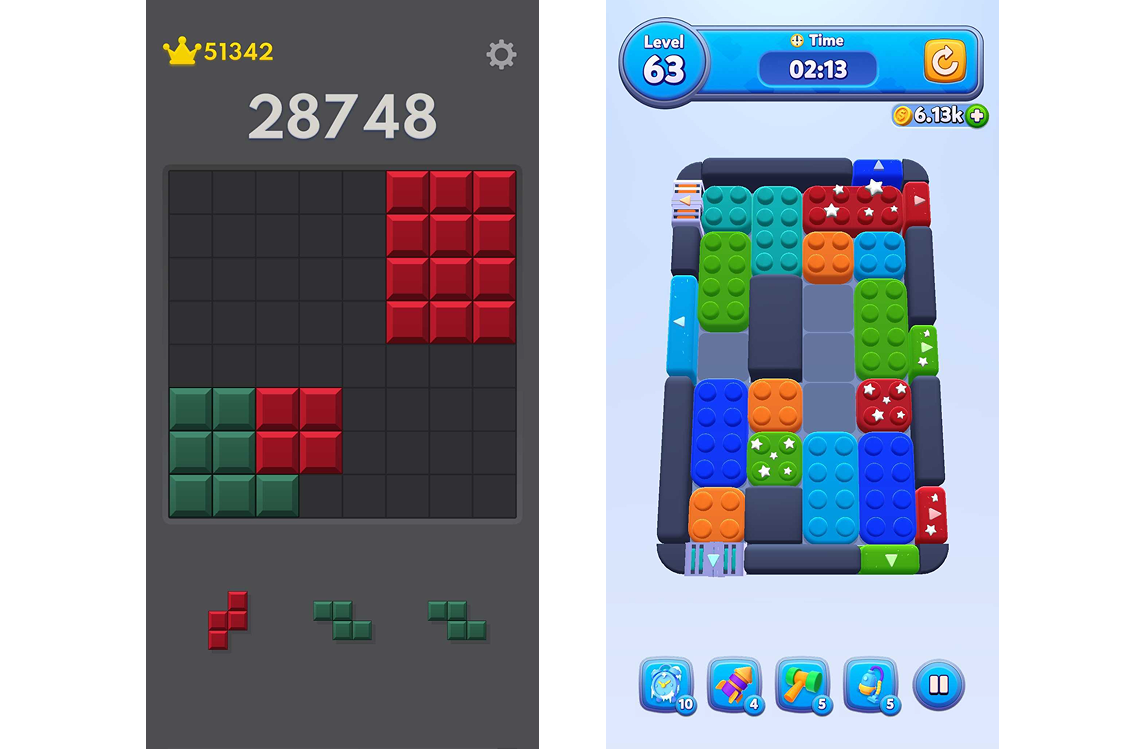 Block Blast (left) and Color Block Jam (right) have been the best examples of the Block space so far.
Block games that came after pushed further: games with distinct themes like Car Jam and Gecko Out wrapped the core Block Puzzle mechanic in their themes, combined with heavier integration of obstacles and boosters. Those titles trend toward higher revenue per download because they are designed from day one to convert purchase intent, not just collect installs.
The Block space will keep producing new variations, and some of them may actually rival Color Block Jam. But the more important and often overlooked fact about Block is its healthy mixture of IAP-heavy and IAA-heavy games running in parallel. That dual structure makes it genuinely difficult to assess Block's true market performance from IAP data alone, and it is precisely what makes the subgenre more valuable than it appears on paper.
Screw Puzzle
Contrary to Block, Screw is the youngest subgenre in this article. But what it has accomplished in roughly 2.5 years is hard to ignore. Like Sort, it has roots in Hypercasual Puzzles, which means the market still generates serious ad revenue alongside IAP. The subgenre's IAP story, however, is really a before-and-after Screwdom story.
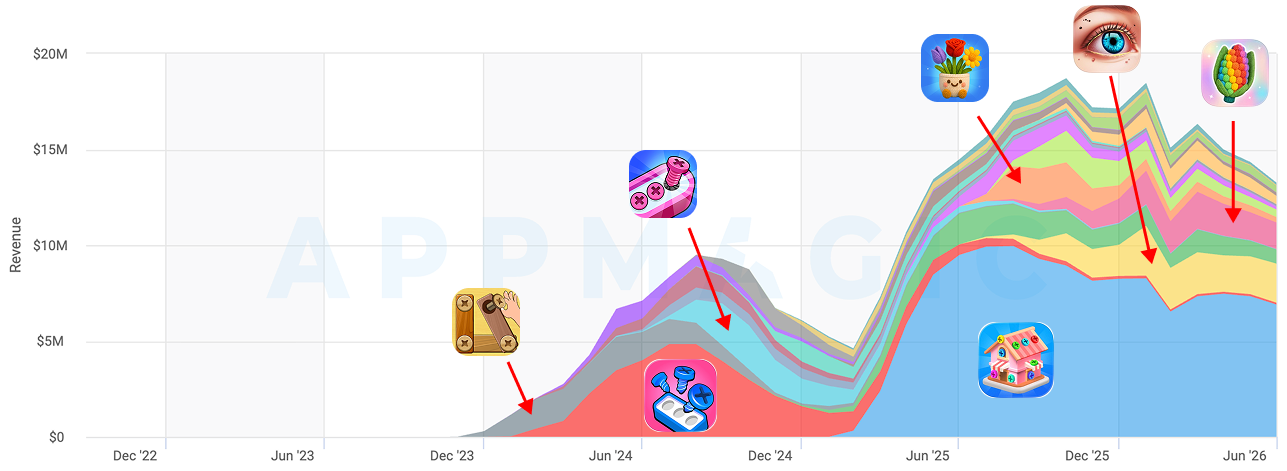 Just by looking at the IAP revenue chart for the Screw market, you can see when Screw Jam and Screwdom were released, in order. Source.
Screw started its true journey with Screw Jam, released at the end of 2023. The blueprint it laid out was clean: items stacked in layers behind translucent glass, a limited dock to stash spare screws, colored box targets that force deliberate sequencing, and a level structure where every constraint doubles as a purchase hook.
Screwdom took that blueprint and made it harder to read. The shift to 3D objects hid more than 80% of each level upfront, turning the experience from "plan and execute" into "discover through play." Players invest time, feel momentum, and then feel obliged to purchase the EGO (End Game Offer) when they fail.
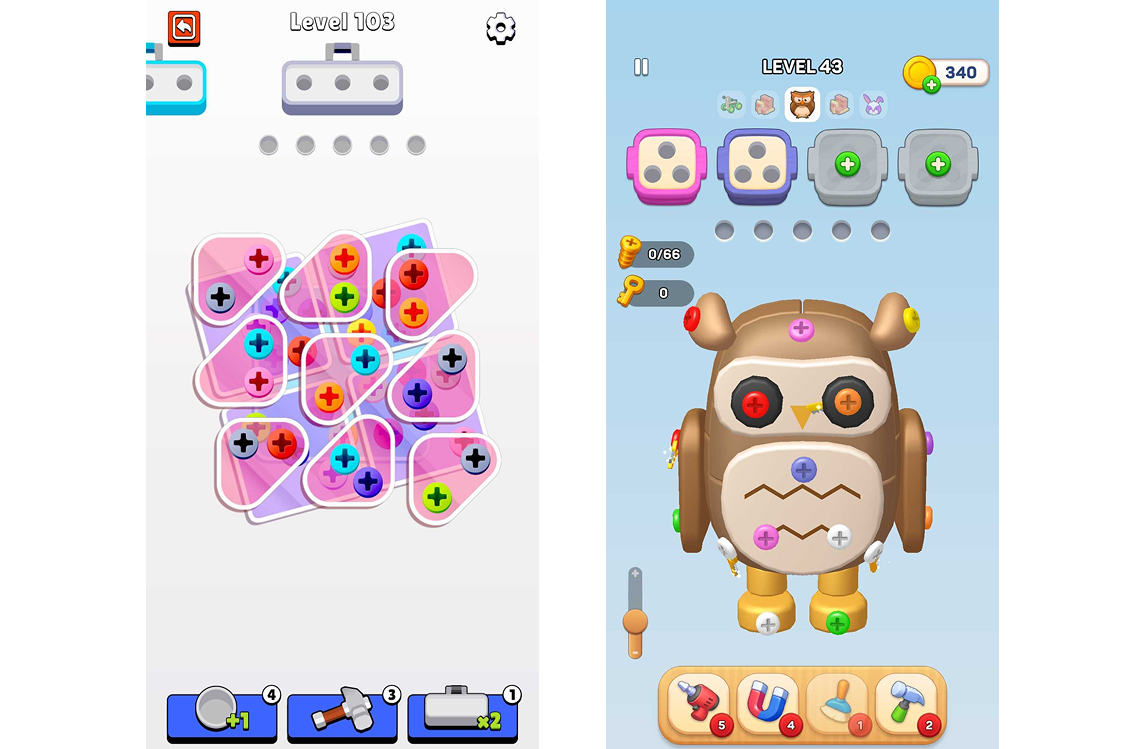 Screw Jam (left) and Screwdom (right) have been the only two meaningfully successful Screw puzzles so far.
Yarn reskins like Wool Craze followed, offering a more immersive unraveling fantasy. However, without meaningful gameplay or monetization innovation, they have stayed underwhelming relative to Screwdom and its stronger copies.
Since Screw is the youngest member of this fresh batch, it still gets the benefit of the doubt. That is not the same as saying it is thriving. Compared to its peers, Screw is not exactly pulling ahead. If the market keeps producing Screwdom reskins without genuine mechanical innovation, Screw could easily lose ground to other subgenres in a couple of years and settle into a niche.
But that outcome is not inevitable. The subgenre's static backbone and discovery tension are genuinely strong foundations. If a team finds a way to inject real dynamism into that structure without compromising readability (as Block Jam 3D did for Sort), Screw could become a serious competitor to Block. The design space is there. The question is whether anyone is willing to actually explore it.
The Way Forward
The Puzzle market is shifting, and it is not a temporary blip. This is no longer a space controlled by a handful of subgenres, and the new entrants are not losing momentum anytime soon. Match-3 and Merge will stay at the top for the foreseeable future, but their cushion over the rest of the market gets thinner every year.
The newcomers also carry an advantage that IAP charts alone cannot capture, which we already mentioned briefly. Most of them are Hybridcasual Puzzles, running on ad monetization in varying degrees alongside IAP. A strong IAP performance means a more sustainable game in the long term, but pairing it with healthy ad revenue goes a long way, especially for studios that must make more pragmatic decisions under tighter budgets.
A 50/50 split between IAP and IAA is not shocking for a successful Hybridcasual Puzzle. Even a 60/40 split in IAP's favor still means these games are considerably larger businesses than their IAP numbers suggest. What we see through IAP performance is quite literally half the story.
That is exactly what we should expect more of in the coming years. New mechanics will keep getting invented, and new games will keep optimizing them to perfection. The Sort market's hypergrowth happened in just a few years, and it is still in its early innings. Everything that lies ahead in the Puzzle market points to a shift in power and to new winners being born through more pragmatic, hybrid business models.
This article was written in collaboration with Ahmetcan Demirel, CPO at Rotatelab & Product Advisor to Puzzle Teams.