Casual Puzzles in 2026: The Past, The Present, and The Future
Together with Ahmetcan Demirel, we explored how the three main Puzzle genres—Match-3, Merge-2, and Blast—have evolved over time, and which ones ended up stagnating over the past three years.
— Ahmetcan Demirel

As a genre, Casual Puzzles have spent the better part of a decade sitting at or near the top of the mobile market in both revenue and downloads. That much is not a dispute: $8.7B in IAP Revenue and 7.3B in downloads in 2025 speak for themselves. What is worth examining is how that dominance was actually distributed. After all, for a long time, the Puzzle market was less of a broad category and more of a two-horse race with a few stragglers.
Match-3 was, and still is, the undisputed king. Candy Crush Saga built an empire on it. Royal Match redefined the very idea of a “ceiling” for Casual mobile games. These titles not only lead the Puzzle charts, but also compete for the top of the overall grossing rankings.
Merge, meanwhile, pulled off one of the cleaner genre evolutions in recent memory: the moment it went from Merge-3 to Merge-2, it unlocked a stickier loop and started eating into Match-3's share in a way few subgenres ever managed.
Then there is Blast, which, to say the least, has been the limping donkey of the Casual Puzzle space. Without its two best titles, it is basically irrelevant.
 Blast, as a subgenre, has been in steady decline for more than 3 years now…
Word and Hidden Objects round out the picture, though not in a flattering way. In 2025, they made $270M and $300M in total IAP revenue, respectively, showing a consistent decline year over year. Both have been fixtures of the category for years, yet neither ever built meaningful momentum. And whenever a new subgenre posted strong enough numbers to turn heads, those two were reliably the first to give up ground. That’s why we won’t even discuss them further today.
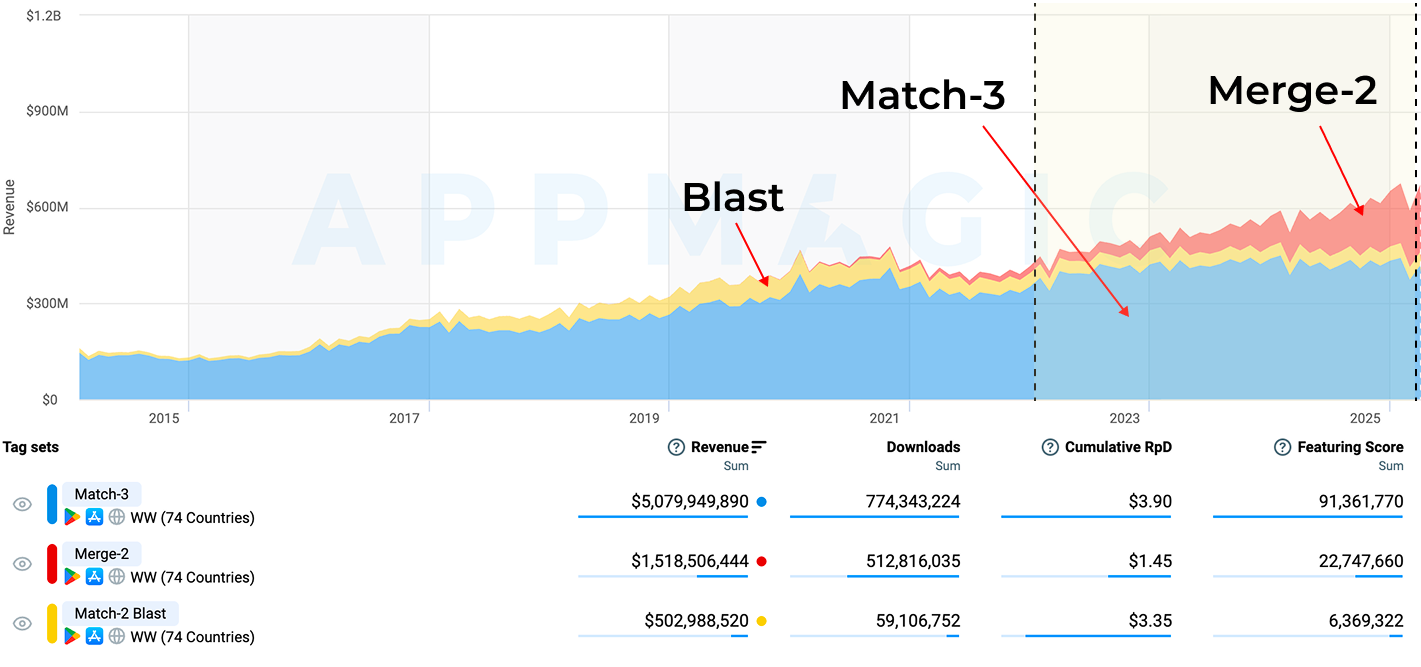 Recent years in Casual Puzzles: while Merge has been growing exponentially, Match-3 flatlined, and Blast just kept losing market share. Source.
For the last 3 years, the Puzzle market has continued to grow, but most of that growth has come from new subgenres. Some of the existing subgenres that once belonged to purely ad-driven Hypercasual publishers got picked up, reworked, and rebuilt around IAP-viable loops. Alongside them, entirely new subgenres were engineered from scratch to expand the addressable market rather than cannibalize it.
The Puzzle market is at an inflection point. While giants still dominate the highest-grossing genres, growth for smaller teams is increasingly coming from a cluster of smaller, faster-moving, more innovative subgenres that did not exist in their current form 3 years ago. Before turning to those, it is worth taking a hard look at where Match-3, Merge, and Blast actually stand today, as the story of what comes next starts with understanding what is losing ground—and why.
Match-3: The Pillar of Mobile Gaming
Before getting into the state of the market, Match-3 deserves a brief but important caveat: it almost does not belong in this conversation at all. It is not a Puzzle subgenre that happens to do well. It is one of the top-performing subgenres on mobile, full stop. As mentioned before, top Match-3 titles like Candy Crush Saga and Royal Match do not compete for a spot in the Puzzle charts. They compete for everything.
That said, even Match-3 does not stand in carefree isolation from what has been happening since 2023. The subgenre's IAP revenue has effectively flatlined, stabilizing at just under 5 billion dollars annually.
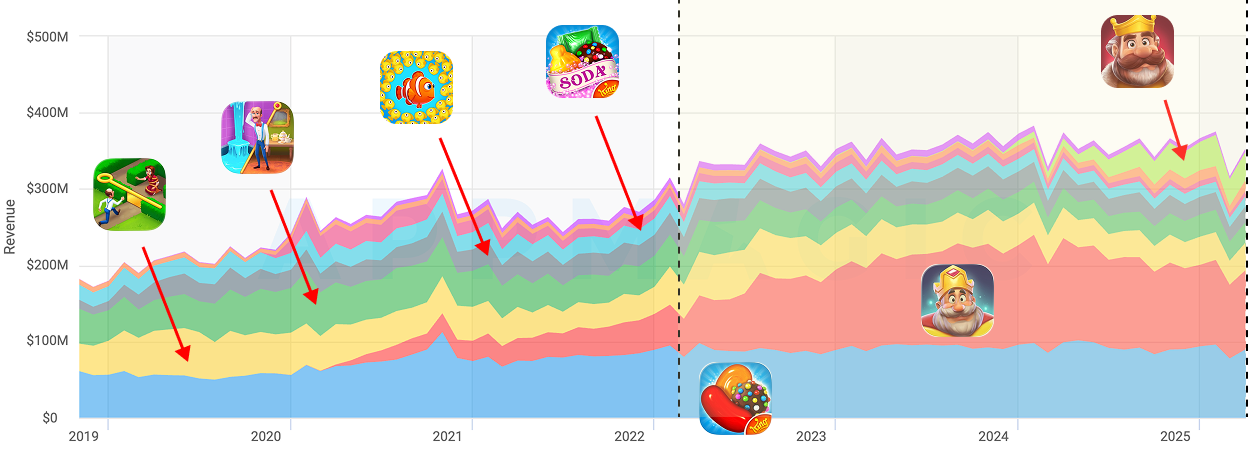 3 years later and Match-3 still hasn’t been able to grow in IAP revenue… Source.
That number looks respectable on its own. In context, it signals a market that has hit a ceiling and stopped climbing. And, similar to the other two subgenres we’ll discuss today, Match-3 carries essentially no meaningful ad revenue. That means what you see in IAP figures is what you get. There is no supplementary line to cushion the stagnation. Webshop and D2C revenue exists as an escape valve, but Casual Puzzle is one of the least likely genres to move the needle there in any meaningful way.
The downloads picture is harder to ignore. Monthly downloads contracted from roughly 90 million to around 70 million over the same period. A shrink of more than 20 percent at the top of the market.
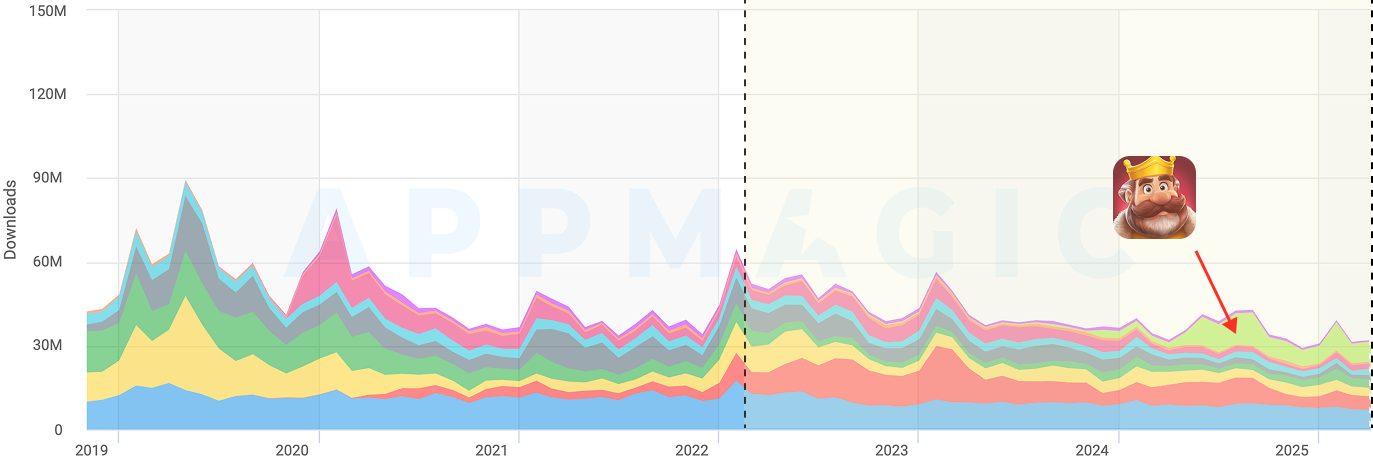 Even Royal Kingdom’s recent performance couldn’t save Match-3 from losing market share in downloads… Source.
None of this makes Match-3 irrelevant. It remains a massive business. But it is increasingly a business owned by a shrinking number of titles, most of them five years old or more, compounding their leads while the space around them thins out. As covered in an earlier piece, the math of building a new Match-3 right now does not work in a developer’s favor, and the market data is not doing anything to change that calculus…
Merge-2: The Ever-Growing Genre
Merge is an exception in this piece that does not fit the declining arc. It grew, and it grew substantially. What started as a niche corner of the Puzzle market, all clunky Merge-3 mechanics on 3-dimensional boards with limited mainstream appeal, became the second largest Puzzle subgenre by doing something counterintuitive: it got simpler.
The move to Merge-2 on a flat, grid-based board removed the friction and unlocked a far broader audience. And it happened to land right in the middle of pandemic lockdowns, which added fuel to its growth. Then the revenue followed.
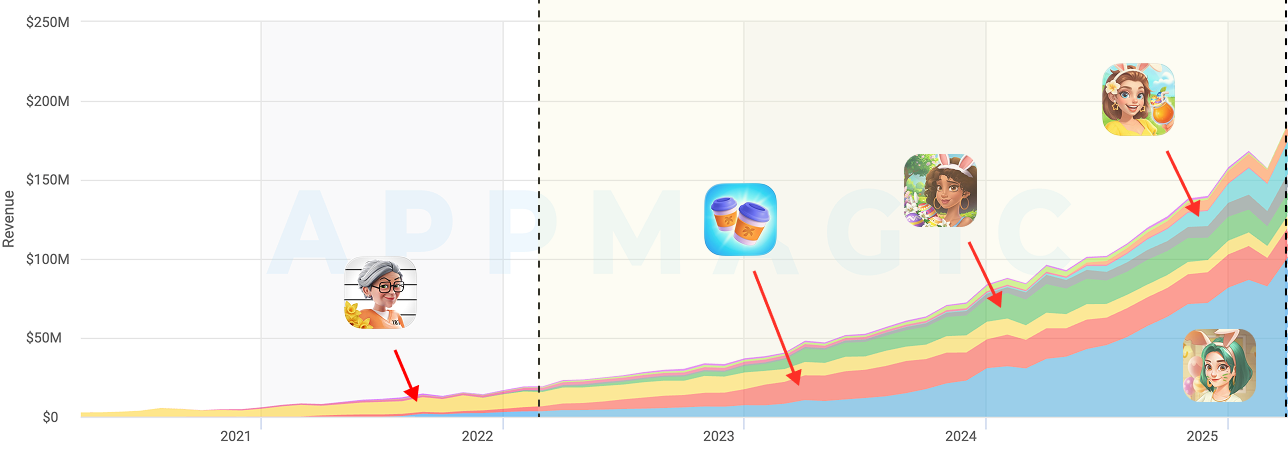 Merge was barely competing with Blast 3 years ago, but now it is nearing Match-3 territory in revenue. Source.
However, the way that growth played out afterward tells you more about the Merge market than the headline number does. Being the first turned out to mean very little. Merge Mansion, once the defining title of the subgenre, couldn’t really keep up with the hypergrowth of the Merge market. Performance dwindling, relevance fading. And Love & Pies had every ingredient to become another Gossip Harbor, yet it still could not get there. The first-mover advantage in Merge aged about as well as a pandemic-era sourdough starter…
The downloads story adds the other half of the picture.
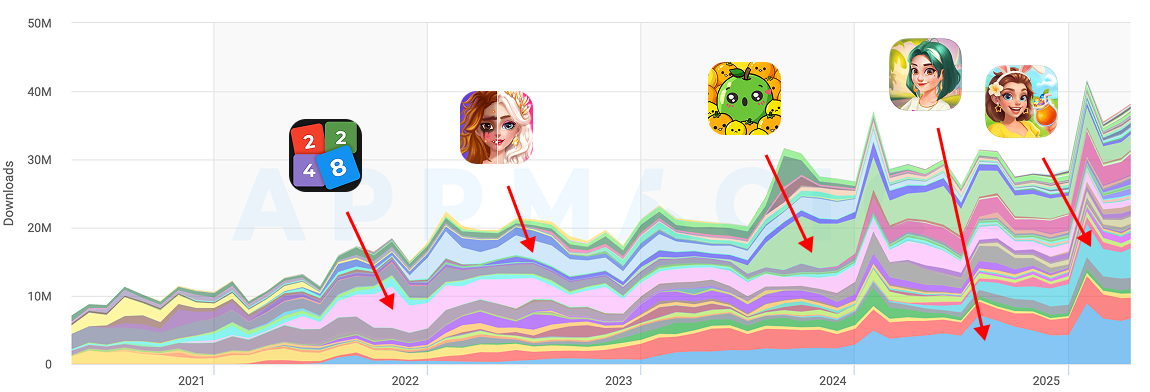 Based on how the downloads are performing, Merge might see a slower rate of revenue growth in the coming years. Source.
Merge used to function as a viable training ground. A smaller studio could build a Merge game, get it to market, turn a profit, and grow the team while the subgenre still had room for mid-tier players. That window now seems closed, and the flat install numbers make no effort to hide it. To have a Merge game that stands a chance today, you are looking at a significant production mountain to climb before launch… And then an uphill UA battle in a market that has gotten crowded fast. You can read more about this in the Casual Games Report 2025 from AppMagic.
It is no coincidence that most of the new Merge titles gaining any real traction come from teams that already have a successful Merge game in their portfolio. The subgenre is eating its own.
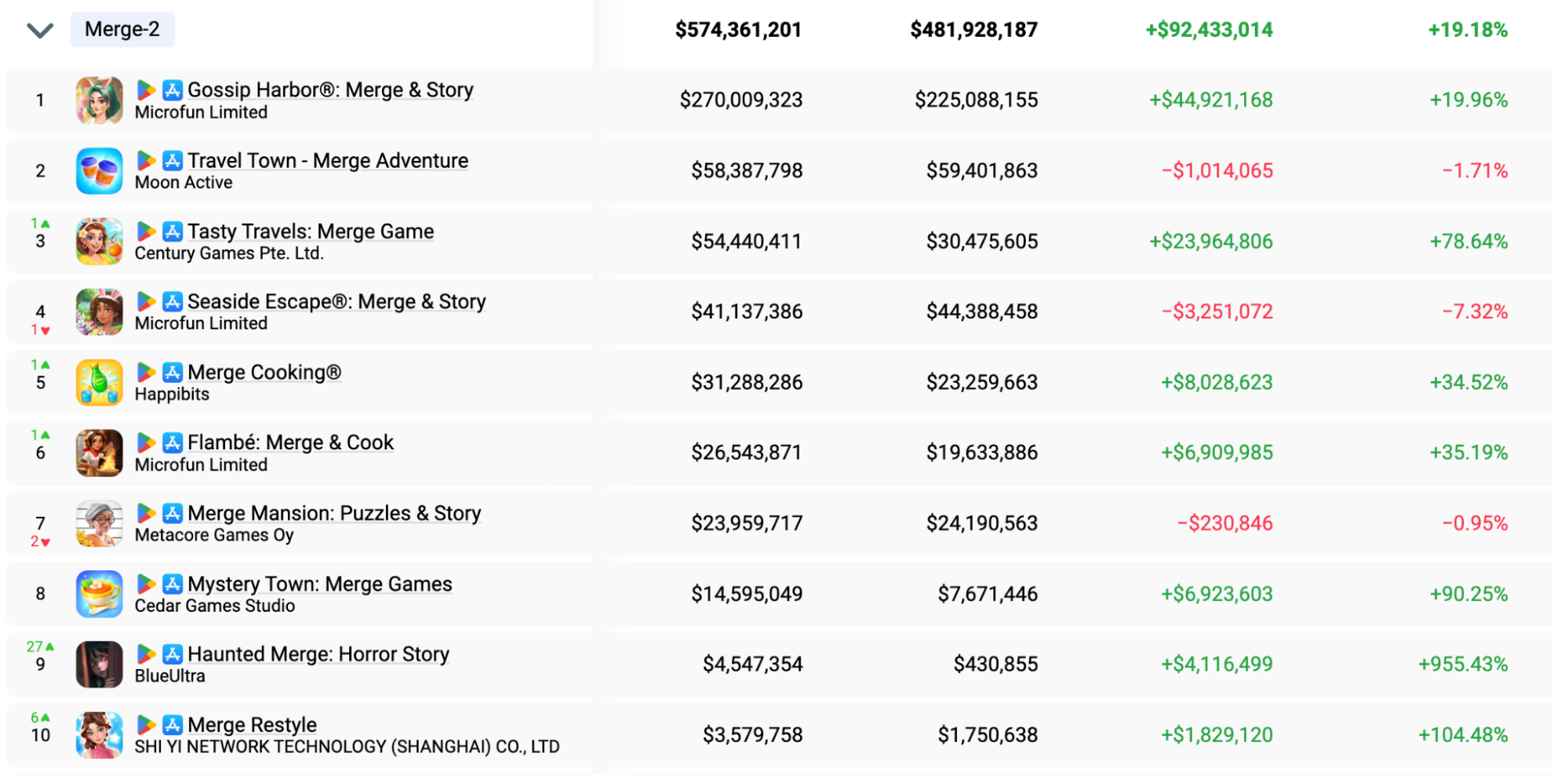 Merge-2 performance from AppMagic’s Period Comparison for Q1 2026 says it all. Source.
So if you are sitting on a plan to build a Merge game, stay far away from any video or podcast recorded at the height of COVID-19, promising you can ship one in eight weeks. You probably still can. The thing is, it simply will not matter.
Blast: In the Shadow of Puzzle Leaders
Then there is Blast, the last subgenre on the list, and the one that has fallen the furthest from where it once stood.
At its peak, Blast was the undisputed number two in Casual Puzzles, sitting behind Match-3. Peak Games led the space with Toy Blast and Toon Blast, anchoring the top grossing charts, and several other Blast titles held consistent positions below them. It was a healthy, competitive subgenre with real depth.
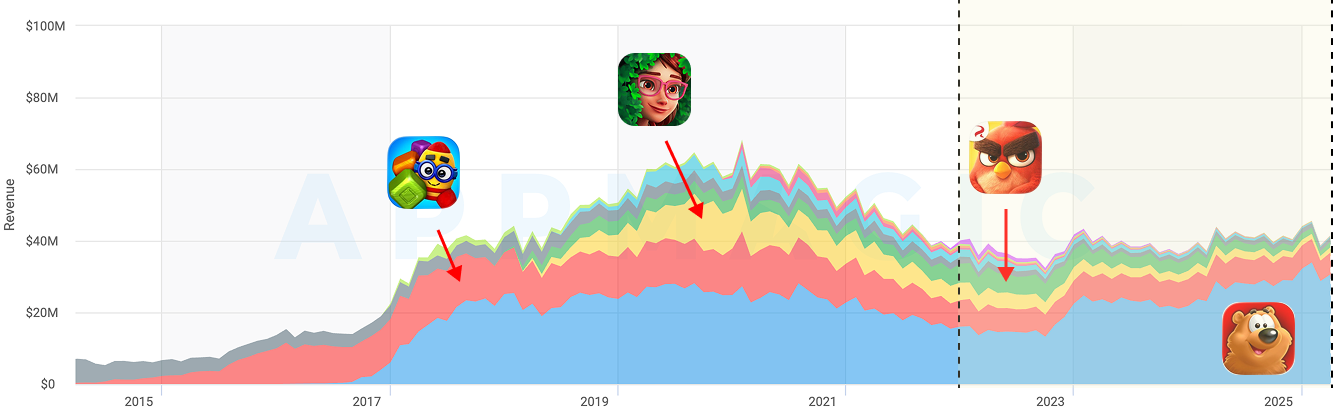 Blast revenue just stayed flat over the last 3 years despite its top performer, Toon Blast, doubling its run rate in the same period… Source.
That picture did not survive the post-2023 market intact. What happened since is effectively a one-title story: Toon Blast held on and even improved its performance. In fact, right now the game makes over $20M a month, which is an amazing result that competes against Merge-2 leaders.
However, everything else went the opposite way. Toy Blast, Toon Blast's predecessor, and the game that first proved Blast could work at mass scale, is nowhere near its pre-pandemic form. And it is by far the second most successful Blast title at the moment. The rest of the subgenre barely registers.
If you thought the revenue decline was bad enough, you might want to look away from the install chart…
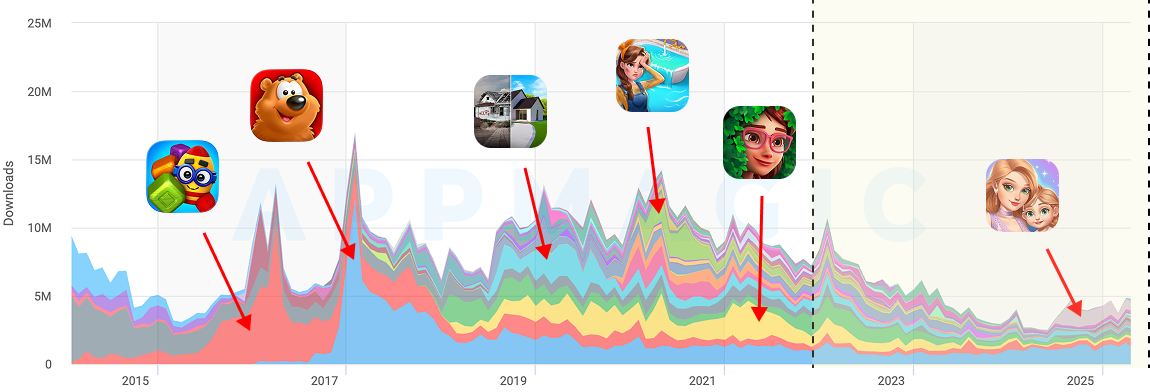 This is what a single title, almost a decade old, carrying an entire subgenre looks like. Source.
Blast took a steep nosedive around the start of 2023 and never came back up. This timing is not random. It coincides with the very window when Hybridcasual Puzzles started establishing themselves as a serious market force. And by 2026, the damage is visible in the rankings: Blast has ceded its third position in IAP revenue among Casual Puzzle subgenres to Sort, a subgenre that generates at least as much from ads as it does from IAP, and likely more. Losing ground to a subgenre built on a fundamentally different revenue model is not a great sign for where Blast goes from here.
Conclusion
The verdict across these three subgenres is not that uniform. Merge has been the clear winner in terms of growth over the last few years in the Casual Puzzle space. (If you need a second opinion, ask Gossip Harbor.) But even Merge is showing signs of the ceiling we have talked about. The subgenre is struggling to expand through new titles and new teams, with winner-takes-all dynamics consolidating performance faster than the market can produce credible challengers.
Match-3 is quietly shrinking its share within the Puzzle category. That should serve as a warning sign to everyone in the space, whether you are an existing title defending its position or a team still entertaining the idea of building one. That said, shipping a successful Match-3 game remains one of the hardest and most impressive things you can do in mobile gaming, with a revenue ceiling that almost nothing else in the category can match. Pixel Flow might have thoughts on that, but the point stands.
As for Blast, the kindest thing to do at this point is let it rest... Toon Blast and Toy Blast, particularly the former, will keep printing money for Take-Two's quietly lucrative mobile arm for years to come. But the subgenre as an opportunity is gone. More teams chasing it means more teams learning that lesson the hard way, and there is no shortage of better places to put that energy.
Where that energy is actually going is the subject of part two. The teams winning right now in Casual Puzzle are clever, small, and focused on a much wider spread of subgenres than this category has ever seen. And as we will get into, that part about being small is already starting to matter less than it used to.
This article was written in collaboration with Ahmetcan Demirel, CPO at Rotatelab & Product Advisor to Puzzle Teams.