Strava's Record Year Is Past $170M, and It's Not Just AI
Strava has been around for over 15 years, but 2026 is shaping up to be one of its biggest years yet. So what’s behind its latest growth? From run clubs and social sharing to subscriptions, acquisitions, and (yes!) AI, we take a closer look.
— Maria Bolshman
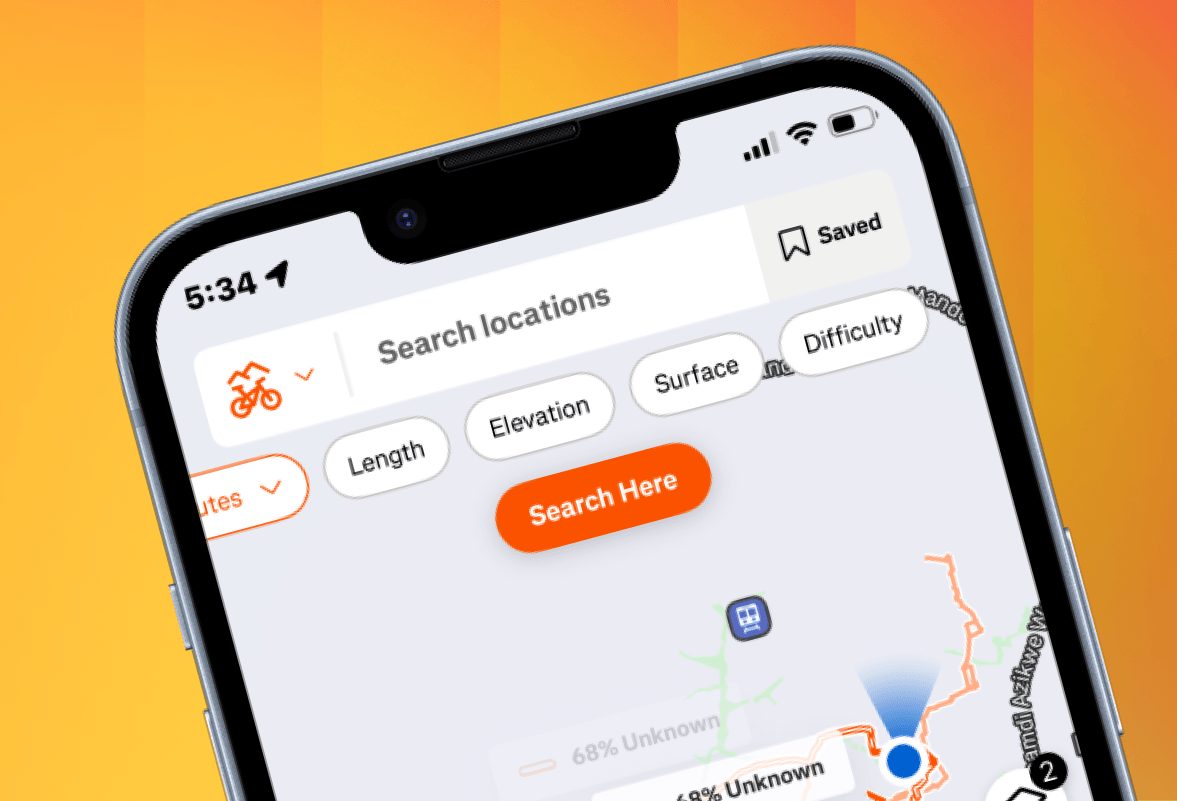
Strava is hardly new: the app has been around for more than 15 years. Still, if Strava seems to be everywhere lately, that's because it is, and social media deserves some credit. The past few years have brought a new wave of growth, and 2026 has pushed it even further. Even a quick look at its mobile performance backs that up.
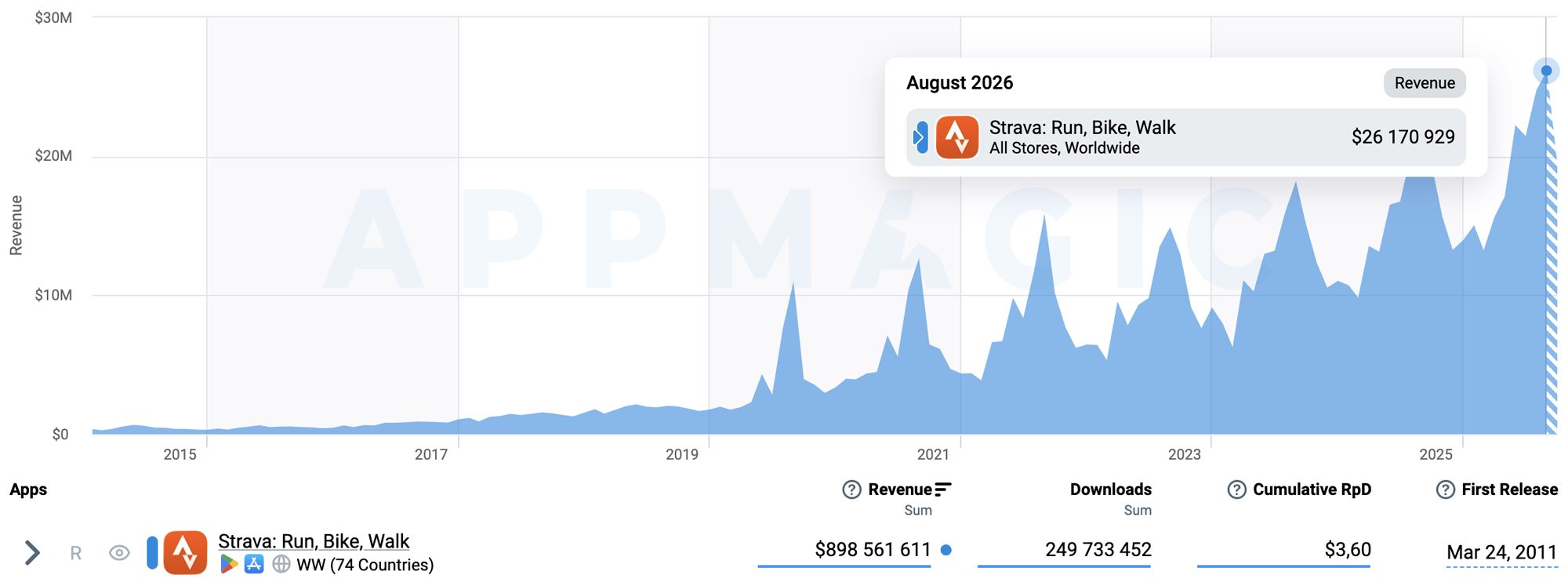
Strava's performance since 2015
Strava has generated more than $890M in mobile IAP revenue since 2015, hitting a record $26M in August 2026. And 2026 isn't over yet: the app has already picked up roughly as many downloads as it did in all of 2025, while its IAP revenue is closing in on last year's total with almost four months still to go.
The audience has grown fast, too: by June 2026, Strava had more than 200M users across 185+ countries. By August 2025, the business was already approaching $500M in annual recurring revenue.
Either way, those numbers are quite something. And here’s a spoiler: getting there had as much to do with community and the social side of fitness as with product decisions and monetization.
There's even an AI chapter in there, but we're getting ahead of ourselves. At this point, what app hasn't added some kind of AI feature, right? Whether AI is really behind Strava's latest success, though, remains to be seen…
When Tracking Became Social
Strava started with a very specific crowd: passionate road cyclists. Yes, cyclists. Yes, with all the running content everywhere these days… anyway, now you know!
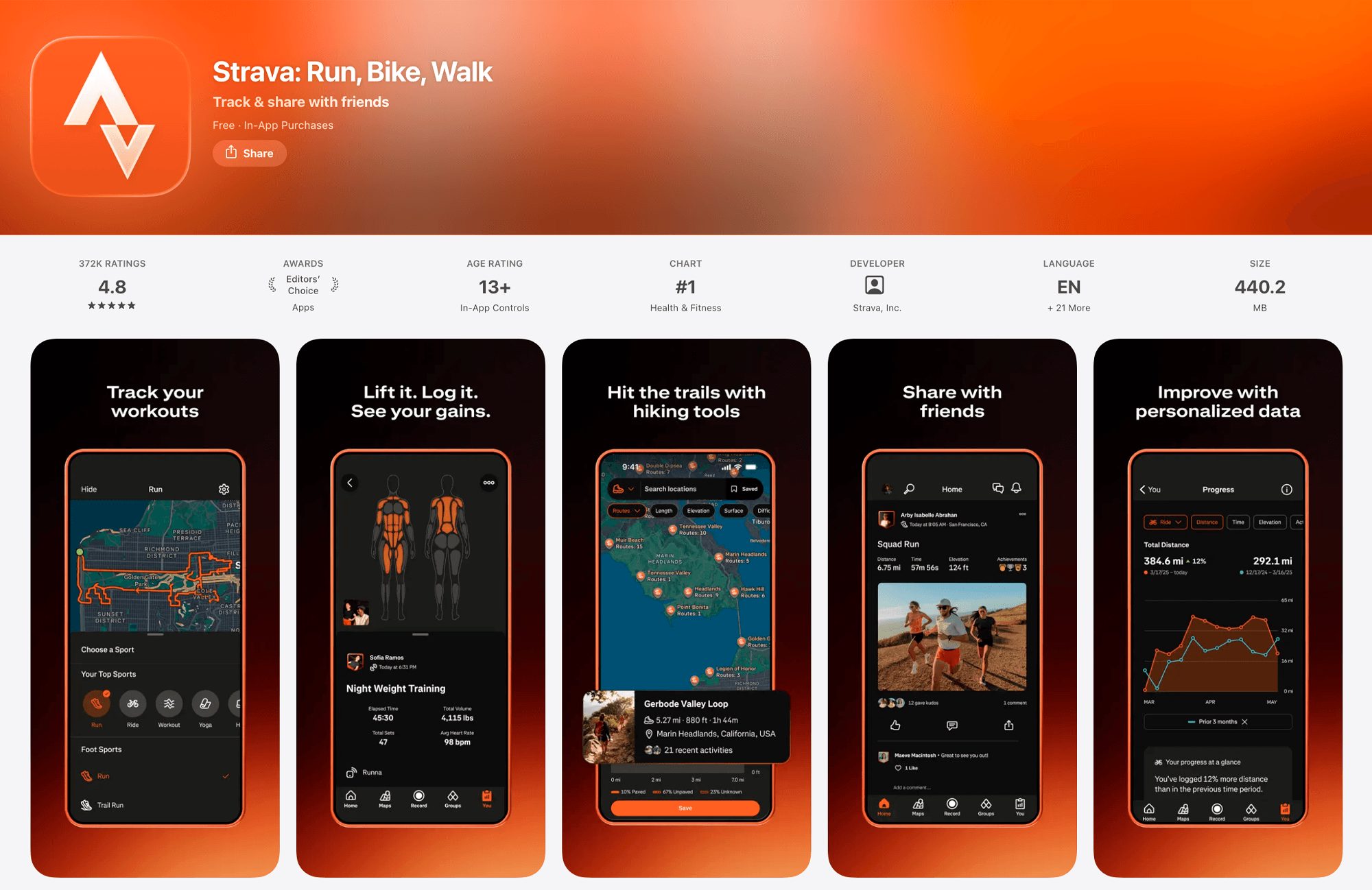
Strava on the App Store today
Co-founder Mark Gainey describes the early strategy as going “an inch wide and a mile deep.” So instead of chasing every athlete at once, Strava went deep on what cyclists already cared about. And cyclists, as it turns out, care about more than total miles: they want to know how they perform on specific stretches of road, especially climbs. Strava turned those stretches into Segments—basically, a way to track your time and compare it with everyone else's.
But naturally, people wanted to know even more, like “How did my friend do?” or “How do I compare with everyone else?” That urge to compare made Strava competitive and social, and leaderboards gave it somewhere to play out. It's a classic example of gamification, a trend we’re seeing more of across the app market—think Duolingo's XP and leagues or Reddit's streaks and achievement badges. In Strava's case, each leaderboard ranked cyclists by their Segment times, so there was always someone else’s result to check (or beat).
Except that the Strava team hadn’t actually planned to build a sports social network. As Gainey puts it, the product first had to work in “single-player mode” before the social side became part of the experience. Needless to say, Strava isn’t just a “single-player” cycling product anymore. If the run-club boom hasn’t made that obvious already, let’s take a look at the App Store data.
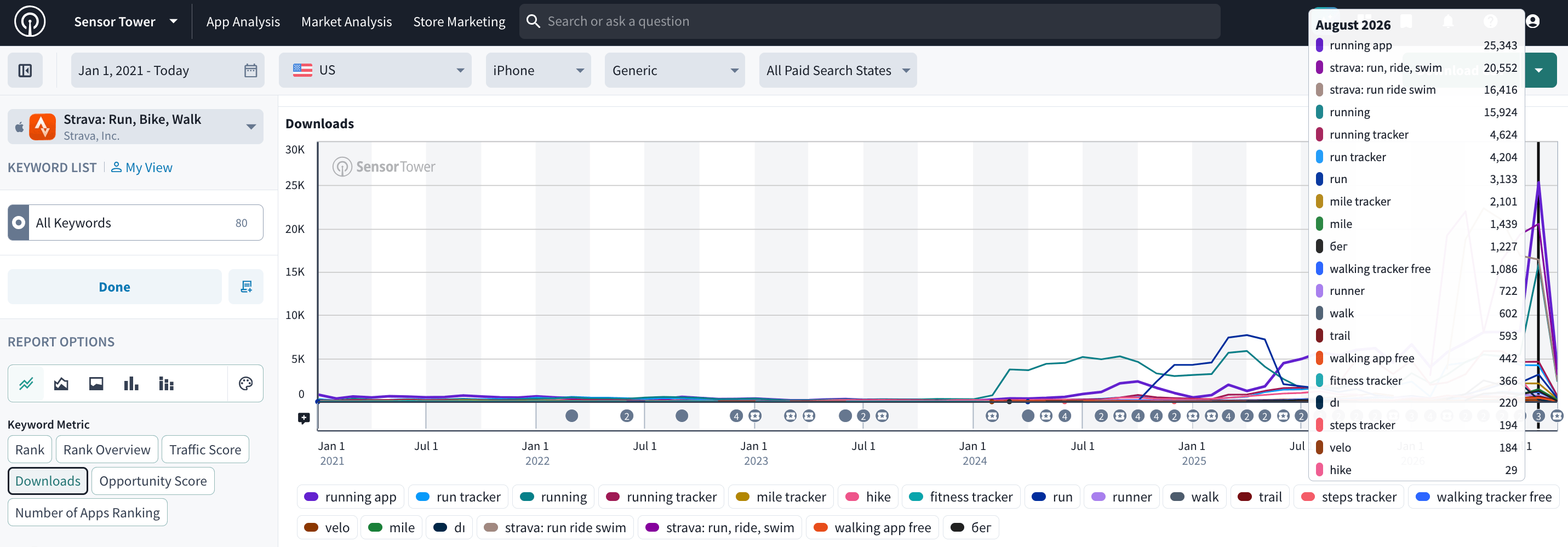
Strava's estimated US iPhone downloads by generic keywords, August 2026
We checked Strava's US App Store performance with our ASO Plus tool, and generic running searches are bringing in a meaningful number of estimated downloads. In August 2026 alone (also Strava's biggest month for mobile IAP revenue to date), the keyword “running app” accounted for an estimated 25.3K downloads, followed by nearly 16K from “running” and another 4.6K from “running tracker.”
And it's not just runners either! With more than 50 sports, from hiking to swimming, Strava covers a lot more ground now. Open the app today, and there's a feed, clubs, challenges, routes, comments, kudos, plus activities flowing in from a whole ecosystem of devices and apps. From a product perspective, this also means Strava doesn't need to own the workout from start to finish. An activity can be recorded somewhere else, analyzed somewhere else, and still make its way to Strava.
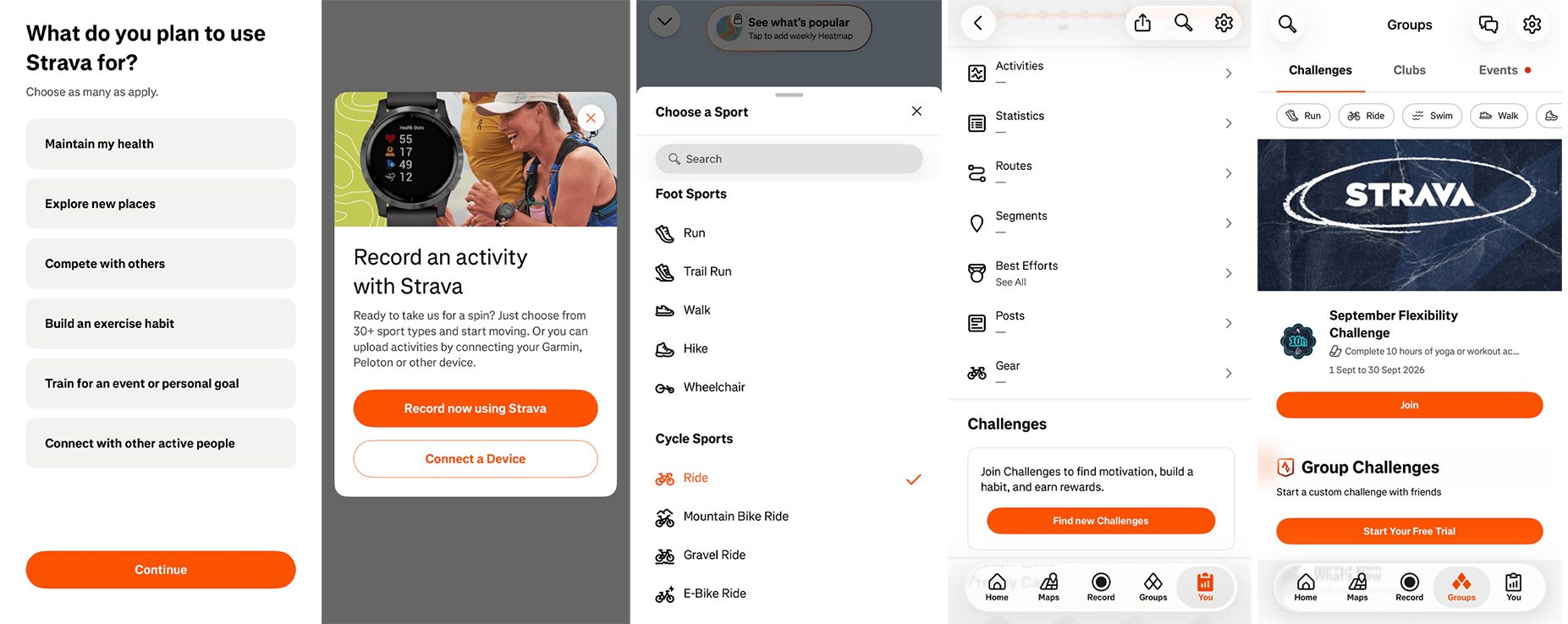
Inside the Strava app
But why bring it to Strava at all? For many users, the workout itself became the content to post. A morning run or weekend ride was now something friends could see, react to, compare with their own efforts, and talk about. Strava strove to become the social layer connecting a much larger fitness ecosystem, adding value to workouts recorded elsewhere. As more athletes joined, that network gave Strava a moat of its own because competitors can copy features, sure, but they can't take the community with them.
When Fitness Became Content
So Strava had the network, and that social layer gave it some serious staying power. Then, around 2024, the pace started picking up again. Strava later called the period one of “unprecedented growth,” with new user numbers jumping more than 50% YoY.
And 2025 was quite a year for Strava, too! The app generated more than $184.4M in IAP revenue and picked up 47.8M downloads, ranking #1 by revenue and #2 by downloads among Health & Fitness apps.
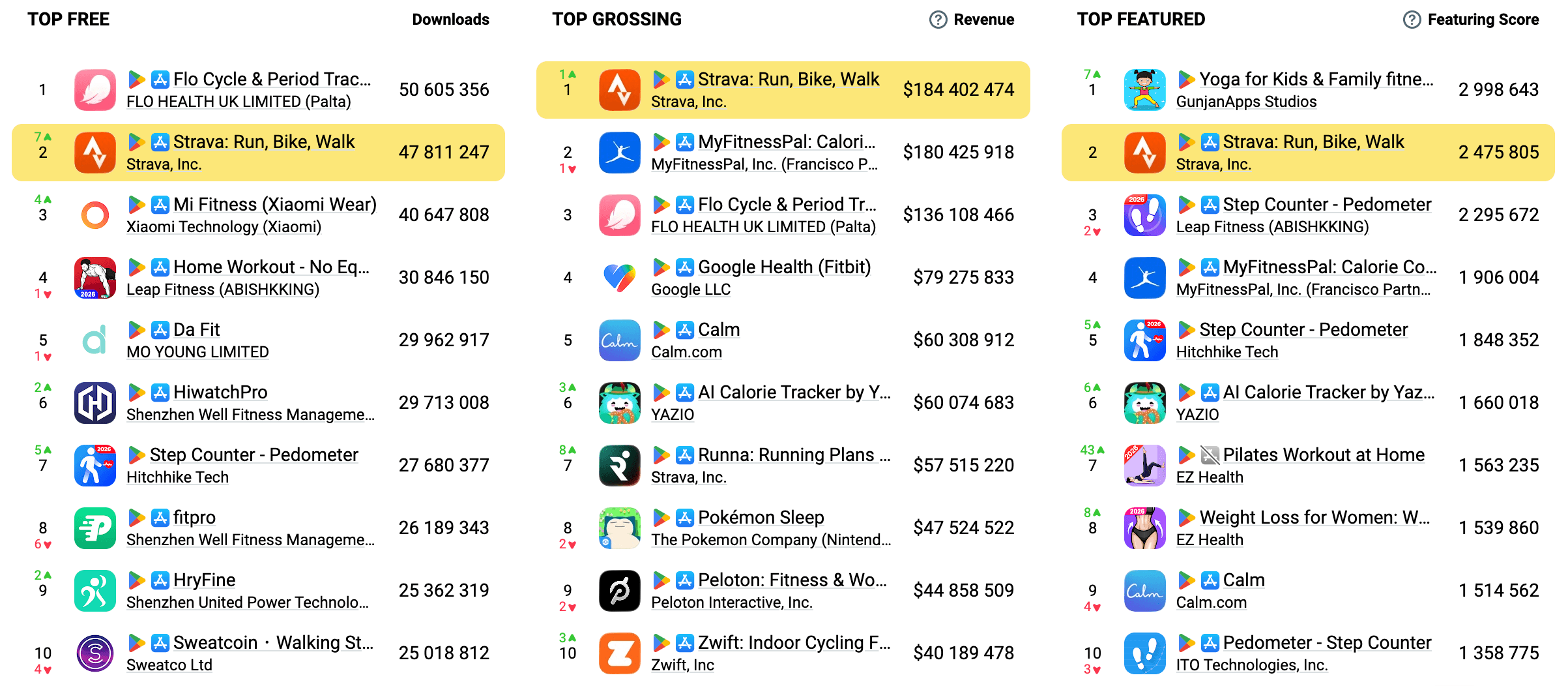
Top Health & Fitness apps of 2025
Then came 2026, and Strava climbed to #1 in the category by both downloads and IAP revenue, with more than 51M installs and over $171M in revenue so far this year. So, what's pushing it forward? Part of the answer is actually outside the app.
While Strava was building a social layer around exercise, fitness was becoming more social in real life, too. Which, once again, brings us to run clubs—probably the easiest place to see it. People show up to run, technically, but also to grab coffee, meet friends, train for a race, maybe find a date, and then post about the whole thing. After all, the workout is only part of the event now…
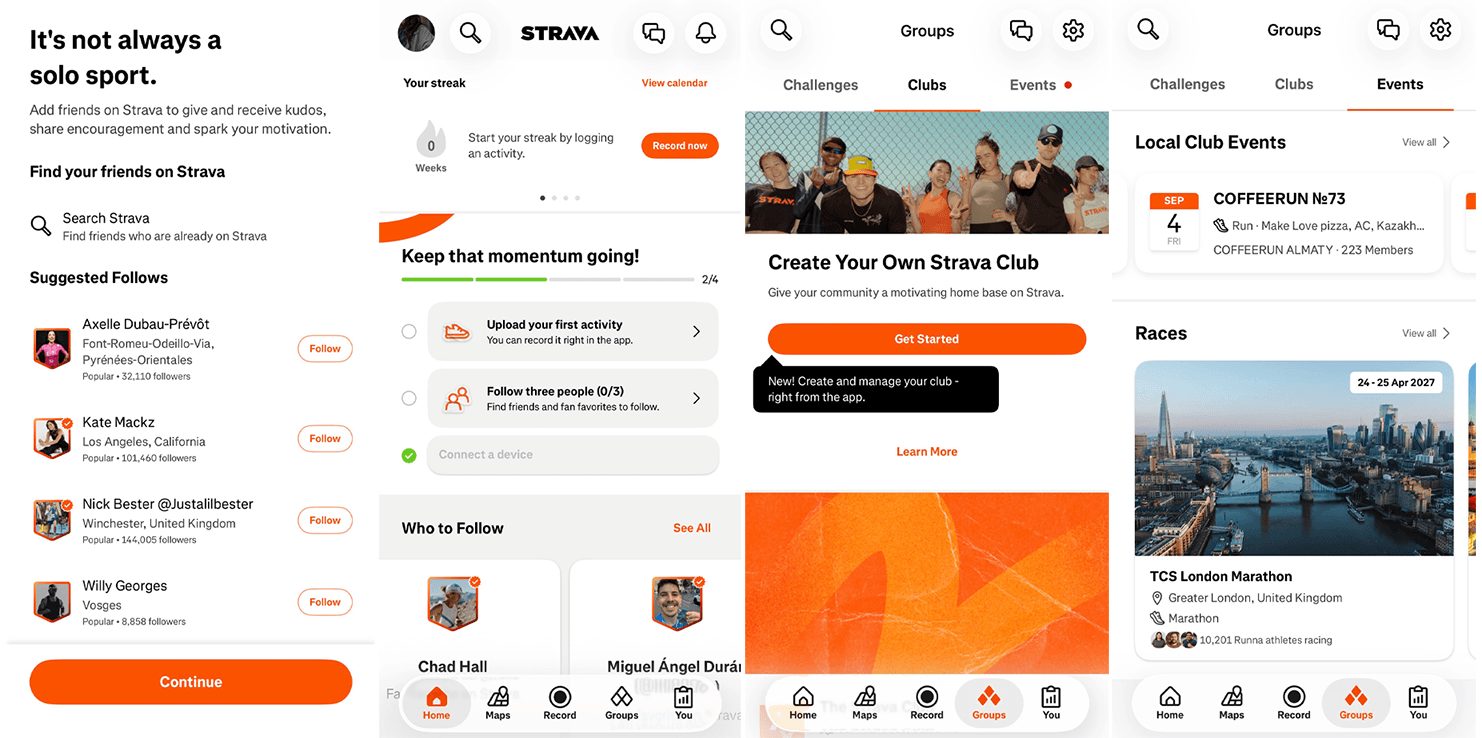
The social side of Strava
In 2024, running-club participation on Strava gained 59% globally, with social connection being the biggest reason people worked out together. Nearly one in five Gen Z respondents had even dated someone they met through exercise, and almost 1B runs landed on Strava that year.
By 2025, Gen Z was Strava's fastest-growing demographic, and users handed out 14B kudos (Strava's version of likes). More than half of Gen Z planned to use the app even more in 2026, while most expected to spend the same or less time on Instagram and TikTok. And, of course, running now comes with content. Maps, pace, distance, photos—the activity is basically halfway to becoming a post already.
So a run doesn't necessarily stop when someone gets home. It can go from the street to Strava to an Instagram story, taking the Strava brand with it. That creates a useful loop:
- People exercise because fitness has become social
- Strava gives that activity a visible identity
- Users share it elsewhere
- And even non-users recognize Strava's orange map card in their feed
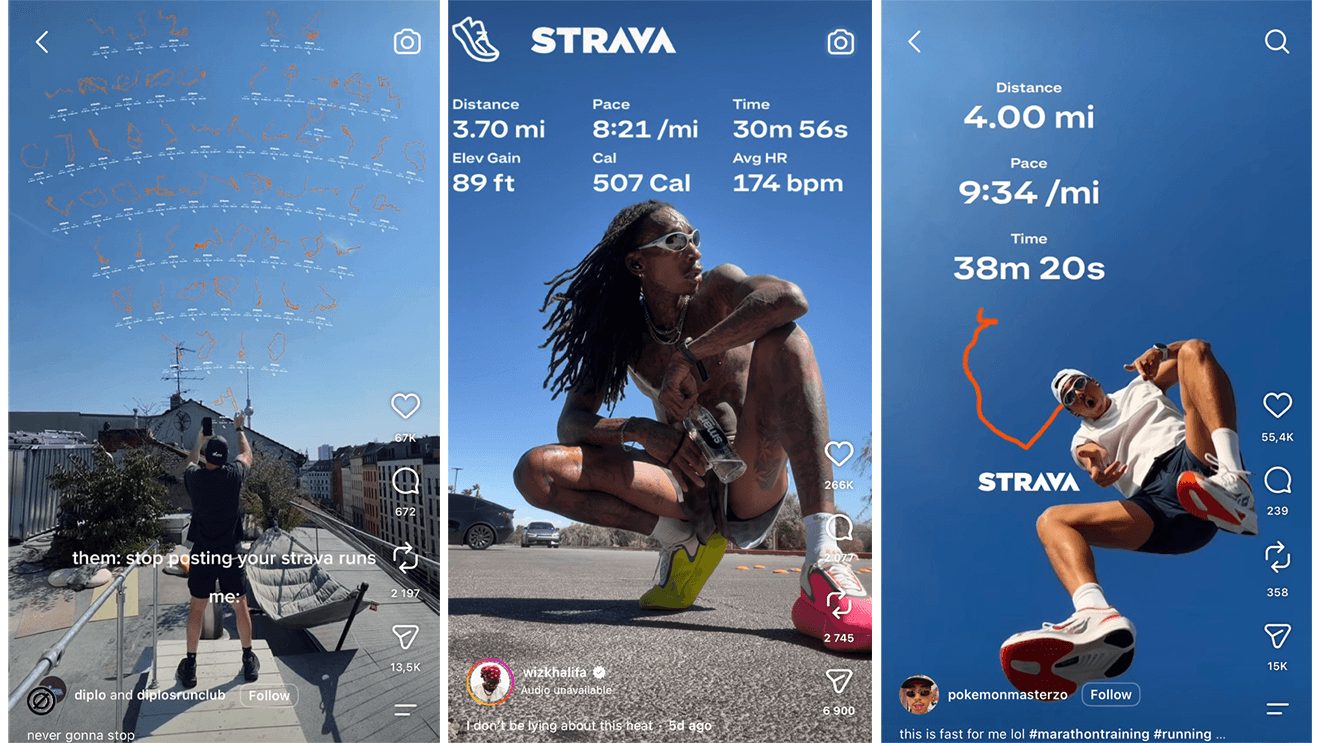
Strava workouts shared across social media
And while running may be having the louder moment right now, cycling fits the same pattern. Group rides, road bikes, fixed gears, routes, gear, and cycling content all have their own social life, but Strava adds something a Reel can't: the record of the ride, Segments, clubs, personal records, and the eternal hunt for a KOM or QOM (King or Queen of the Mountain titles, respectively): the fastest time on a Segment. Strava—or it didn't happen, so to speak.
Not that Strava created these trends, started the run-club boom, or got the Gen Z posting workouts. But it had spent years paying attention to where fitness was heading and what its audience wanted, and building around those behaviors. So when fitness became more social, public, and shareable, Strava was ready. That's a useful place for any app to be: when using the product naturally creates something worth sharing, users can do part of the distribution for you.
And in Strava's case, that growing network eventually became a much bigger business, too.
The Road to Record Revenue
Now, back to that revenue graph. See those spikes? Quite a few of them have something in common: August. The first big one came in 2020, and revenue never really returned to its old baseline afterward. August stood out again in 2021 and 2022, before the whole curve climbed much higher in 2025–26.
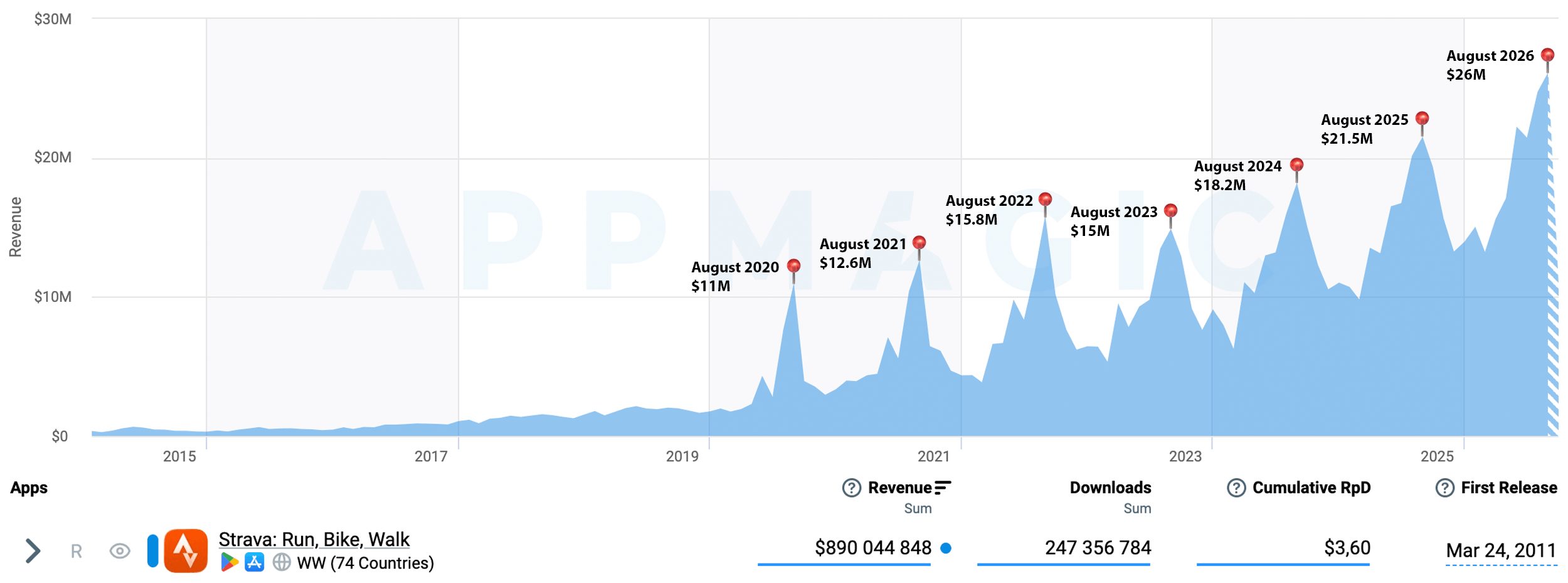
Strava's August revenue spikes over time
That first spike in 2020 is worth a closer look. Just a few months earlier, in May, the team had put subscriptions “at the center of Strava,” moving full Segment leaderboards, route mapping, and other features behind the paywall. Meanwhile, the pandemic was driving a huge wave of interest in fitness apps, and in August, Strava's IAP revenue jumped to $11M.
August kept coming back, though. Why that month specifically? The team hasn't explained it publicly, but seasonality probably plays a part. Running and cycling are simply more inviting in summer, and don't even get us started on hiking! Plus, the endurance calendar tends to get busy around this time. In August 2026, for example, several major IRONMAN races took place, including Copenhagen and Kalmar.
Strava regularly gives users plenty to do throughout the season. In July 2026, right before that record August, it launched Race Discovery with thousands of events from Runna—the running training app the company acquired the year before. The feature helped runners find their next race and start training for it during what the company called “peak running season.”
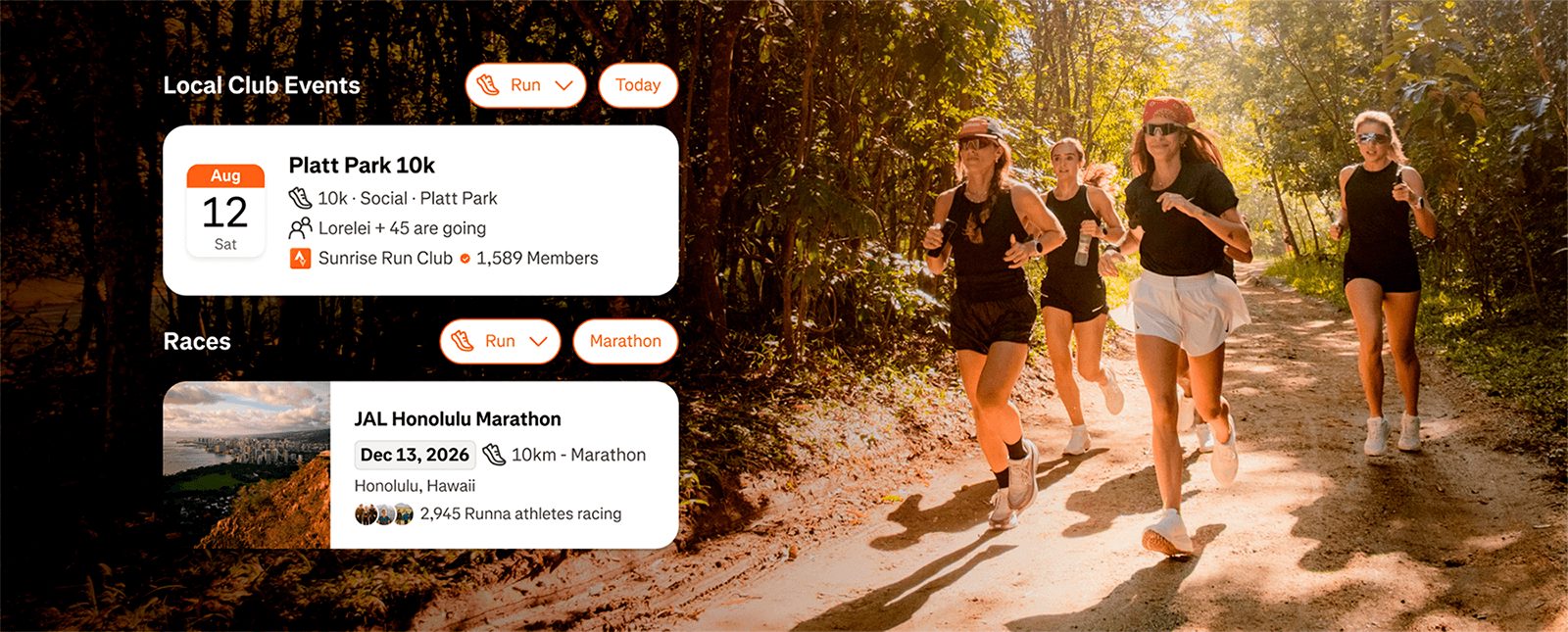
We also checked ASO Plus for August 2026 and found Strava promoting its new Race Discovery feature through the Your Next Event Is Waiting in-app event. Alongside it, Hit the Trails with Strava pushed summer trail adventures and Routes, while the August 5K Challenge gave runners a 5K to pursue.
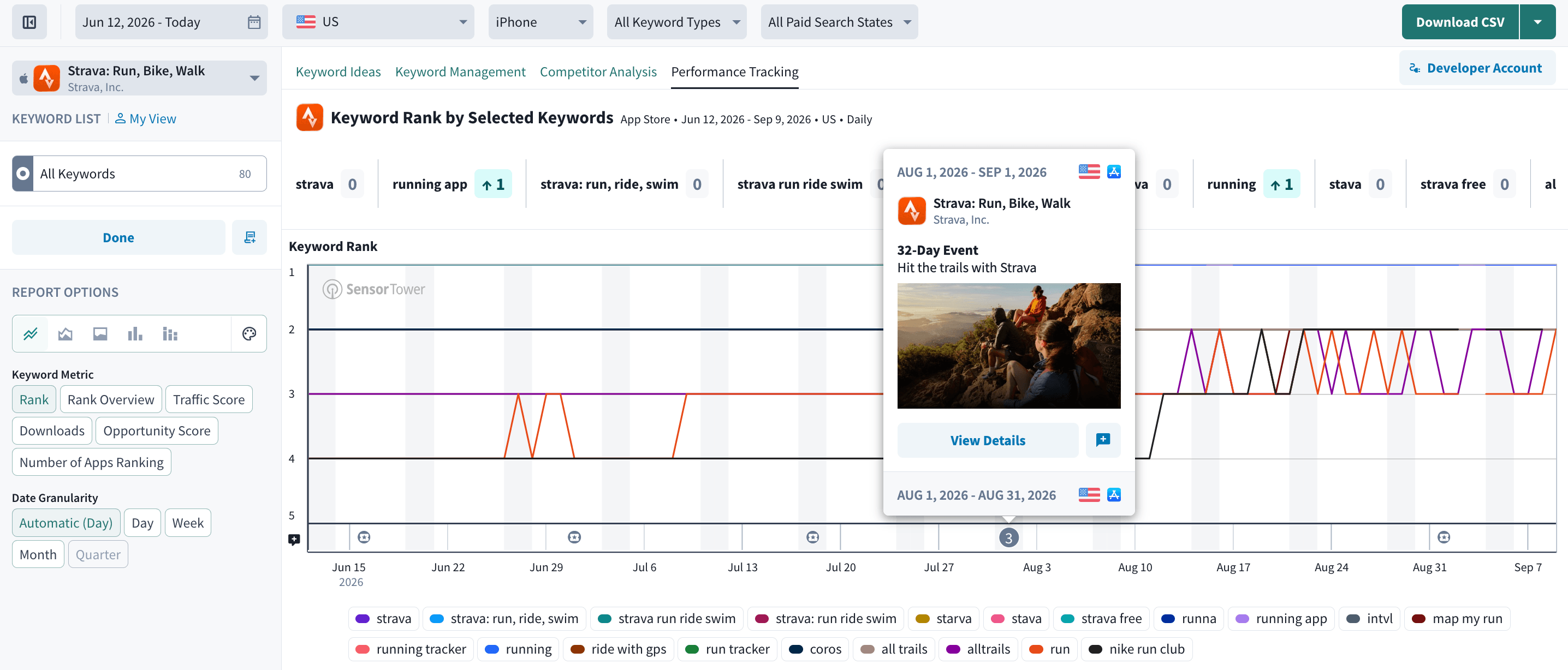
ASO Plus: Strava in-app event tracking
All that aside, while looking into what might be behind the spikes, we checked Strava's IAP revenue distribution and found something else about how the app makes money.
Take August 2026: roughly three-quarters of its iPhone IAP revenue came from annual plans. The two $79.99 subscriptions alone accounted for 69.4%, versus 24.6% from the two $11.99 monthly options. Even the newer $149.99 Strava + Runna annual bundle (with personalized running plans) was already contributing 3.9%.
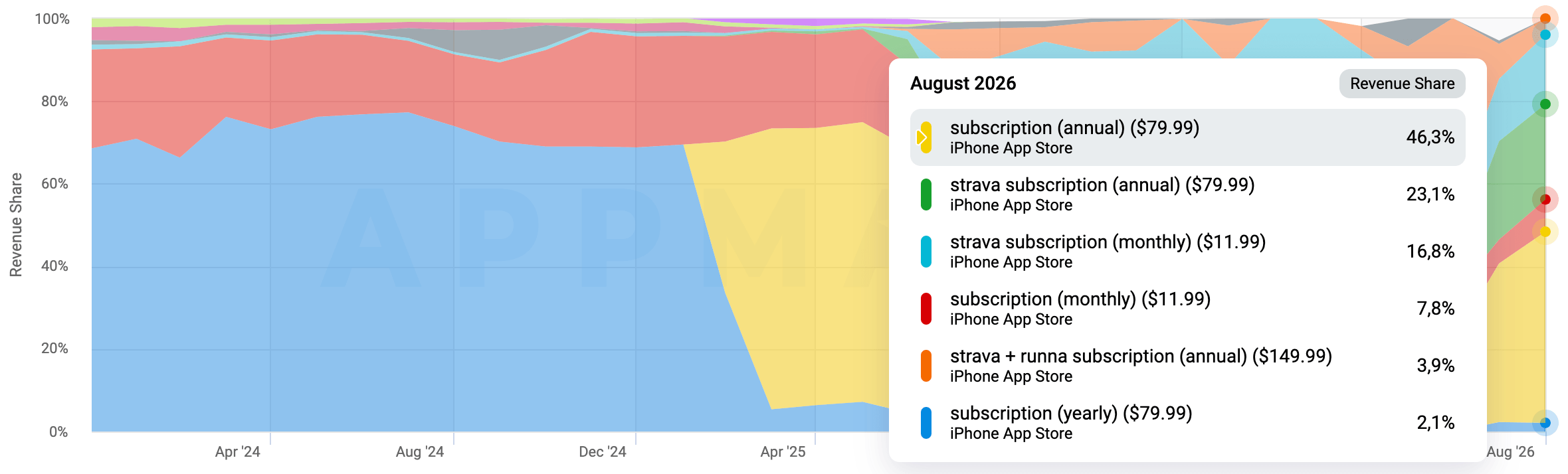
Strava's iPhone IAP revenue share by subscription, August 2026
And again, it's not just August. From January 2024 through August 2026, annual plans consistently generated most of Strava's iPhone IAP revenue, with a fairly similar share across the period. In other words, yearly subscriptions account for much of Strava's mobile revenue.
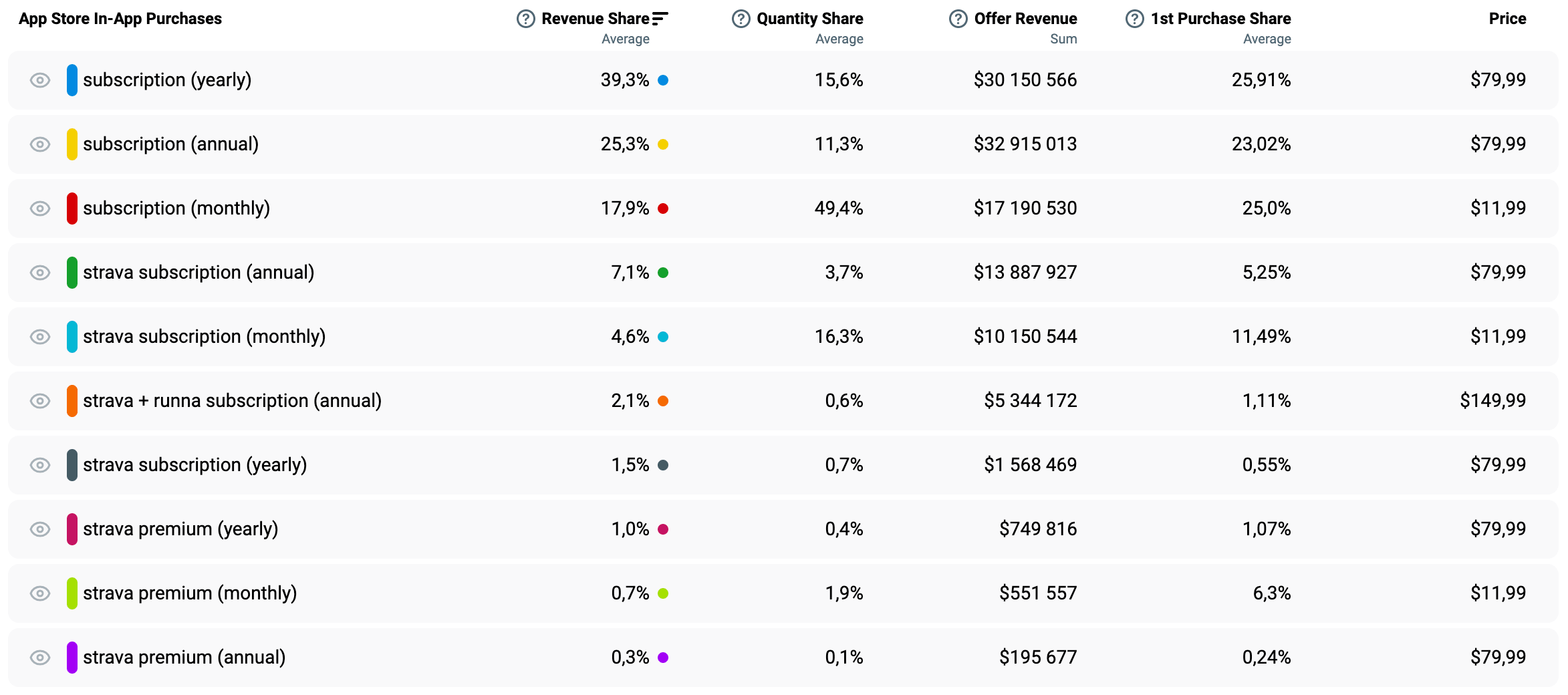
Strava's IAP revenue distribution, 2024–2026
For users, there's an obvious reason to go annual: in the US, $79.99 a year works out to about $6.67 a month, compared with $11.99 on the monthly plan, saving roughly 44% over a year. And who knows, annual billing may well contribute to those recurring spikes.
Anyway, around 2024, revenue started moving higher between the peaks, too, and that same year, Strava got a new CEO.
More Than AI
Michael Martin joined after executive roles at YouTube and Nike, and the product pace soon picked up. Over the following year, Strava shipped more than 40 features, from updates to Routes and leaderboards to new subscriber tools. Among them was Athlete Intelligence, which uses generative AI to turn workout data into plain-English insights.
By 2025, Strava was moving further into training: it had already acquired running coach Runna in April, followed by cycling training app The Breakaway a month later, helping users figure out what to train for and how to get there. In a way, this gives Strava a little more of the “single-player mode” it started with, offering athletes focused on their own training and performance more reasons to use the app beyond the social feed.
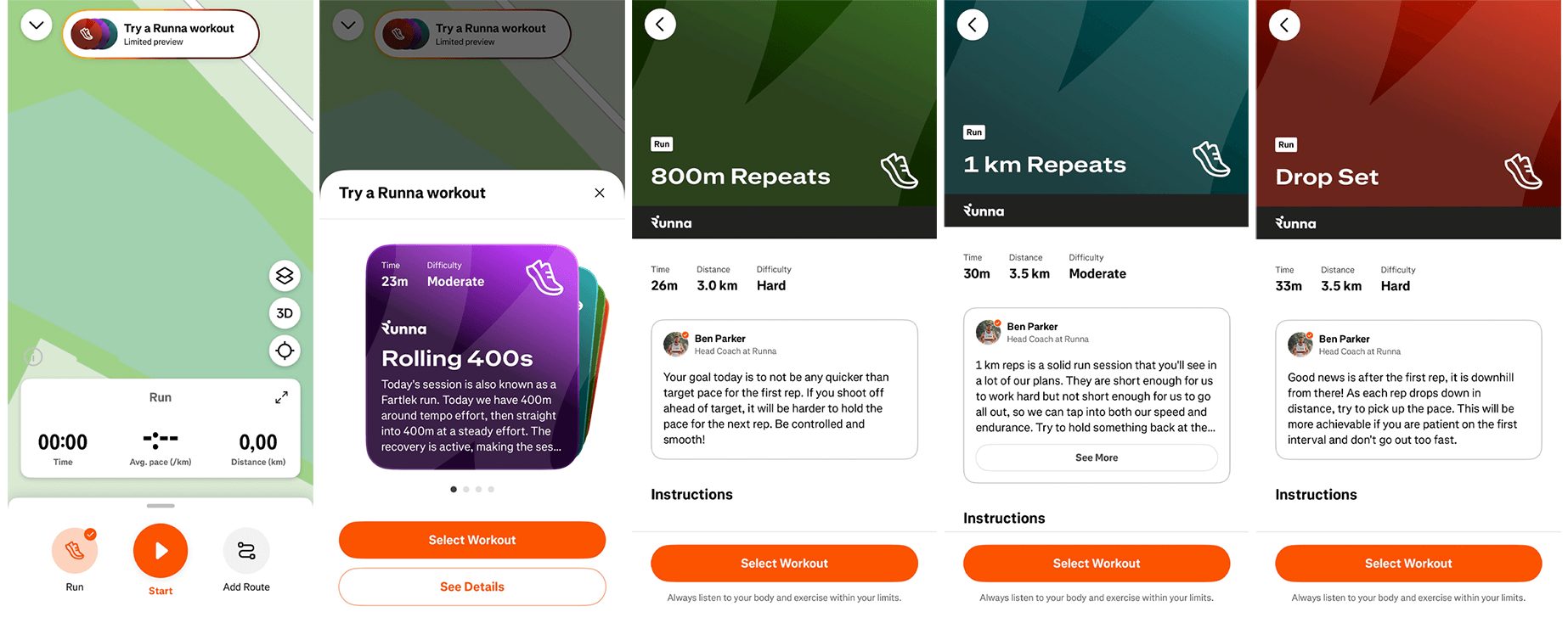
Runna-powered workouts in Strava
Strava was also getting more out of the workout data it already had. With Athlete Intelligence, that data could now help guide what comes next: the feature can spot trends across the previous 30 days, interpret metrics like pace and heart rate, surface milestones, and offer personalized feedback for the next activity.
In June 2026, Strava made that training data accessible outside its own app with a subscriber-only MCP Connector for Claude, letting athletes ask questions across their own training history instead of digging through past activities themselves.
And unlike AI added to a product from scratch, Athlete Intelligence and Claude have years of Strava data to work with: activities, training history, and performance trends. The product also comes with something AI can't create overnight: a network of more than 200M users.
Which brings us back to the original question: how much of Strava's recent success is really an AI story?
AI certainly adds to it, but it came after Strava had already spent years building the foundation. The valuable stuff was already there: years of workouts, personal history, and a huge social graph. Now AI can do more with all of that data and give subscribers more to get out of it.
Key Takeaways
A few things are worth borrowing for your own product, even if you're building nothing like Strava:
- Nail the core utility first. Strava started narrow, focusing on cycling before expanding into running, swimming, and other activities, and eventually growing to support 50+ sports.
- Let free users add value. On Strava, every activity strengthens the network, so charge users for getting more from it, not for contributing to it.
- Give users something worth sharing. If people want to share what your app produces, let them. Strava made workouts worth posting, letting the product travel beyond its own feed.
- Keep working on monetization. Strava shows that better economics can come years after launch, as a bigger audience opens up new ways to price, package, and monetize.
- Find your USP beyond AI. Strava already had years of training history and an established network when AI arrived. And let's face it, that foundation is much harder to replicate than an AI feature.
For Strava, all of that sure took time, but after 15+ years, you could say it was in it for the long run…!