Temu: The New Shopping Apps Titan?
Discover the rising star in the Western shopping app market: Temu. Find out when its popularity surged, explore its regional strategy, delve into its business model, and discern how it stands apart from Shein—all in one overview.
— by Diana Levintova

The year 2023 brought about a surprising shift in the shopping apps market, ending its plateau of roughly 4B annual installs that had persisted for a few years prior with a significant 10% increase. In fact, this change was largely driven by a 2022 market newcomer. You've probably guessed it already: it is the Chinese gem Temu. We have a runner-up, too, though: a slightly less pronounced effect is attributed to the fast-fashion app Shein.
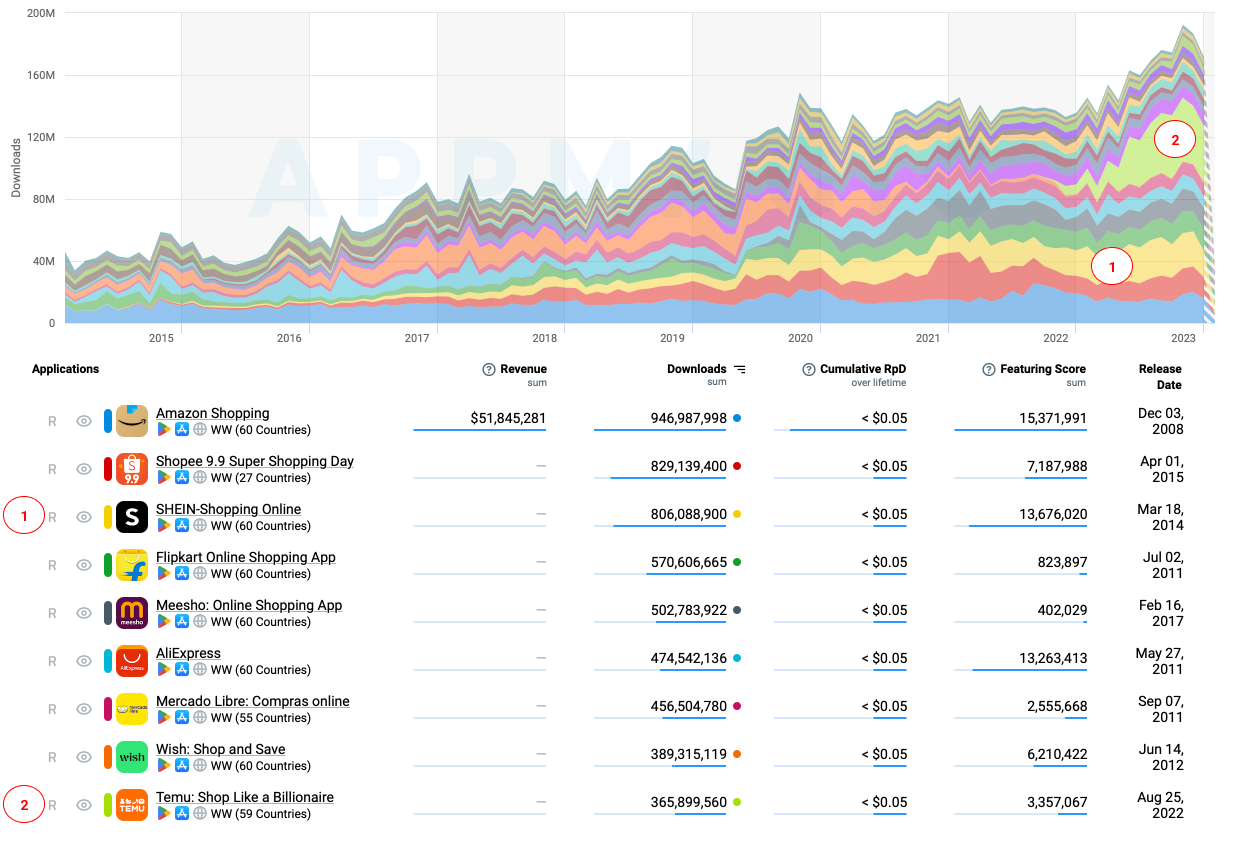
To give you a better idea of how the shopping apps market has been evolving in different regions and what is so special about those two apps, let’s do a quick deep dive.
Regional Strategies
We have already seen in the previous graph that Temu and Shein dominate the shopping apps industry, significantly influencing future market share redistribution worldwide. This impact, however, differs across various regions, attributed primarily to the distinct regional approaches adopted by each app.
To support this notion, let’s have a look at the dashboard with the Top Free chart trends of Temu’s and Shein’s one by one.
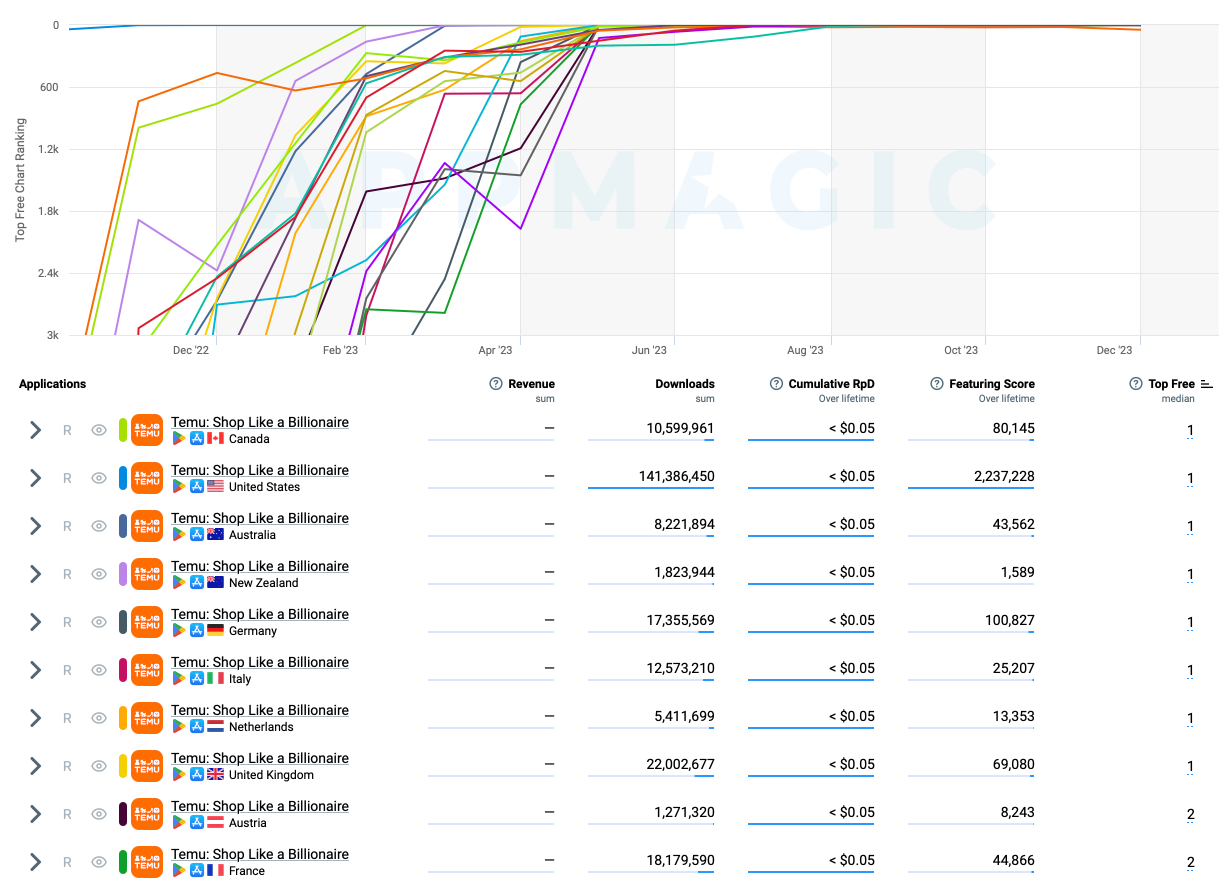
As you can see, Temu has been actively going West starting in the fall of 2022, securing the No.1 spot in the Downloads chart by summer 2023. Their stronghold includes, among others, markets like the USA, Canada, Australia, and New Zealand; Germany, Italy, the Netherlands, and the UK. In contrast, Temu’s ranking remains modest in the regions not actively targeted.
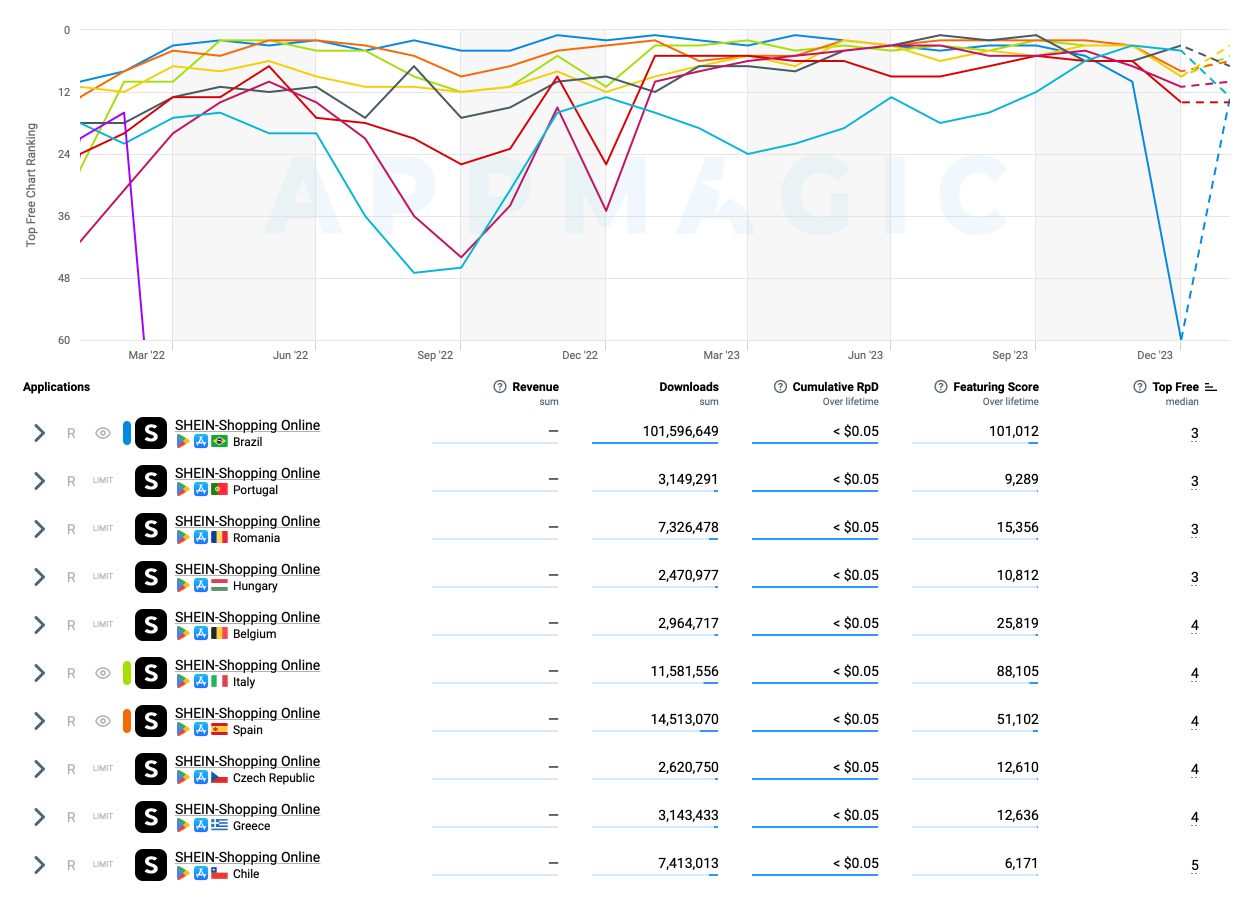
Shein, on the other hand, operates globally, especially excelling in Tier-2 markets, such as Portugal, Hungary, Romania, Brazil, and Czech Republic.
Business Model Showdown
Temu
Temu, established by its China-based parent company PDD Holdings, has a local counterpart in Pinduoduo. In 2023, following a scandal involving malware on Android devices linked to Pinduoduo, Temu distanced itself from its sister company. It even relocated its legal entity to Dublin to reinforce this separation.
Notably, Temu represents one of the first significant global expansions by a Chinese company. While Alibaba's AliExpress and JD.com's Joybuy also ventured internationally, they are both yet to match Temu's impact on the global market.
Notably, Temu represents one of the first significant global expansions by a Chinese company. While Alibaba's AliExpress and JD.com's Joybuy also ventured internationally, they are both yet to match Temu's impact on the global market.
What is so special about it? Well, we came up with several key aspects: 1. Business Model: Temu operates a B2B2C model, serving as a bridge between suppliers and consumers. This setup allows suppliers to concentrate on production while Temu handles product listings, marketing, and logistics. While sellers cede control over pricing, return policies, and long-term strategies, Temu benefits from extending payment periods to sellers, thereby shifting cash flow pressures onto them. 2. Logistics Model: Unlike traditional retailers, Temu doesn’t stock products in the US. Orders are shipped directly from China, skirting bulk customs duties under US policies. This method saves potential hundreds of millions of dollars in duties that retailers like H&M and GAP incur. 3. Affordable Products: Temu provides a vast range of products at wholesale-like prices, with over 200 categories including apparel, footwear, toys, pet supplies, interior design, and more. For instance, men’s sneakers might cost as little as $7, and a quality outdoor tent rings up as low as $3. 4. Marketing Strategy: As reported by The Guardian, Temu invests approximately $500M in marketing each quarter. This includes Super Bowl ads, campaigns across social media platforms, and incentives for customer referrals. They have also heavily invested in influencer marketing, with significant budgets for TikTok and Instagram content.
However, as mentioned in the opening paragraph, there’s another app that has had an impact on the shopping apps market growth in 2023: Shein. To give you a comparison of those two, Temu’s total number of installs in 2023 was 337M, and Shein’s 261M.
Shein
At first glance, the two apps may seem quite similar, since both are platforms offering products at highly competitive prices. However, they differ significantly in their product range and business models. While Temu operates as an online megastore, providing a diverse array of product categories from apparel and footwear to appliances and tools of all sorts, Shein primarily focuses on offering a wide selection of apparel.
Furthermore, as previously noted, Temu utilizes the B2B2C (online marketplace) business model. This approach facilitates connections between shoppers and merchants, enabling the latter to sell directly to consumers via Temu. Additionally, Temu has adopted the Next-Gen Manufacturing model, which assists suppliers in improving product development and meeting consumer demand by providing insights into consumer preferences.
Conversely, Shein initially adopted the first-party model, holding ownership of its inventory and collaborating with numerous manufacturing partners. Although it doesn't own the factories, its substantial order volume positions it as a primary customer, thus enabling it to keep the prices low. Notably, in 2023, Shein expanded its approach by introducing a third-party cross-category marketplace.
Conclusion
Both companies have proven the sustainability of their business models in the face of economic downturns, successfully leveraging diverse regional strategies. Their strengths lie in low-cost offerings, diverse product ranges, data-driven strategies, and efficient supply chains, which have enabled them to secure and maintain leading positions in global markets. However, as sustainable consumption and conscious shopping are both on the rise, this trend might pose future challenges for Temu and Shein, as well as for the smaller market players, requiring adjustments to their current strategies.