New “Beauty” Trend In Casual Gaming: “Ugly” And/Or Misleading?
Recently our team noticed a growing number of games exploiting so-called Ugly Beauty trend for its ad creative in genres like Tycoon, Match-3, and Merge. It looked like something from the world of Hypercasual, so we decided to get on with it!
— by Diana Levintova
Our team has spotted an interesting commotion lately in some of the most promising casual genres covered in the State of Casual Gaming report not that long ago. There is a growing number of games in the Tycoon, Match-3, and Merge genres with a distinct so-called Ugly Beauty trend, as well as in the Games for Kids category (outside the scope of this review though). Here, “ugly beauty” literally stands for things like manky ears stuffed with wax, oozing skin wounds or lesions, all sorts of parasites in all sorts of places, decaying skin and nails, etc. We know, right? Now, as a player, your main task is giving the poor character a makeover, removing the unhealthy manifestations and/or treating the aftermath.
This sounds like something from the realm of the Hypercasual segment, and it sure is. About 20% of the games with the largest number of downloads that are currently riding this trend are Hypercasual. You may remember how, some time ago, we covered the wildly viral Pimple Popping in one of our articles on social media trends, which can be seen as part of today's agenda for Ugly Beauty (sometimes called Ugly To Pretty, too); this time, however, it’s reached a whole new level.
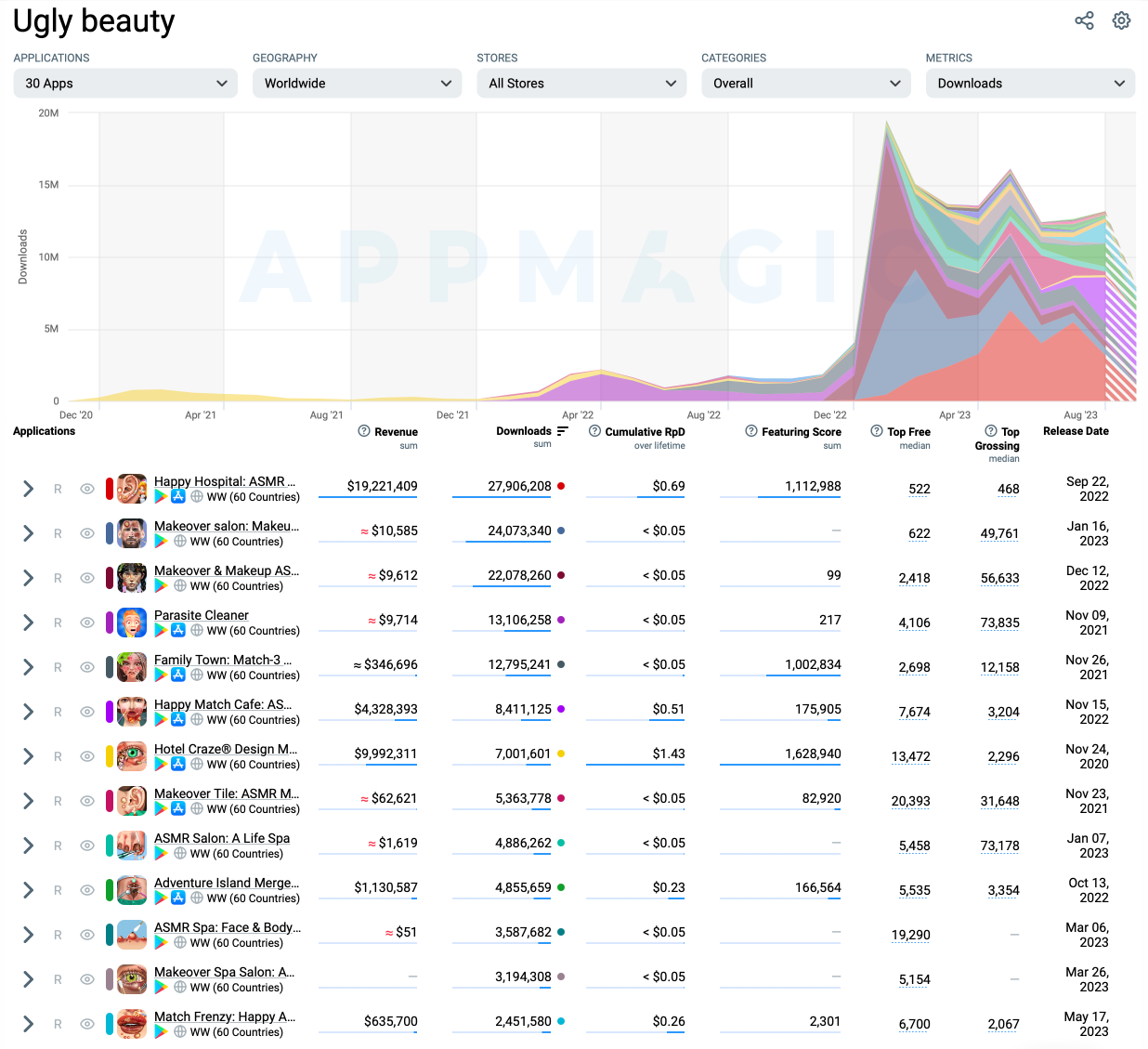
So, with the remaining 80% of casual games left to ponder over, let's discuss the following: 1. Where can we find the mechanics for this trend? 2. Why is it popular with users at all? 3. Why do misleading ads work in casual gaming?
Where can we find the Ugly Beauty mechanics?
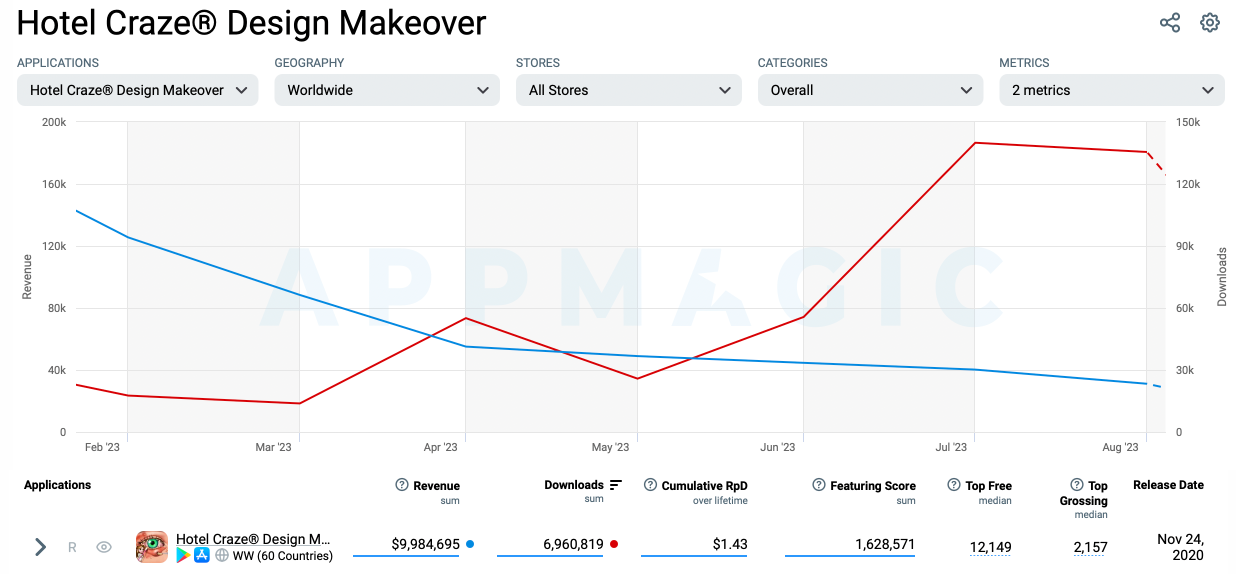
Let’s start with the two games that are at the top of the list with the largest number of downloads over lifetime: Happy Hospital: Doctor ASMR with earnings of $17M and Hotel Craze Design Makeover with its nearly $10M. We can see that these two titles have not just integrated the Ugly Beauty concept into their icons and screenshots but also embedded additional mini-games where you have to treat all the yucky sores on top of the core Simulator gameplay that is, on its own, in no way related to this trend. Happy Hospital: Doctor ASMR is also exploiting it in all of its creatives starting from early July 2023—a couple of months after adding the first few ASMR levels (Ugly Beauty ASMR, that is, of course). Let’s have a look at how well it has worked for the game though:
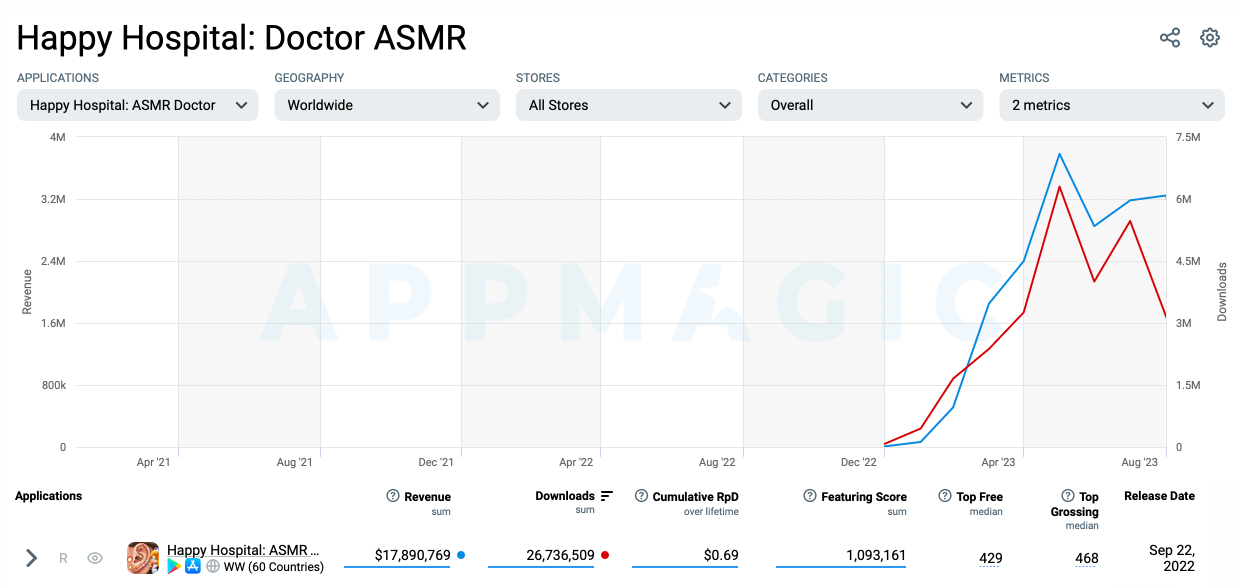
Both downloads and revenue graphs are showing the same dynamics with two peaks: one right after the first ASMR level was added and another one after the release of the first Ugly Beauty-inspired ad creatives. Cannot be pure coincidence, right?
Similar dynamics are noticeable with Hotel Craze Design Makeover: the game had been stagnating at its lowest points just before releasing those ASMR mini-games in July 2023, and right afterwards, the downloads picked up. (Cannot quite identify a similar trend for the revenue yet though.)
Judging by all the other titles from our extended list, the tendency stays the same: games don’t build their core gameplay around Ugly Beauty but rather use it for their icons and screenshots. Those who are ready to invest more time and money also add Ugly Beauty creatives and mini-games. And, from what we see, it all started with Happy Hospital: Doctor ASMR in late April 2023.
Why is the Ugly Beauty trend even popular with users?
Talking about trends, it’s always interesting to understand the psychology behind them: what makes people fall for them? With Ugly Beauty, there are a few plausible factors at play: 1. Predecessors' habits. There’s a hypothesis that us being attracted to “disquieting” visuals and activities might have evolutionary roots. Ages ago, people were helping each other clean their skin from various parasites and sores (a.k.a. picking and grooming). This not only helped with hygiene but also improved the social bonds. So, it can be possible that, over time, the process of removing impurities has imprinted on our minds as something satisfying. 2. Sense of order. Removing impurities from the skin can give you a feeling of resolution. It is similar to cleaning an apartment or organizing a fridge: gets truly mentally rewarding. 3. Novelty. While human curiosity knows no boundaries, it’s always captivating to witness something you’ve never seen before. It might be the case with this trend as well, since it provides an opportunity to have a peek at something we haven’t been much exposed to. 4. Shock. The best thing about experiencing something shocking apart from the endorphins outburst is an opportunity to share it with the community. Being social creatures, talking about situations that provoke strong feelings helps us strengthen existing relations or form new bonds.
There’re also a few other factors that we have discussed in previous articles, including the release of endorphins and the vicarious experience (satisfaction from watching someone else undergo an uncomfortable experience you yourself don’t have to).
Another big psychological aspect behind the popularity of this trend is ASMR. If you look at the naming, you’ll notice that a good share of titles feature the ASMR acronym. So, why is it such a big thing for the Ugly Beauty trend?
- Trigger for the ASMR effect. For some people, listening to the sound of others eating or pouring liquids may provoke an ASMR effect—those pleasant tingles down the spine. For others, the same thing might happen when looking at closeups of meticulously dealing away with body imperfections. It’s all about the sensation of release after the painful event.
- Predictability. ASMR is well-known for its predictability and repetition, which could be soothing for the users, especially those experiencing anxiety.
- Feeling of intimacy. Since ASMR typically features profound focus on details and a handful of zooming in, it helps establish the connection with the user, fostering the feeling of closeness.
Why do misleading ads work in casual gaming?
Misleading advertising approaches are hardly a new say in the mobile gaming industry. They first gained traction back in 2017—largely thanks to Matchington mansion. Numerous companies have since employed similar uncanny tactics. However, it's crucial to understand that such non-core-gameplay advertising has evolved over the years. In the past, these ads often promoted aspects that were absent from the actual game. Today, however, as mini-games are added, these ads, while having nothing to do with the core gameplay, are nevertheless not as misleading as before.
Still curious though: why would studios resort to these tactics? Remember how, in this “Games & Names", Jesse discussed uninstalling a game after being disappointed by its unrepresentative ad? While such reactions might seem like game over for many developers, a study by Nexters suggests otherwise. They have found that 35-46% of gamers are not deterred by the disparity between the ads and the actual gameplay and would still give the game a chance. Interestingly, almost 75% of European and US players find non-core-gameplay ads more captivating than the in-game experience.
Just to reiterate: many ads today, while labeled as misleading, are less deceptive in essence. They have earned a new title: “unconstrained”. These unconstrained ads might be jarring initially—only 5-10% of players stick around after being introduced through such advertising compared to 20-30% who stay after seeing gameplay-centric ads. However, in the long run, these percentages level out.
The rise of unconstrained ads aligns with current content consumption habits. In the TikTok era, users gravitate towards shorter, snappier content. TikTok itself advises keeping ads between 21 and 34 seconds long. Under this premise, presenting actual game mechanics becomes a challenge. If the eventual outcome isn’t drastically affected, why not opt for something more attention-grabbing?
This trend has been extensively discussed across various media platforms. Capturing user attention with provocative content and drawing them into the game by any means has proven to be a more effective strategy than just showcasing actual gameplay. This holds true even if the genuine gameplay is dynamic and addictive. Games like Survivor.io and Archero, for instance, predominantly employ what can be perceived as misleading techniques for advertising.
However, these ads aren't entirely deceptive. They often incorporate some elements or assets from the actual game, though the gameplay depicted is significantly altered. This nuanced approach gained traction in 2021-2022. It's not an outright misleading advertisement strategy, such as the "pins" or "save the girl" campaigns of 2018-2019, but something that's stylistically and genre-wise reminiscent of the actual game being advertised, yet distinctly different.
Conclusion
Looks like our new beauty trend is neither really ugly (some actually find it relaxing, don't they?) nor misleading, especially when mini-games are introduced. The task of captivating users with lively content in brief time frames intensifies daily, prompting studios to increasingly resort to unrestrained ads vying for players' attention. And the Ugly Beauty concept, while perceived as unappealing or even off-putting to some, still draws our attention by triggering strong emotional reactions. Seems like a compelling mix, and the results have already proven worth everyone’s while!