Casual Games Report H1 2026: Growth Beneath the Still Surface
While the broader Casual games market remained largely flat in H1 2026, each major genre—Puzzle, Casino, and Simulation—found its own path to move forward. This report explores which strategies are actually working in today's market, and why.
— Lera Kalashnikova

In 2025, Casual studios adapted their strategies to move forward in a market that had largely stalled. The first half of 2026 followed a similar pattern, with overall revenue remaining virtually unchanged from H1 2025 at around $11B. But that seeming stagnation only tells part of the story. Beneath the surface, new growth opportunities and genre breakthroughs are steadily reshaping the market.
As always, this report focuses on the three largest Casual genres, each representing a different path to growth. Puzzle games continue to lead the market, growing both revenue and UA while fueling the next wave of Hybridcasual titles. Casino publishers are doubling down on D2C faster than ever. And Simulation proves that, with the right team and long-term support, games in even the most mature genres can still break new records.
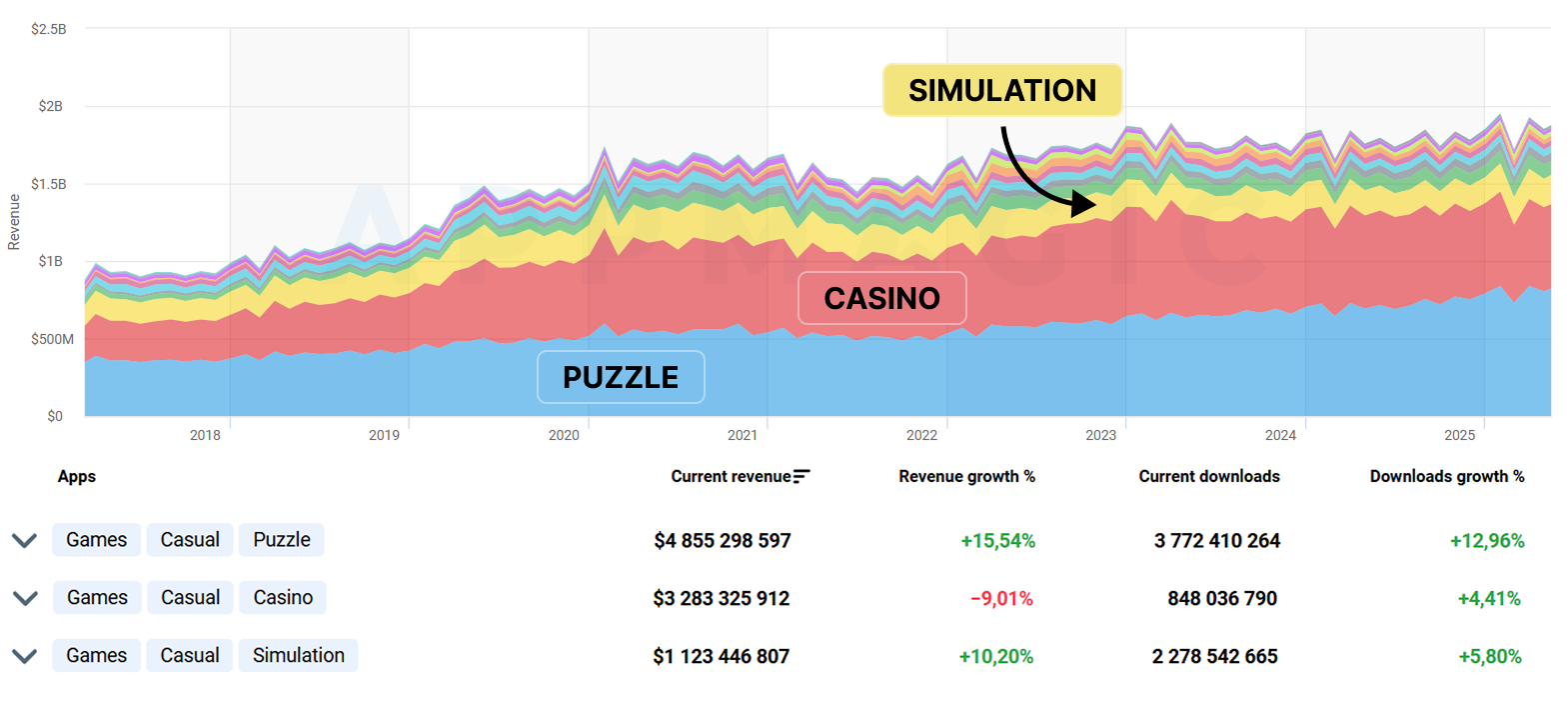
Each segment is finding its own way through the challenges, and in doing so, they leave behind a clear trail of what's actually working in today's market. In this report, we’ll break down three leading Casual genres and explore:
- Which Match-3 games are growing despite the segment’s general stagnation
- Why large publishers like Century Games and Moon Active are doubling down on Merge-2
- Which Hybridcasual trends dev teams can't afford to ignore
- How the Coin Master IP is taking up more space in the Coin Looter market
- How mature Farming titles are still setting new revenue records
Now let's start where Casual's center of gravity has always been: Puzzles.
Puzzle: The Headliner of the Casual Market
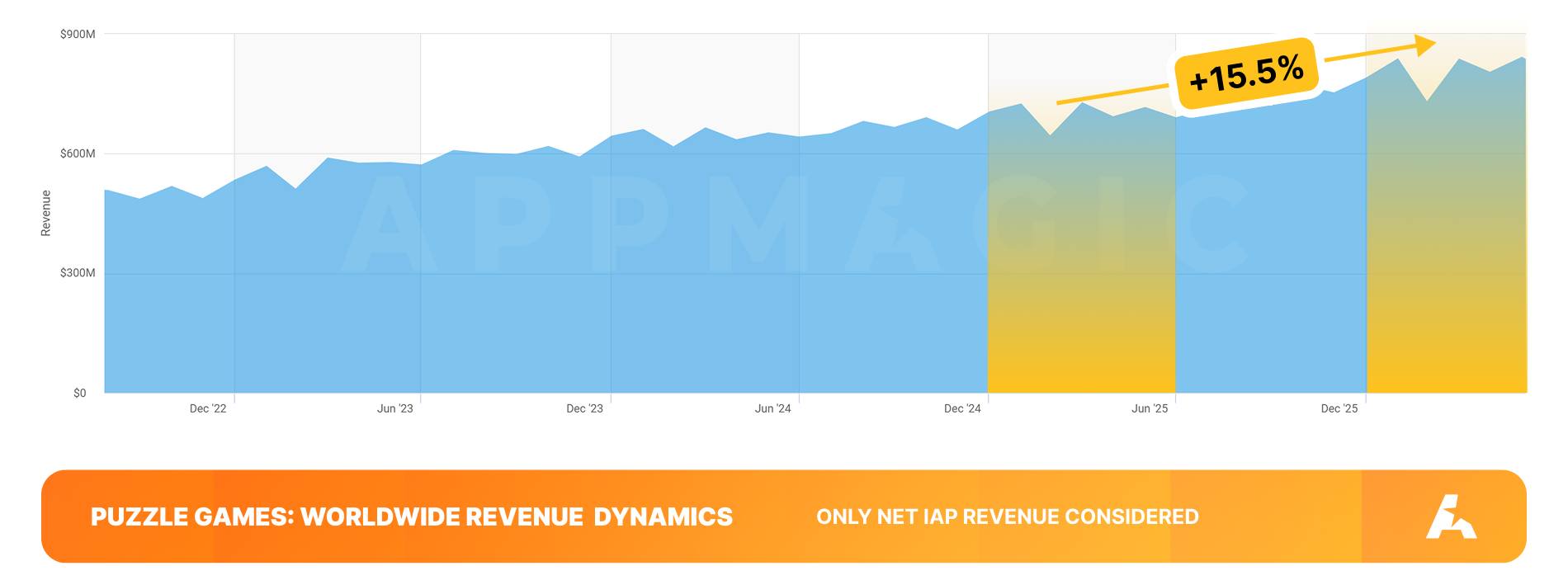 Market Segment Comparison: Puzzle market revenue
Puzzles continue to lead the Casual market, and their grip is only tightening. In H1 2026, the segment generated $4.9B in IAP revenue, with its overall market share now exceeding 44%. Here's how that breaks down across the top-performing subgenres:
- Match-3: $2.5B in revenue (–0.4% YoY), 392M downloads (+10% YoY). Royal Match, Candy Crush Saga, and Royal Kingdom
- Merge: $1.3B in revenue (+74% YoY), 311M downloads (+22% YoY). Gossip Harbor: Merge & Story, Tasty Travels: Merge Game, and Travel Town - Merge Adventure
- Match-2 Blast: $257M in revenue (+2% YoY), 35M downloads (+35% YoY). Toon Blast, Toy Blast, and Angry Birds Dream Blast
Although Match-2 Blast is the third-largest Puzzle subgenre, we won’t explore it in detail this time. Instead, we’ll turn our attention to Hybridcasual Puzzles, whose rapid growth and increasing influence make them impossible to leave out of the conversation.
And when we zoom in closer on that lineup, we’ll see that Match-3 has new stars despite tough competition hits, Merge-2 keeps expanding at a pace only a few genres can match, and Hybridcasual is pulling in both players and publishers with lower costs, flexible monetization, and fast-moving trends. A lot is happening at once, but don’t worry: we’re about to break it all down, one genre at a time!
Match-3: Where Kings and Villains Reign
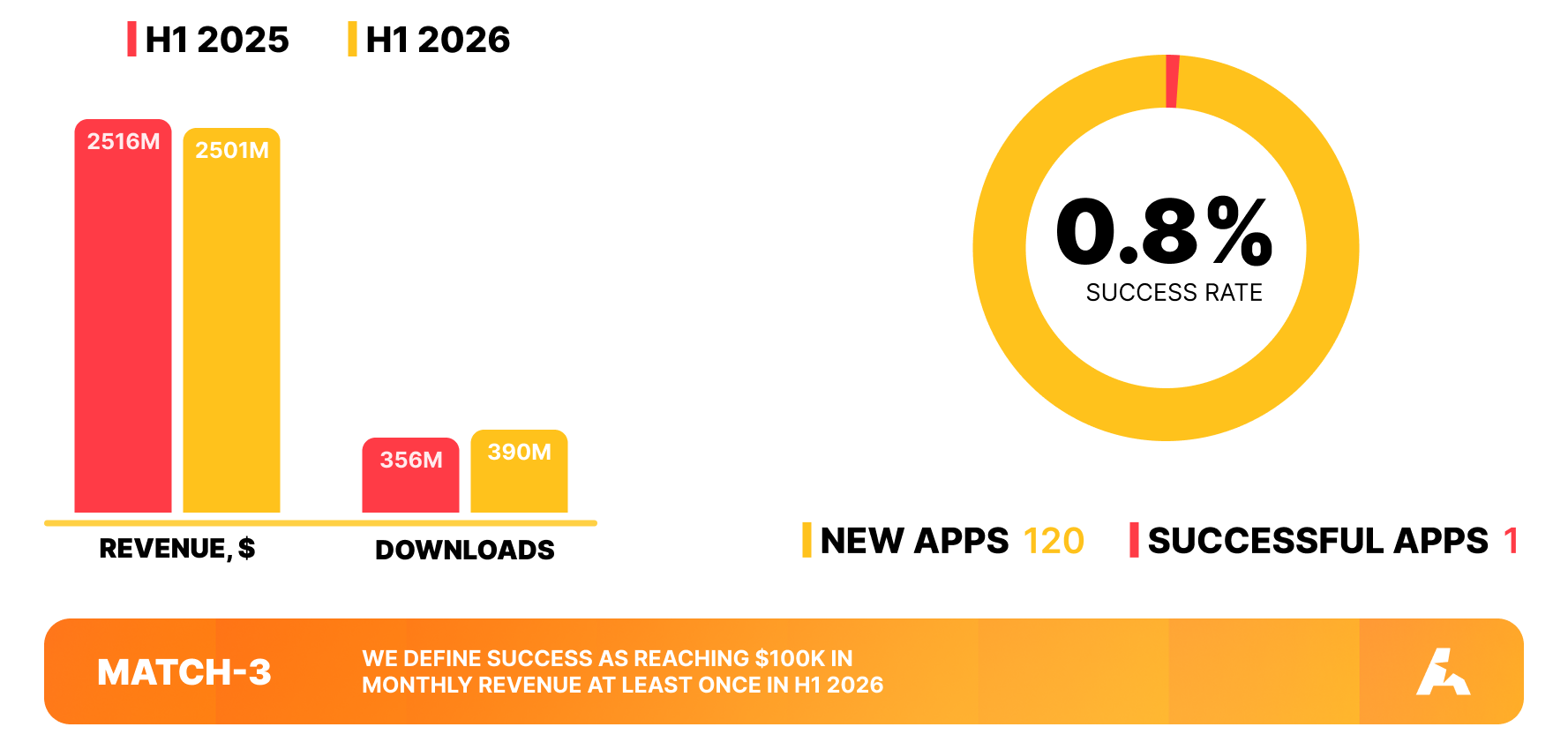
Match-3 remains the largest Casual subgenre—no surprises here—as the genre brought in around $2.4B, accounting for more than half of the entire Puzzle market (51%). At the same time, it is also one of the industry’s hardest categories to break into, with the same market leaders holding their positions year after year. Royal Match and Candy Crush Saga have remained comfortably ahead of the competition for years, and nothing seemed capable of disrupting the status quo. Or did it?
We’ve made it a tradition to begin every Match-3 chapter by following *Royal Kingdom*’s journey up the charts. Step by step, the game has climbed higher with each report, and in H1 2026, it finally secured the #3 spot, with only two legendary giants still ahead. This journey is a clear result of Dream Games’ remarkable focus: rather than spreading resources across multiple projects, the studio doubled down on scaling just two games and refining the genre’s formula.
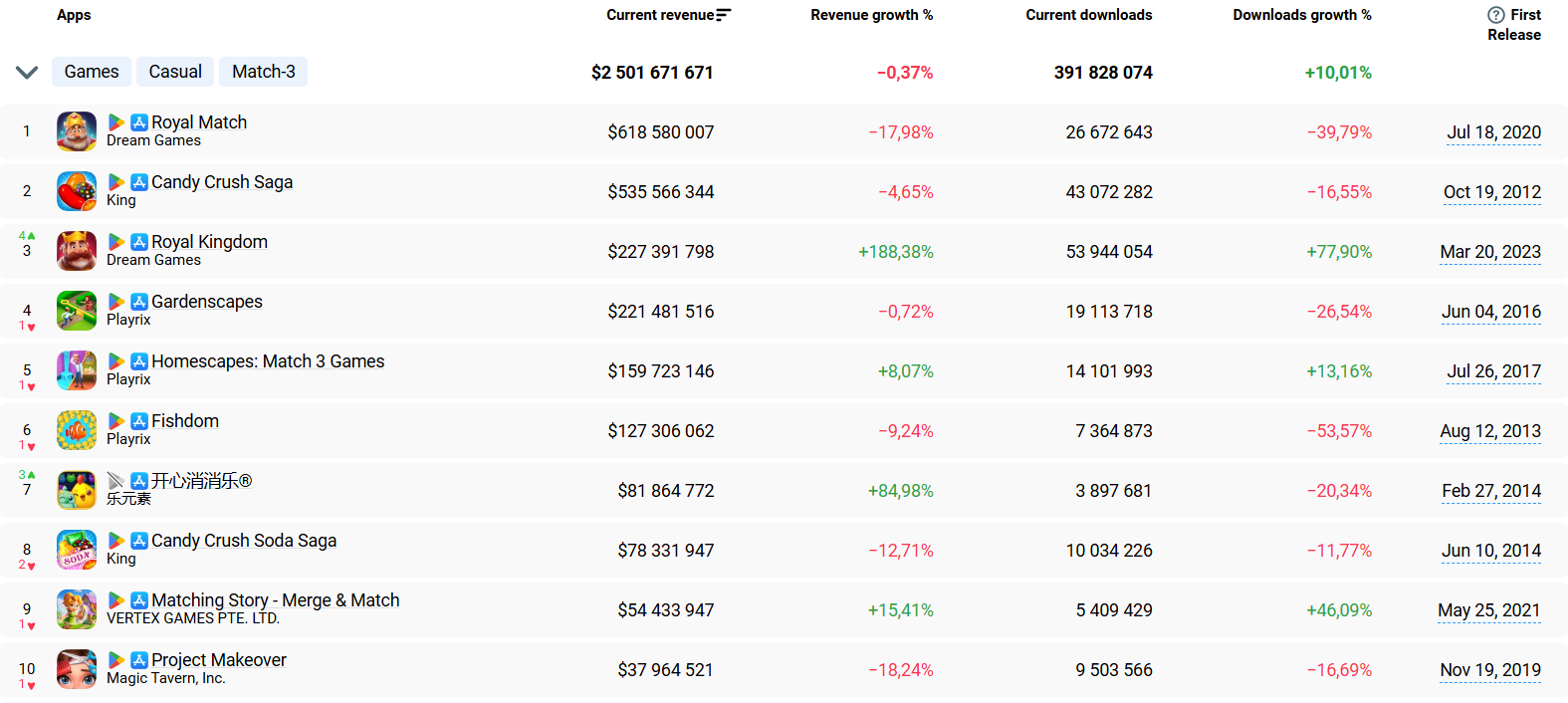 Period Comparison: top 10 grossing Match-3 games in H1 2026 (YoY growth)")
Since its global launch in November 2024, Royal Kingdom has generated more than $510M in lifetime IAP revenue, compared to *Royal Match*’s $465M over the same period following its own global launch. In other words, Royal Kingdom is actually outperforming Royal Match! If the current trajectory continues, the studio may soon occupy both of the genre’s top positions, even overtaking Candy Crush Saga.
That puts extra pressure on competitors, even the more experienced of them, such as Playrix. The studio has spent years testing several Match-3 projects, but most of them have yet to see their global release. Among them is Austin's Odyssey, the long-awaited expansion of the Gardenscapes IP with $1.9M generated while the game is still technically in its soft-launch stage since August 2022. Playrix is clearly searching for its next major hit, yet the main focus stays on scaling existing blockbusters like Gardenscapes and Homescapes—titles that have long proven they’re built to last and thrive.
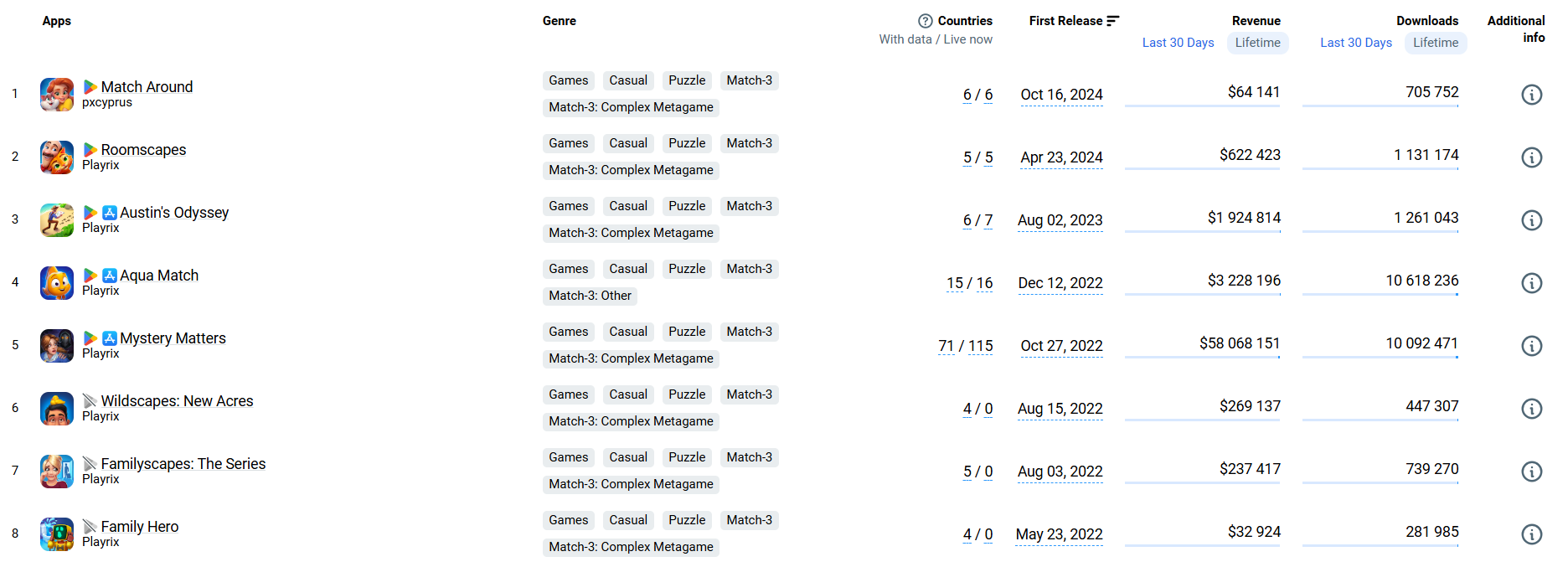 Match-3 projects by Playrix since 2022
Matching new projects to today’s genre standards is challenging even for the industry giants, and for newcomers, it's even harder. Still, the next shake-up in the rankings may be just around the corner. Match Villains by Good Job Games is now just one position away from entering the genre's top 10, having generated roughly $30M in IAP revenue during H1 2026. Its rapid rise may seem sudden, but it's actually backed by years of experience building successful Puzzle games.
Today, Match Villains is the only major successful title currently owned by the studio, but it's far from its first. Back in early 2022, Good Job Games launched Wonder Blast, which later went to Fugo Games after generating more than $2.6M in IAP revenue. The same story happened to Zen Match: the game already reached $92M before its acquisition by Moon Active in December 2022.
These titles gave the team much more than revenue. They provided valuable expertise in building scalable games and helped attract investor interest, leading to two funding rounds in 2025 alone. Yet, that combination—deep product experience and real investor backing—took years to build. However, it all laid the foundation for *Match Villains*’ success!
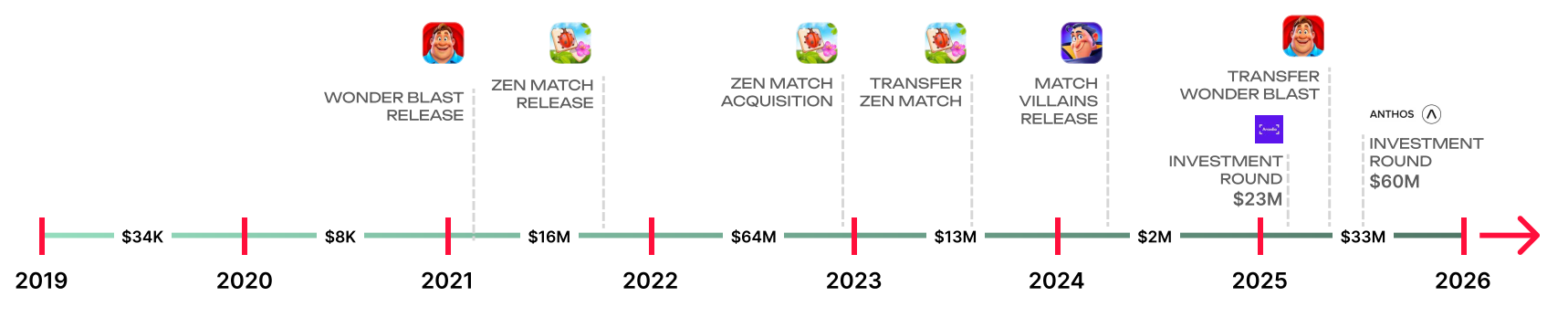 Source: Türkiye's Mobile Gaming Landscape 2026
What truly sets the game apart is a deep system where every moving part is thought through, tuned, and tied back to the player experience. And its LiveOps strategy is probably the clearest example of what that looks like in practice. The event grid is quite intense, featuring roughly 20 formats running all at once, but what stands out even more is how frequently the team introduces new ideas into the schedule.
Over the past six months, the game rolled out 7 new event types built around various mechanics like win streaks, lucky wheels, or tasks. But some of them stepped outside the Match-3 core entirely.
Take April’s Brick Crushers event, which runs a mini-game where players smash a field of bricks with a ball. It offers fresh gameplay yet remains tightly connected to the core progression, as every stage requires event tokens earned by completing regular levels. Mini-games like this mostly show up in Midcore LiveOps, where they give players a break from heavier core systems. For a Casual title, it's a much rarer move.
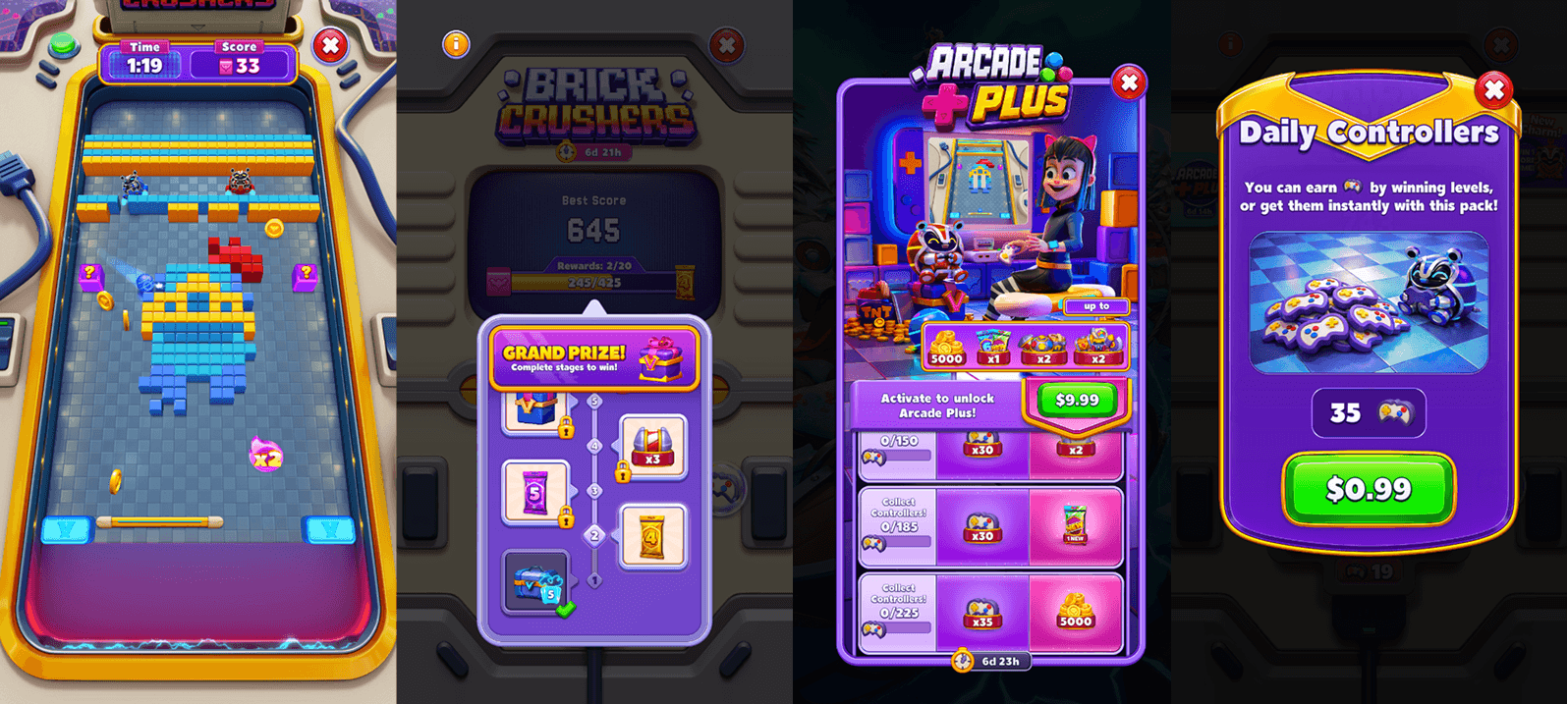 The Brick Crushers event in AppMagic’s LiveOps & Updates Calendar
What makes it work is the structure behind it. The event is a whole system with its own milestone rewards, a dedicated pack, and a dual paid pass. These layers connect the event directly to the game's monetization while adding extra retention drivers. The result? More reasons to spend—and without piling additional pressure onto core progression.
That complexity runs through Match Villains' broader LiveOps approach. New event formats are regularly introduced, existing ones are continuously refined, and fresh monetization layers are added. Once again, it highlights how high the bar has risen in this genre. Strong LiveOps smartly connected with monetization is no longer a nice-to-have but the ultimate baseline.
Of course, events don't drive revenue alone. Gameplay balance and the systems built around it matter just as much. So let's put numbers to the drivers behind Match Villains' success and look at its top-performing offers.
 Match Villains’ top-performing offers (iOS, US only)")
The largest revenue share comes from the $1.99 coin pack and the $9.99 bundle, each contributing around 13%. That split reflects how the game successfully captures spending across different player segments, balancing low-cost impulse purchases with bundles aimed at more committed players.
Thus, Match Villains illustrates how every detail can matter. The polish in gameplay and design, the constant experimentation, the tight links between LiveOps and revenue growth—pull any one ingredient out, and the whole system could crumble. That's simply the reality for any dev team in Match-3 today.
And this is the best moment for another traditional benchmark: the success rate. With each report, we track how many new releases manage to surpass $100K/month in IAP revenue at least once. And for Match-3, the numbers are especially unsettling, with H1 2026 being no exception. Out of 120 new releases, not a single title managed to hit this benchmark... Well, technically, there was one—but it was simply the Vietnamese version of Gardenscapes.
You might think that for a genre as large as Match-3, $100K a month is hardly an ambitious goal. You are right! Yet even that level remains out of reach for most newcomers competing against today's market leaders.
🎯 Games to watch in 2026:
- Family Farm Match by Century Games. While it's still a long way from the genre's biggest earners, its growing RpD has been especially impressive, peaking at over $4.2 in June. After Century Games found its next big hit in Merge with Tasty Travels, the publisher may be getting ready to repeat that success in Match-3.
- Simon's Cat Match! by Tactile Games. Big IPs keep finding their way into Match-3. Harry Potter, Disney, even K-pop legacies like Puzzle SEVENTEEN have all taken a shot at the genre—and Simon's Cat is next in line. While the game actually launched in February 2025, it really started picking up speed this year and already surpassed $6M, which could be just the beginning of its story.
Merge-2: Big Publishers Growing Bigger
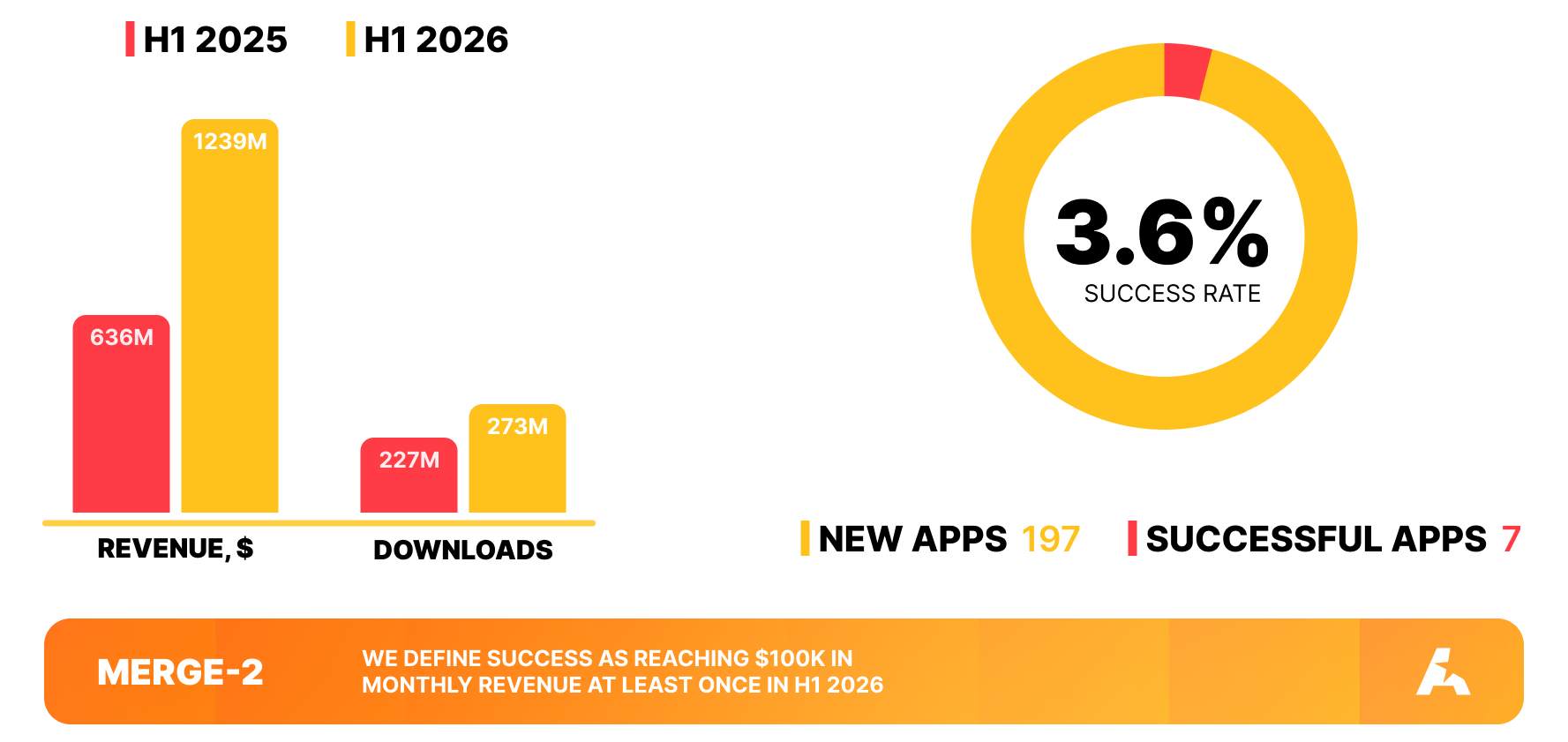
Merge-2 has been the fastest-growing among the big genres for a while now, and it’s only picking up speed. In H1 2026, it almost doubled its revenue to $1.2B and increased its downloads by 20% YoY, proving that monetization is the biggest strength of the genre. Not many Casual genres can pull that off right now, and definitely not at this rate!
Looking at the top charts, Gossip Harbor has been #1 since October 2024. In March this year, the game crossed the $100M threshold in monthly revenue for the first time and has lingered around this mark ever since!
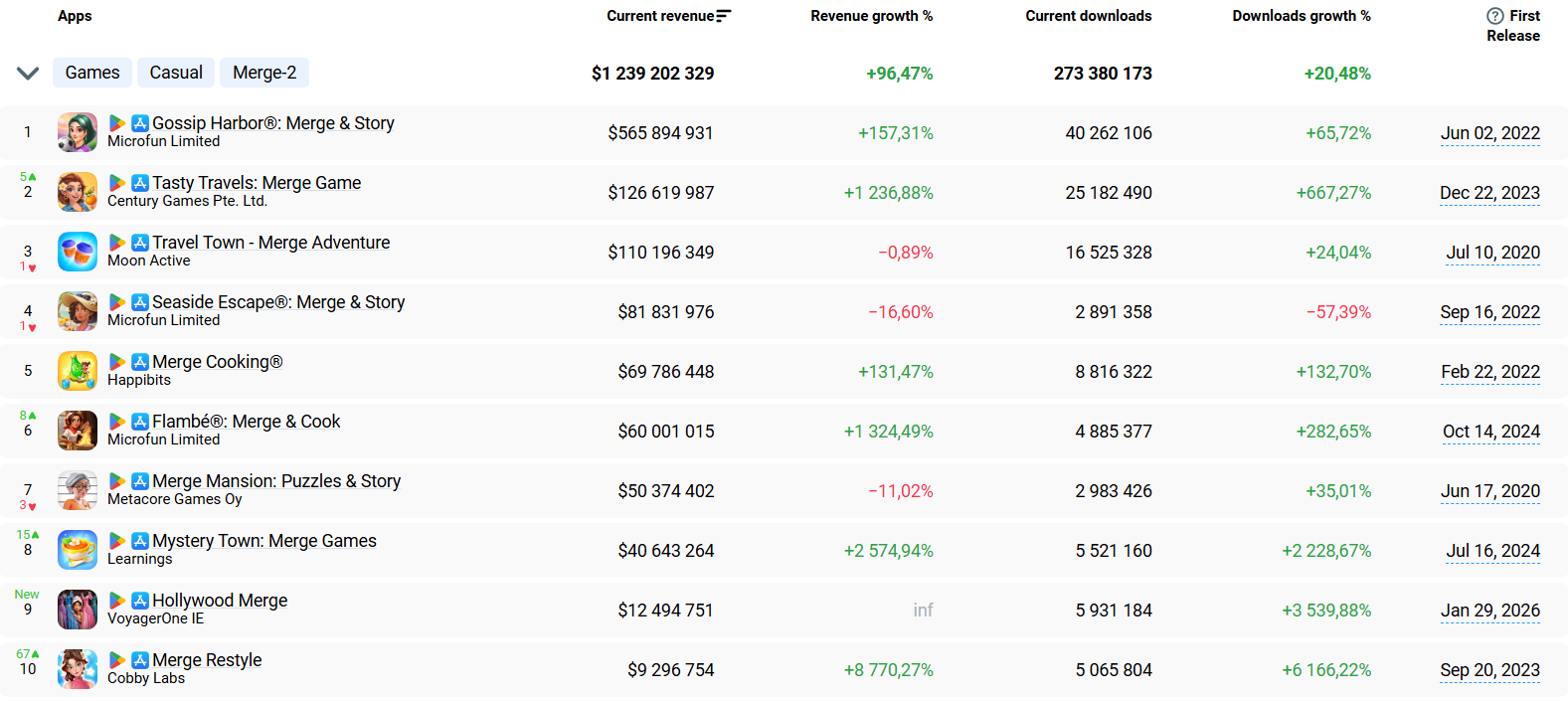 Period Comparison: top 10 grossing Merge-2 games in H1 2026 (YoY growth)")
The bigger shift, however, starts just below the leader. Tasty Travels now sits at #2, with $127M earned in H1 2026! Considering the vast experience and operational scale of Century Games, the publisher might actually be the one to lay claim to *Gossip Harbor*’s throne. Yes, Tasty Travels is still ~4.5 times smaller than the leader, but judging by the explosive 13x YoY revenue growth, it could close the gap much faster than expected!
A big part of Tasty Travels' rise comes down to UA. Where many Merge games—Gossip Harbor included—bet on emotional ad creatives filled with drama and characters in distress, the title plays by a different set of rules. Its best-performing creatives lean heavily into misleading gameplay: some copy Fruit Merge-like endless merge loops, while others borrow popular formats like "save the king" or even ideas from idle tycoons. It's an unconventional approach for the genre, but clearly one that works.
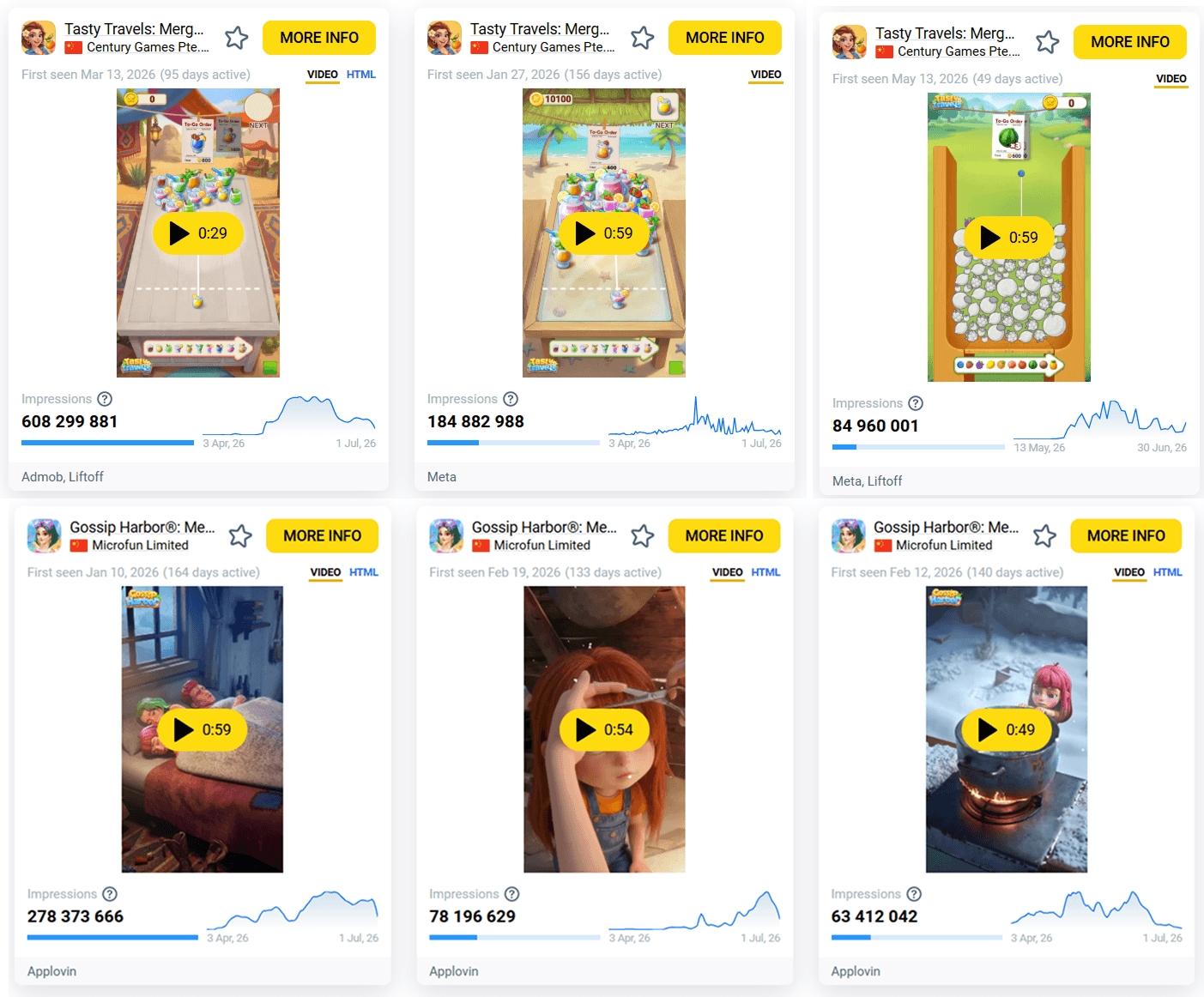 Ad Intelligence: Tasty Travels vs Gossip Harbor top-performing ad creatives
This is where Century Games’ background really comes into play. Known for hits like Whiteout Survival and Kingshot, the publisher built its reputation on 4X Strategies, where misleading creatives have long been a standard part of the UA playbook. Applying that expertise to Merge has helped Tasty Travels stand out in an increasingly crowded market.
Getting players to install the game, however, is only half the job. Keeping them is where many games stumble. Tasty Travels, however, manages that without trying to reinvent the genre and keeping the core formula proven by the top titles ahead of it. The game took it, executed everything at a high level, and added a few twists, which turned out to be enough.
That philosophy becomes clear from the very first minutes. Many leading Merge-2 games open with a narrative hook. Players watch a short cutscene—a character gets betrayed, loses everything—and suddenly they're emotionally invested in rebuilding their life from scratch. Tasty Travels skips that part and drops players straight onto the merging board. Narrative shows up eventually, but it plays a much smaller part. But how does the game compensate for that early on?
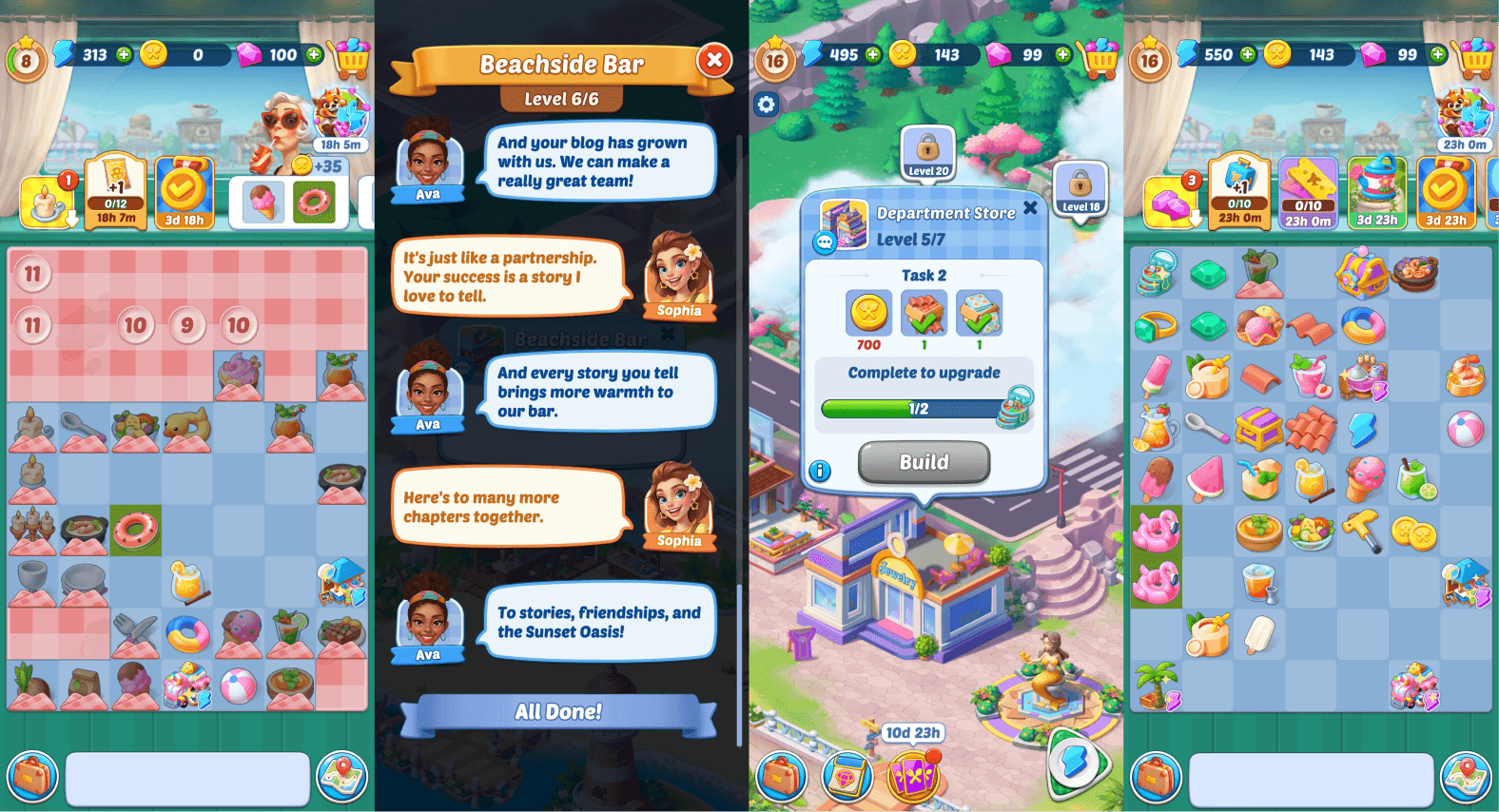
The already varied and goal-driven gameplay loop goes hand in hand with generous rewards, giving players plenty of time to become deeply invested before any meaningful friction appears. The meta reinforces this engagement through multiple overlapping objectives, with location upgrades requiring both soft currency and materials produced on the merge board. With so much depth built directly into the core experience, Tasty Travels does not need an especially elaborate meta to keep players engaged, much like Royal Match.
The next ingredient is LiveOps, which joins the experience almost right away. Albums, login calendars, paid passes, and special merge boards start appearing early and escalate quickly, soon becoming the key engagement driver. At the same time, they also often feed directly into monetization: album cards, for example, are bundled directly into store currency packs, adding a time-sensitive reason to spend before the season ends.
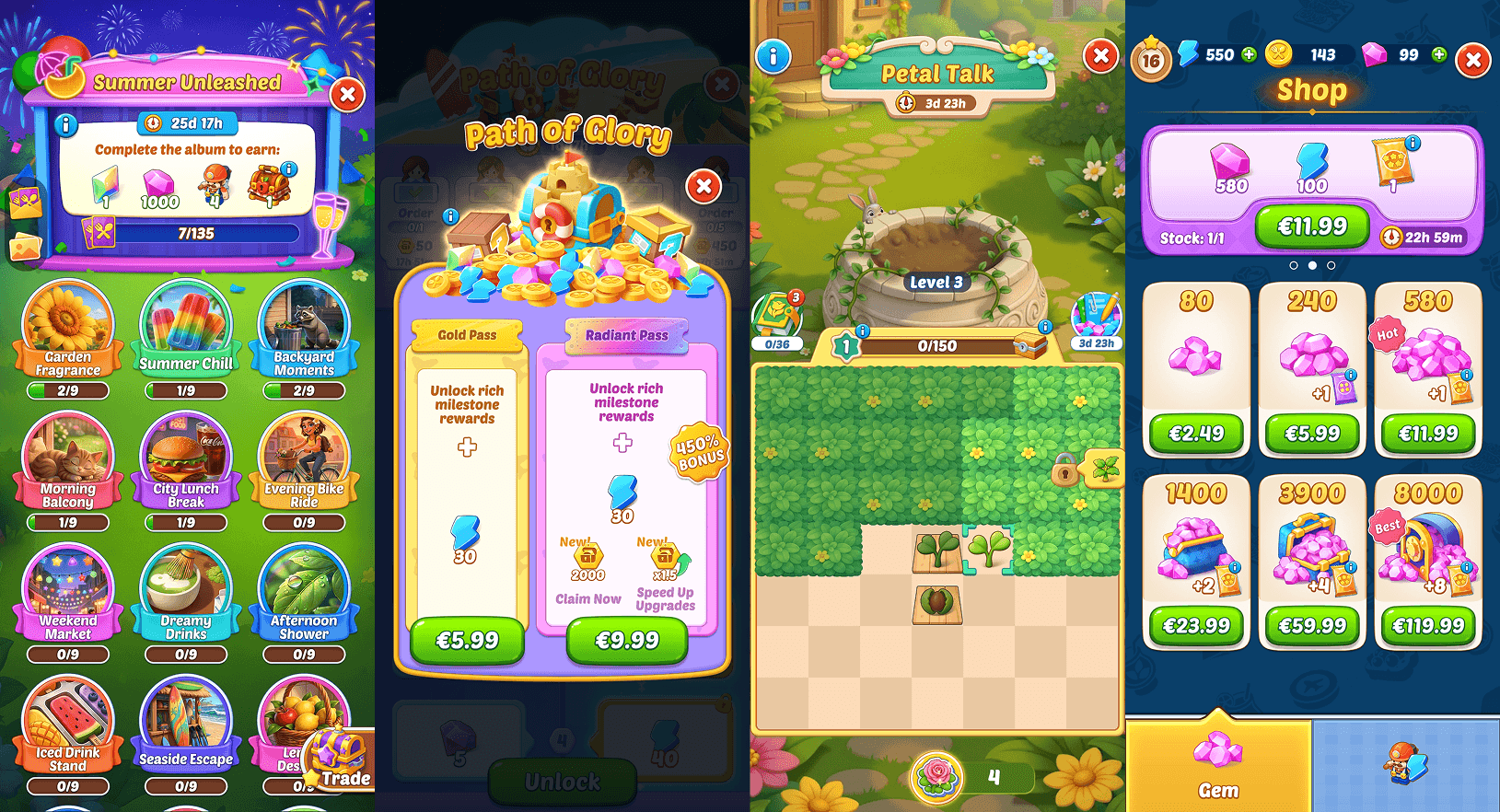
As Tasty Travels grew, it has given Century Games a taste of what the genre can do for them. This year alone, Century Games globally launched three Merge-2 titles and still has two more in soft launch. Mind you: before Tasty Travels, the studio had only two Merge projects! These are no longer just standalone experiments, but a studio scaling the genre, refining the proven recipe, and betting on the category long-term.
And that’s exactly the strategy we've seen work in the genre before. Following Gossip Harbor's breakthrough, Microfun used that momentum to secure more top-chart positions with Seaside Escape and Flambé®: Merge and Cook. Once a winning formula is found, scaling it across multiple projects becomes the next logical step.
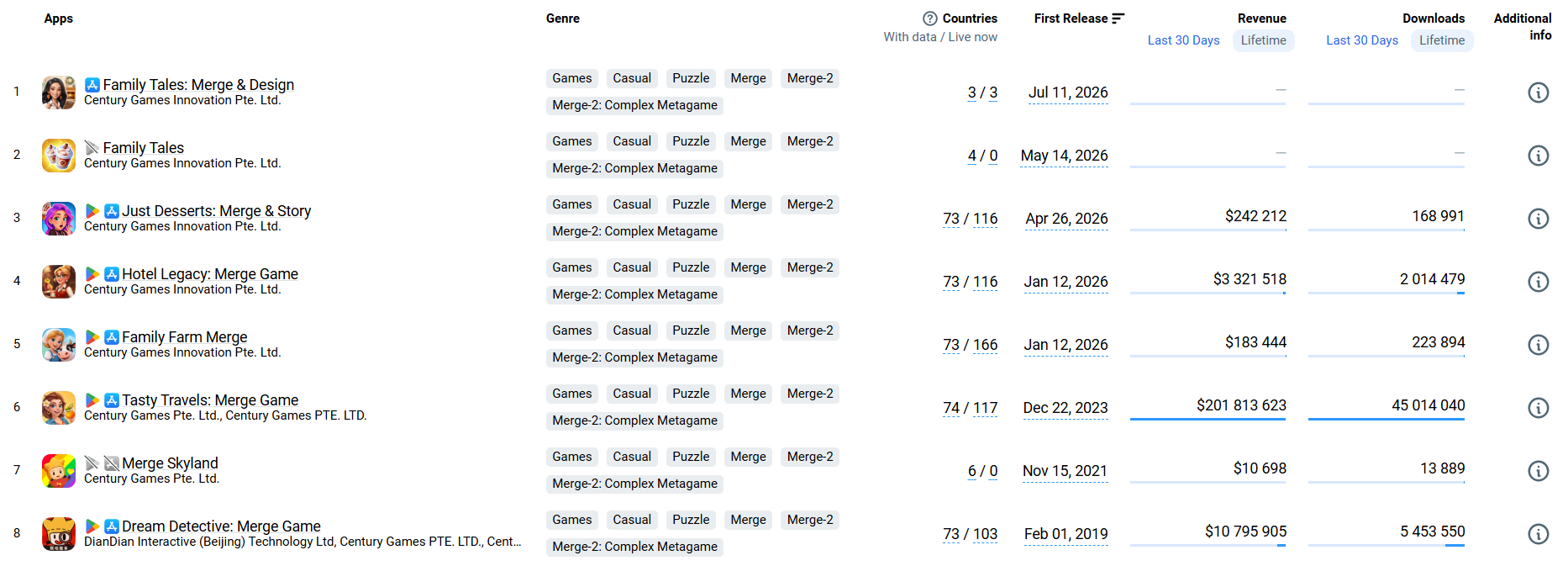 Merge-2 titles by Century Games
And that's perhaps the biggest takeaway for the genre as a whole. Out of 7 new releases that crossed the $100K monthly revenue mark at least once this year, 3 belong to Century Games—the same titles we have covered above—and 2 more come from Moon Active, the creators of Travel Town, Family Bay: Merge & Farm, and Reality Bay: Merge & Discover. That means most of the genre's successful newcomers are owned by studios expanding in a genre they already know well.
Breaking through now requires more patience and consistency than ever. Several titles we highlighted in our 2025 report as games to watch this year are already proving that point, with Mystery Town: Merge Games by Learnings holding the #8 spot among the top-grossers with $40.6M earned in H1 2026 and Haunted Merge: Horror Story by BlueUltra rapidly approaching the top 10 with $9M thanks to its unusual horror theme.
💡 Mystery Town is just one of the success stories from Learnings, alongside Hypercasual hits like Vita Mahjong and Meowdoku. Curious how the studio pulled it off? Find out in our latest breakdown.
Before we wrap up with the genre, we just can’t ignore one of the biggest M&A moves in the Casual market. Supercell is acquiring Metacore, the studio behind Merge Mansion. The game once defined Merge-2 as we know it today. Then new leaders caught up, and the title has been declining ever since. Still, Supercell has a strong track record of reviving mature games—as both Brawl Stars and Clash Royale have shown—so this chapter may be far from over!
🎯 Games to watch in 2026:
- Hollywood Merge by VoyagerOne. A few years back, the studio entered the Match-3 race with Hollywood Crush, and now they've brought the same franchise into Merge. The early results suggest it was the right call: only half a year after its global launch, Hollywood Merge has already generated $15.8M in lifetime revenue, quickly catching up with the $16.6M earned by its Match-3 predecessor.
- Merge Restyle by Cobby Labs now closes the list of the genre's top-grossers, and its UA approach is a big part of why. As we noted in our UA trends overview, the game often shows off its LiveOps content in ad creatives, giving potential players a glimpse of the evolving experience waiting for them. That strategy drove 8M total installs, while the actual in-game events smartly paired with monetization turned them into $13M in revenue.
- Foodstars: Merge & Cook by Happibits. The studio behind Merge Cooking is now following the same path as Century Games and Microfun: growing within Merge-2 through multiple titles rather than betting everything on one. With its flagship title remaining a stable performer since 2022, Happibits has successfully carried that experience into Foodstars, pushing it to the top 12 grossing chart of H1 2026.
Hybridcasual Puzzles: The Gold Rush of 2026
Match-3 and Merge-2 are holding their revenue lead—and in Merge's case, actively growing it. But a closer look at install dynamics across Puzzle subgenres reveals a challenge both of them have to face now. New players are choosing Hybridcasual Puzzles more often.
The appeal is easy to understand. Sort, Screw, and Block Puzzles have become a bridge between the two markets: they carry the DNA of Hypercasual with simple loops, combining them with Casual-like systems like deeper progression, richer LiveOps, and fewer ads.
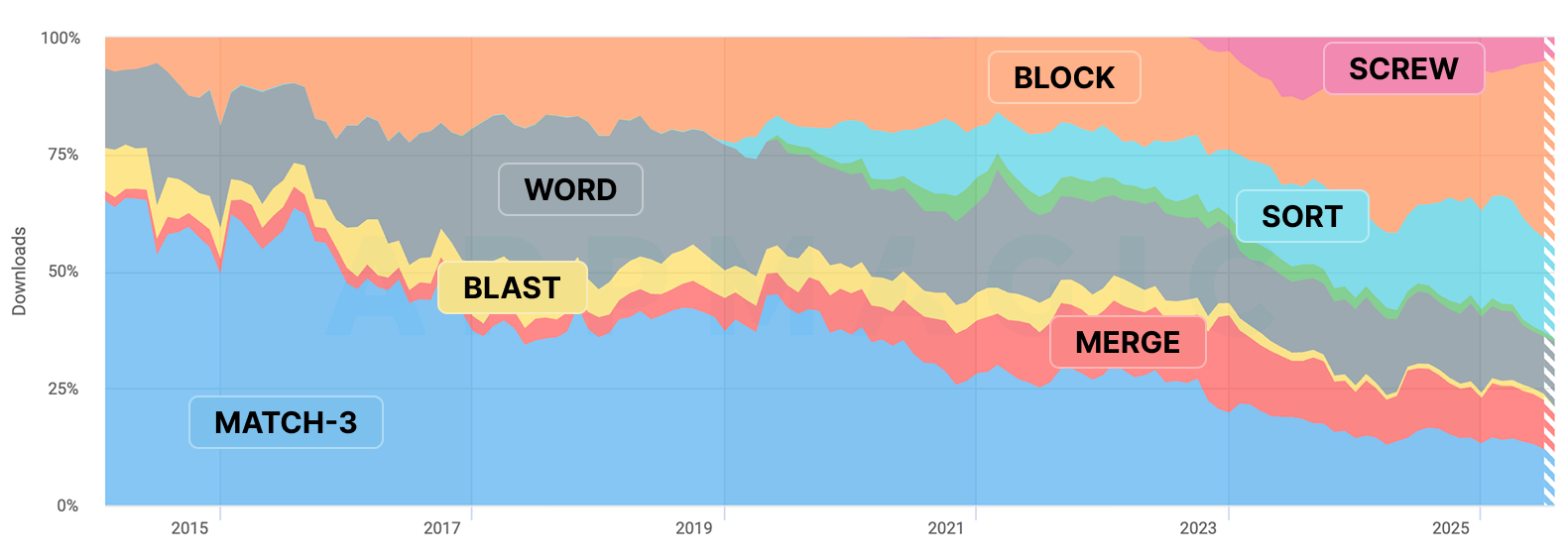 Market Segment Comparison: Puzzle subgenres downloads
The model is just as attractive from the development perspective. Lower production costs create more room for experimentation, while the flexible balance between IAA and IAP allows studios to adapt monetization around the strengths of each game. When done right, the result is a game that's easier to produce and market, yet capable of sustaining revenue in the long term.
Sort, Screw, and Block Puzzles are now the main growth engines within this space, together pulling in nearly $600M in IAP revenue alone during the first half of this year. While that's still well behind Match-3 or Merge-2, the pace of growth makes it hard to ignore. Sort Puzzle games alone more than tripled their revenue compared to last year.

While the broader Casual market stays flat, studios are actively hunting for growth opportunities, and Hybridcasual is where many find it. Block Puzzles became the year's standout hotspot: the number of games released in H1 2026 exceeded 2,000, up 89% YoY. Sort and Screw added roughly another 900K new titles combined, though momentum there is cooling.
As competition intensifies and large publishers strengthen their positions, the focus is shifting away from launching dozens of experiments toward driving higher LTV from existing hits rather than chasing the next quick win. Teams are moving away from volume and toward precision, following the path already taken by Casual developers. As leading titles like Color Block Jam, Screwdom, and Pixel Flow! adopt their best practices, the rapid rise of these hits ripples back across the industry, reshaping player expectations.
Perhaps the clearest sign that Hybridcasual Puzzles have entered the big leagues is the acquisition of Loom Games, the studio behind Pixel Flow!, for more than $1B by none other than Scopely. Launched in August 2025, the game surpassed $125M in lifetime IAP revenue in under a year and, in many ways, shaped what Sort Puzzles are in 2026.
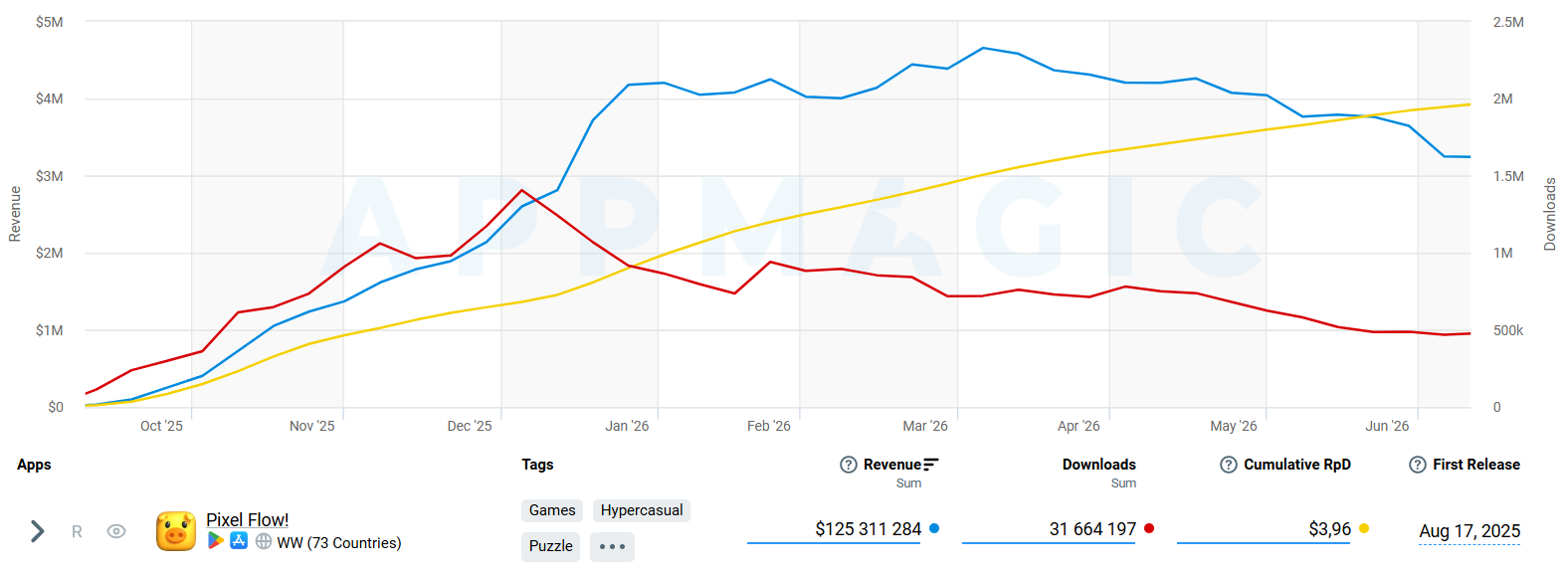 Pixel Flow! revenue, downloads, and RpD
One big reason behind it was a simple but fun core idea: sort colorful pigs onto a conveyor belt to clear an image piece by piece. Wrapped in just enough monetization depth and a consistent event schedule, that concept helped secure the title's chart dominance and made it a trendsetter.
The market responded fast, as games built around related keywords stormed the app stores. The data reflects that well: in H1 2026, 137 new releases used the keyword "pixel" in their names and store descriptions, and 194 more featured "flow," while dozens more adopted "loop" to echo the conveyor-based gameplay and visuals.
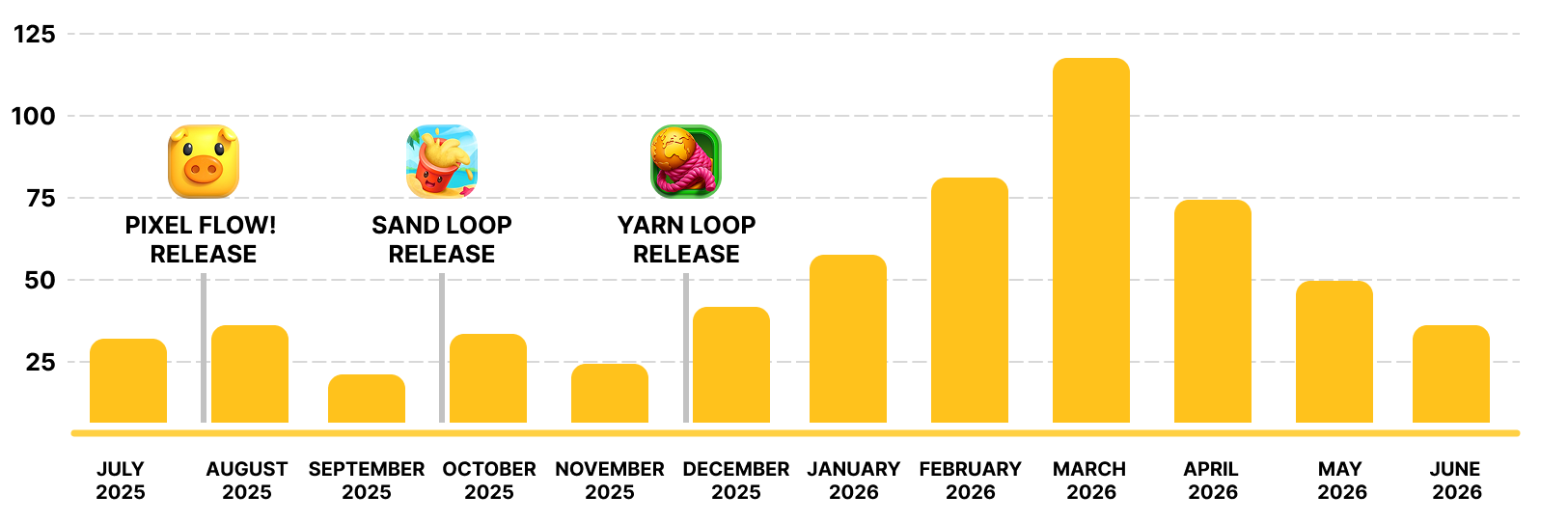 Games featuring keywords “pixel”, “flow” and “loop” in their ASO
It might look like a trend that peaked and faded, but it evolved into something much bigger. When Pixel Flow! entered the charts, the first instinct of many teams was predictable: copy the ASO and clone the core to catch a sudden rising wave. Some even went a little too far, like Color Blaze Shooter, which was removed from stores for being a copycat (yet still made its $8M in four months).
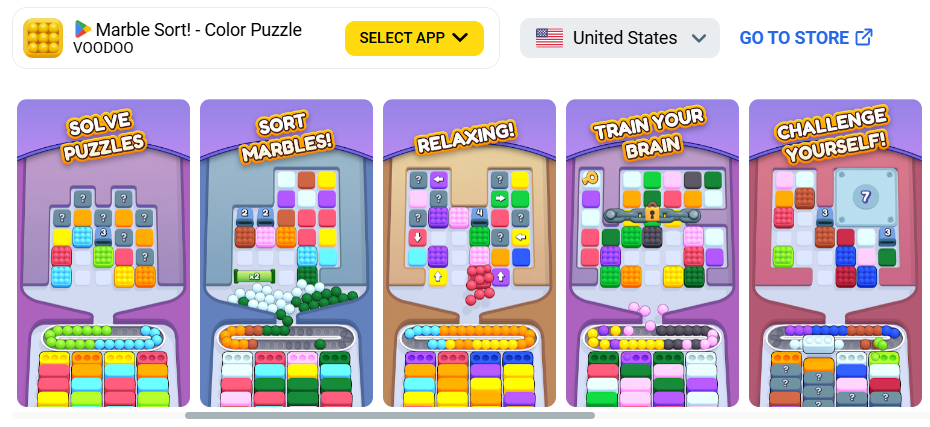
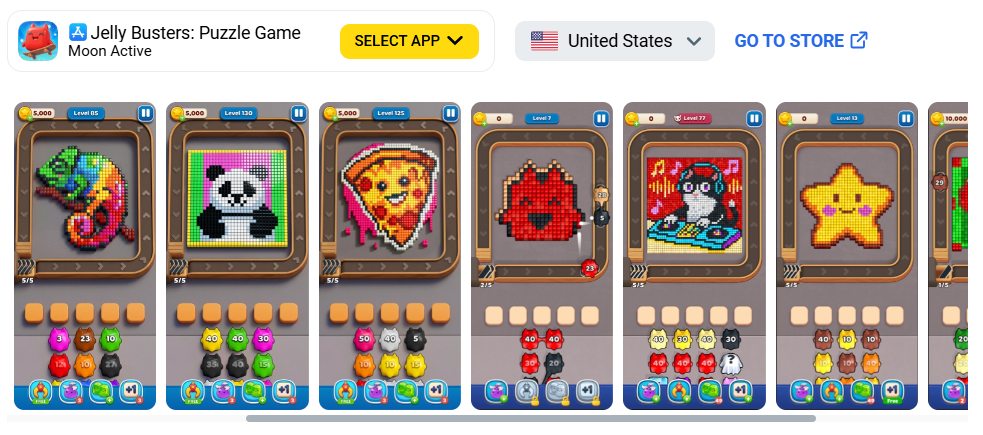
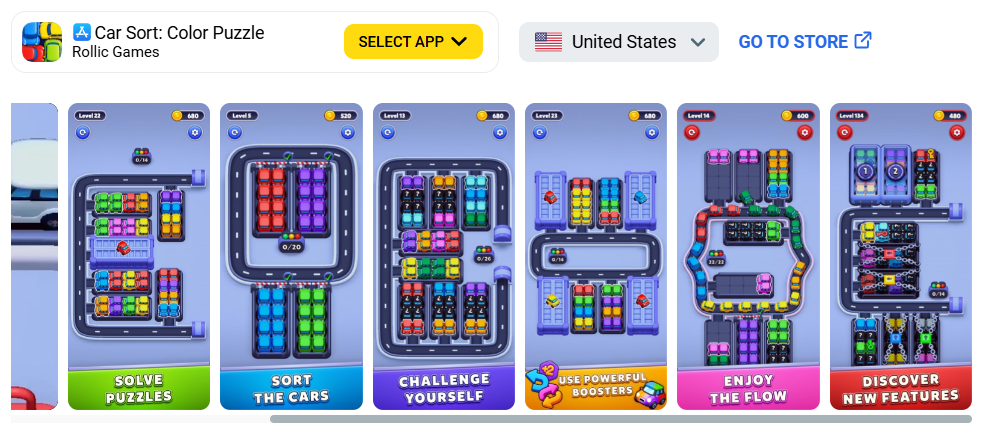
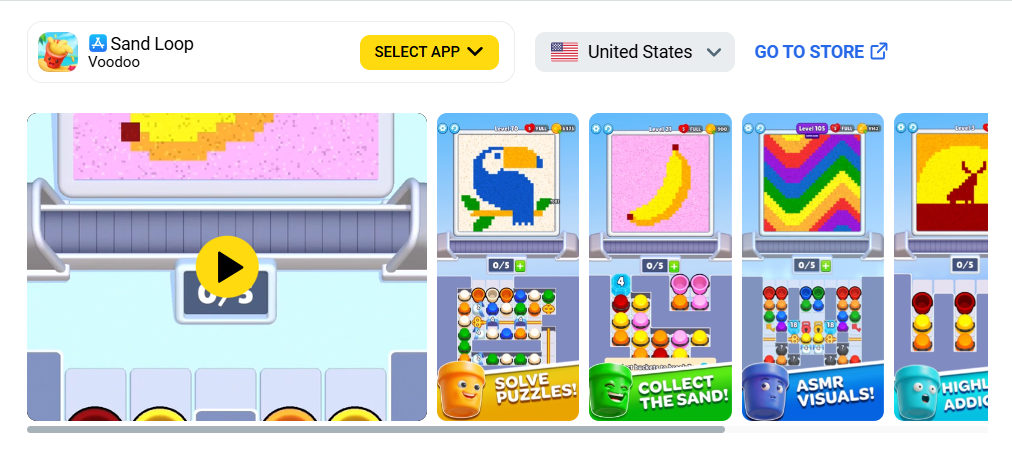
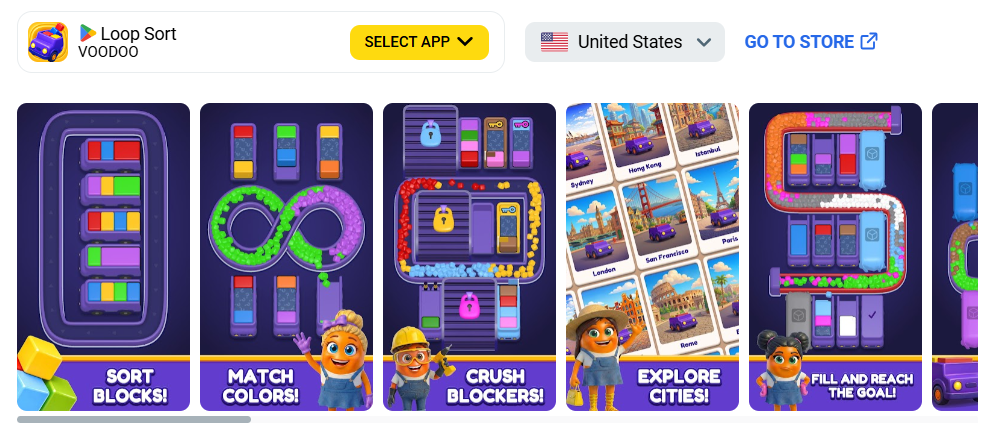
Then, studios started reimagining the conveyor mechanic, and titles like Yarn Loop by Spyke Games and Sand Loop by VOODOO showed how effective that strategy can be. Today, the references have become much subtler. Games no longer need "pixel" or "flow" in the title for the inspiration to be obvious, and here are the recent examples: Marble Sort! - Color Puzzle by VOODOO, Car Sort: Color Puzzle by Rollic, and Jelly Busters: Puzzle Game by Moon Active. When studios of that level are still building on a concept, it says everything about its staying power.
Hybridcasual draws talent and investment from across the globe, but much of its growth is shaped by Turkish publishers in particular. They have been setting the pace in this space for years, introducing mechanics, themes, and monetization approaches that consistently become new benchmarks.
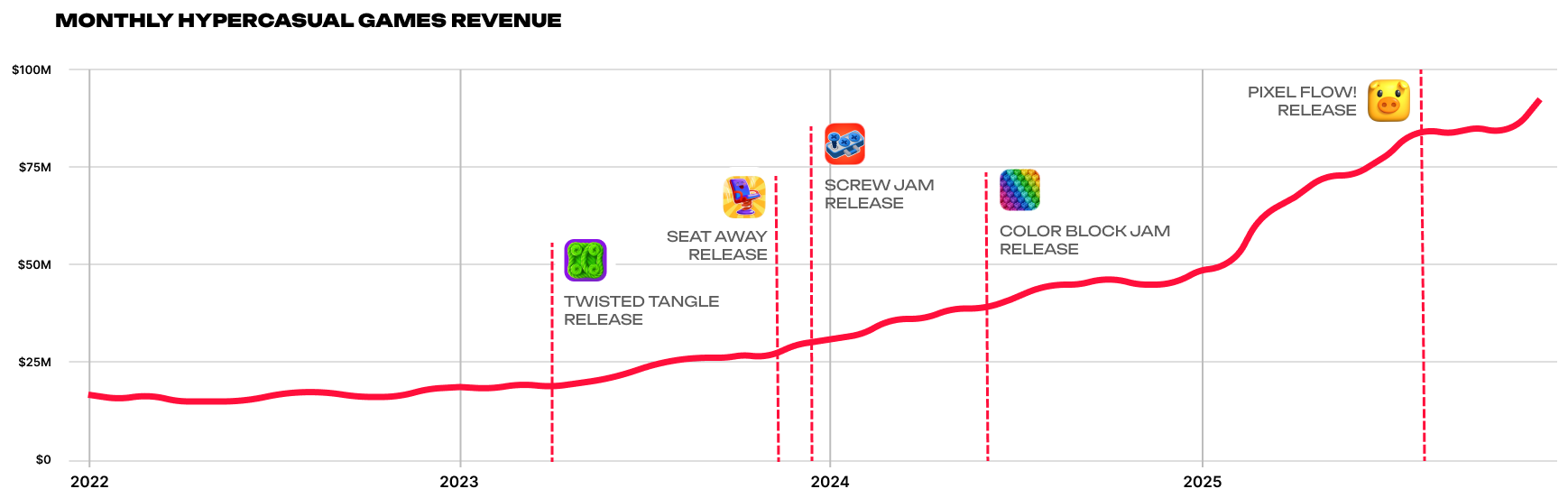
Rollic is the clearest example of that. Since 2022, the publisher has consistently released games that push Hybridcasual forward. Hits like Color Block Jam and Screw Jam borrow heavily from Casual Puzzle design, combining carefully paced progression with IAP-focused monetization instead of relying primarily on ads. That formula has become one of the genre's strongest reference points.
 Source: Türkiye's Mobile Gaming Landscape 2026
While studios like Rollic keep borrowing the best ideas from Casual, major publishers including Scopely and Moon Active are watching Hybridcasual just as closely. The impact goes both ways now, reshaping what players expect from successful Puzzle games across the entire market. With that context in place, let's shift the focus back to Casual and see how it's responding.
🎯 Games to watch in 2026:
- Marble Sort and Sand Loop by VOODOO. Each title has quickly crossed $17M in total IAP revenue, which is a huge shift for a studio built on Hypercasual roots and IAA-first execution. As we explored in our recent piece, these titles demonstrate well how Casual design principles are transforming strategies of Hybridcasual publishers.
- Point Out: Color Escape Puzzle by Lion Studios. Another trend is already taking shape, as games built around clearing paths by moving arrows are quickly spreading across app stores. Most stay close to their Hypercasual origins, leaning on UA scale and ad revenue. Point Out goes a step further, driving meaningful IAP earnings—enough to claim the #11 top-grossing spot in the Hybridcasual Puzzle category with roughly $8M earned this year.
This segment moves fast. New titles emerge, trends shift, and the competitive landscape can look very different from one quarter to the next. Our Top Apps tool is the easiest way to stay on top of what's rising—bookmark it and check back anytime!
Puzzle: Key Takeaways
Match-3 is still a market owned by well-established leaders, and the barriers to compete with them are only getting higher. Yet, games like Match Villains prove that there are still paths to success, even if carved out with years of experience, deep product expertise, relentless iteration, and… a few investment rounds!
Merge-2’s growth just won’t stop. The genre is attracting studios of all sizes, many of which are no longer aiming for a single successful hit. Like Microfun, they are launching several Merge titles at once to capture more of this gold-mine genre. The most successful so far is Century Games, whose Tasty Travels has emerged as a serious contender for the top. Its fight for the throne will be one of the key stories to watch in H2 2026.
Hybridcasual. The defining Puzzle trend of the last few years. Lower production costs, strong UA potential, and the flexibility to combine IAA and IAP allow these games to reach and monetize a broader audience. Nowhere is this shift more visible than in Sort, Block, and Screw Puzzles, the three fast-growing genres that are already pulling players away from traditional Casual titles!
Casino Games: Strategic Bets that Win
 Market Segment Comparison: Casino market revenue
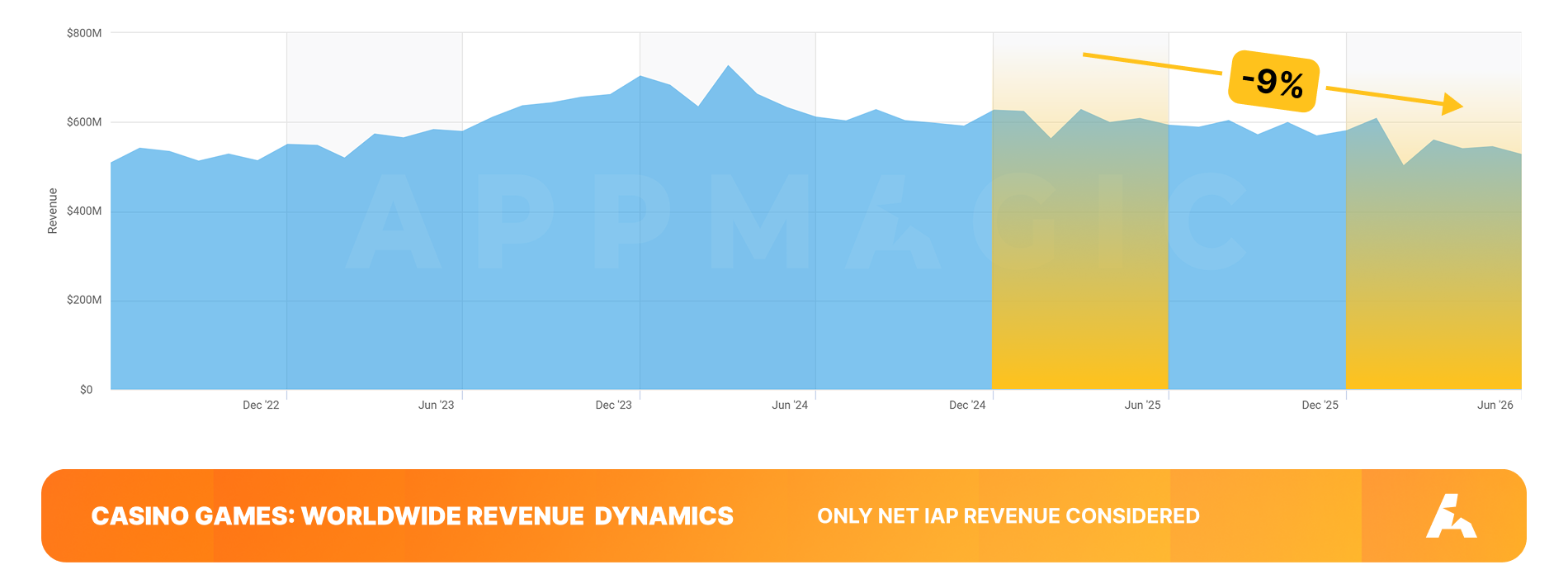
Casino ranks second among Casual's top-performing genres, generating around $3.3B in revenue during H1 2026 despite a slight slowdown. Within the segment, the revenue is split across its largest subgenres:
- Slots: $1.2B in revenue (–12% YoY), 245M downloads (+10% YoY). Lightning Link Casino Slots, Jackpot Party Casino Slots, and Cashman Casino Slots Games
- Coin Looter: $1B in revenue (–11% YoY), 109M downloads (+33% YoY). MONOPOLY GO!, Coin Master, and Dice Dreams
- Casino Card Games: $362M in revenue (–7.6% YoY), 174M downloads (–21% YoY). 欢乐斗地主, WSOP Poker: Texas Holdem Game, and Zynga Poker- Texas Holdem Game
Most Casino games sit closer to iGaming than to what we'd typically call Casual. One exception is the Coin Looter genre, which follows the broader market's playbook, making it accessible to a much wider audience. That is why this genre (our former in-house tag for it used to be Casual Casino) will be the sole focus of our Casino segment. But don’t worry, it has plenty of lessons for the whole Casual market!
Coin Looter: Being Direct with Players
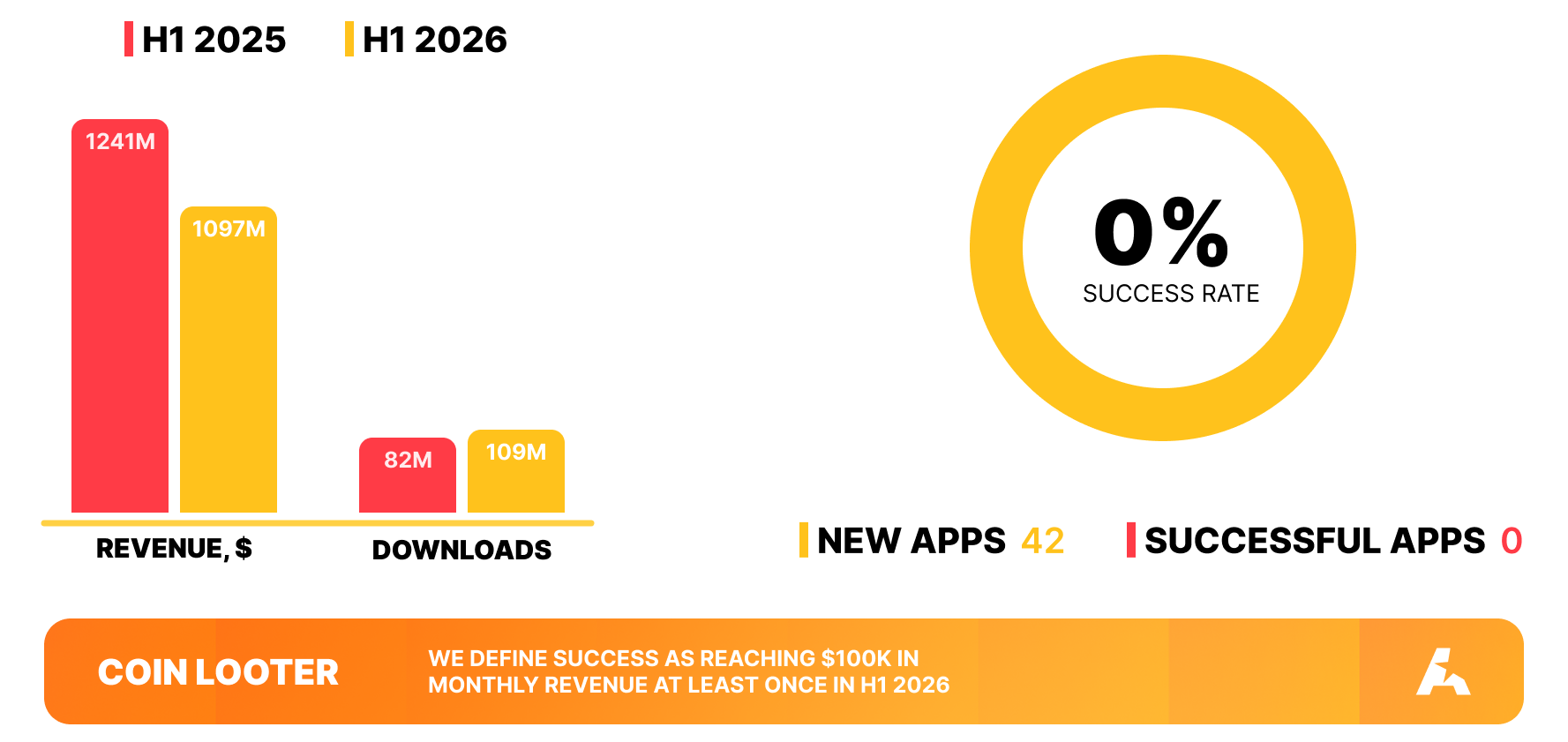
As the first half of 2026 wrapped up, the Coin Looter genre reached $1B in revenue, down 11% YoY. Downloads, however, moved in the opposite direction, growing by a solid +33% compared to H1 2025.
While a few new entries have joined the top chart, the leading trio of MONOPOLY GO!, Coin Master, and Dice Dreams remains unchallenged. A closer look at their revenue, however, shows that all three are in decline. Does it mean they are losing ground and making room for fresh competition? Not quite. A significant share of their revenue has simply moved elsewhere.
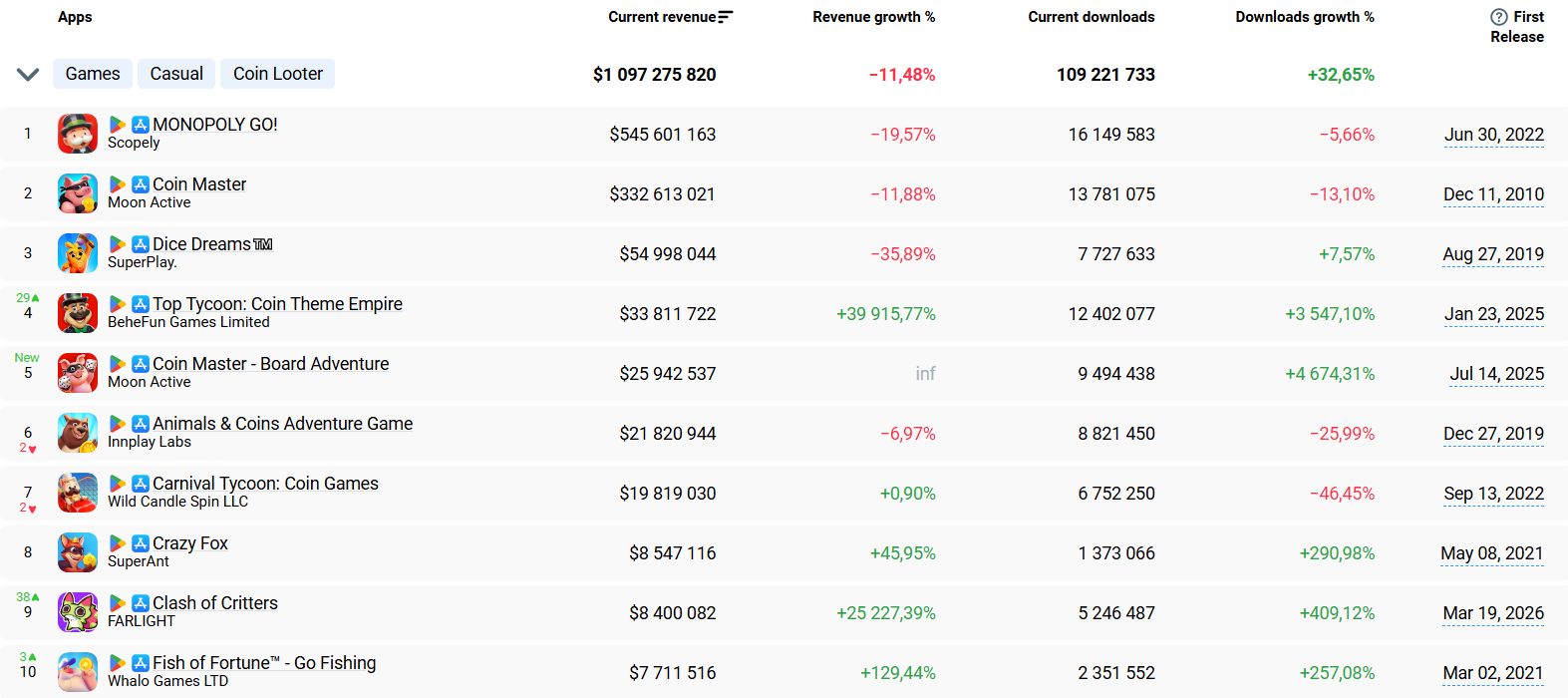 Period Comparison: top 10 grossing Coin Looter games in H1 2026 (YoY growth)")
The missing piece is D2C. Leading publishers are increasingly shifting purchases outside the app stores to diversify their revenue streams and reduce platform fees. If we add D2C income to the picture, both MONOPOLY GO! and Coin Master show much steadier performance than IAP data alone suggests.
Dice Dreams takes that approach even further. Since early 2026, the game has been rapidly scaling its D2C revenue, with direct purchases already making up around 50% of its total US revenue this year. And if the genre’s biggest games are shifting this much revenue outside the stores, what is that if not proof of just how much untapped potential D2C still holds?
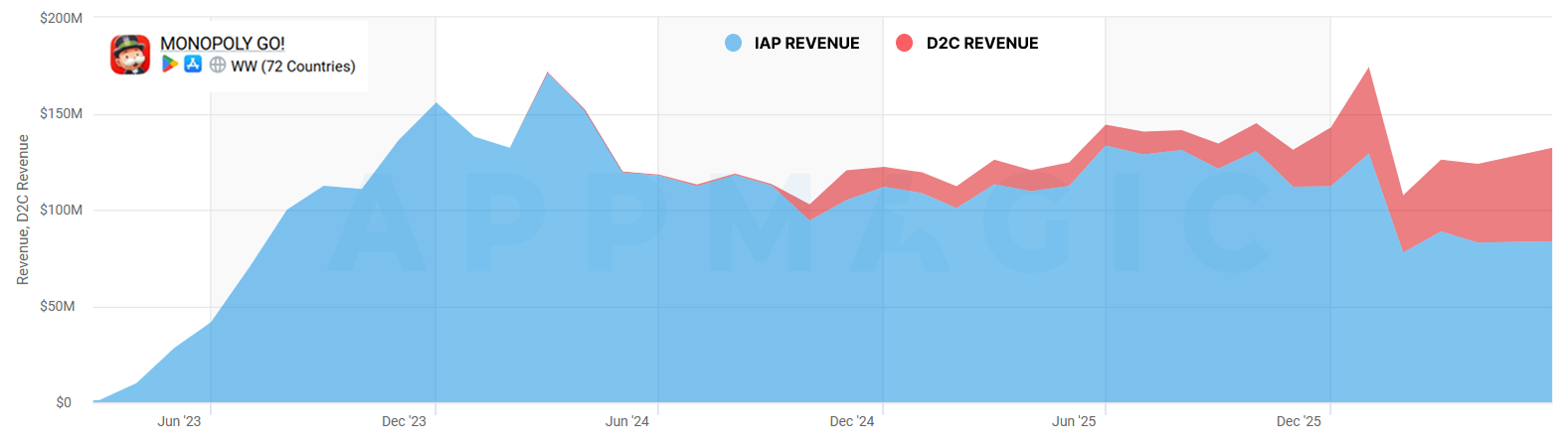
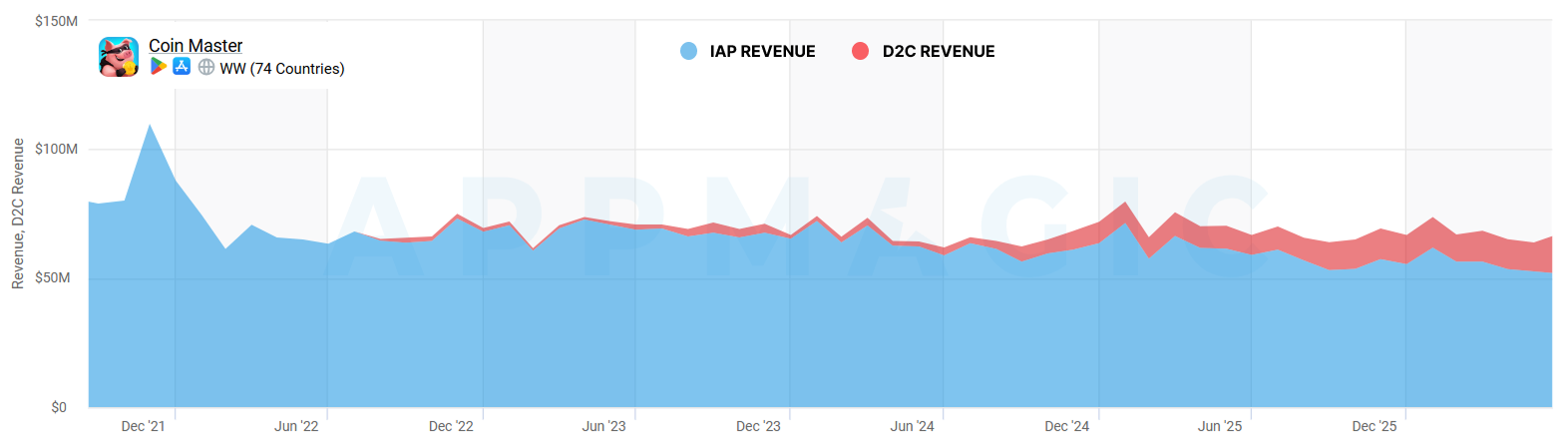
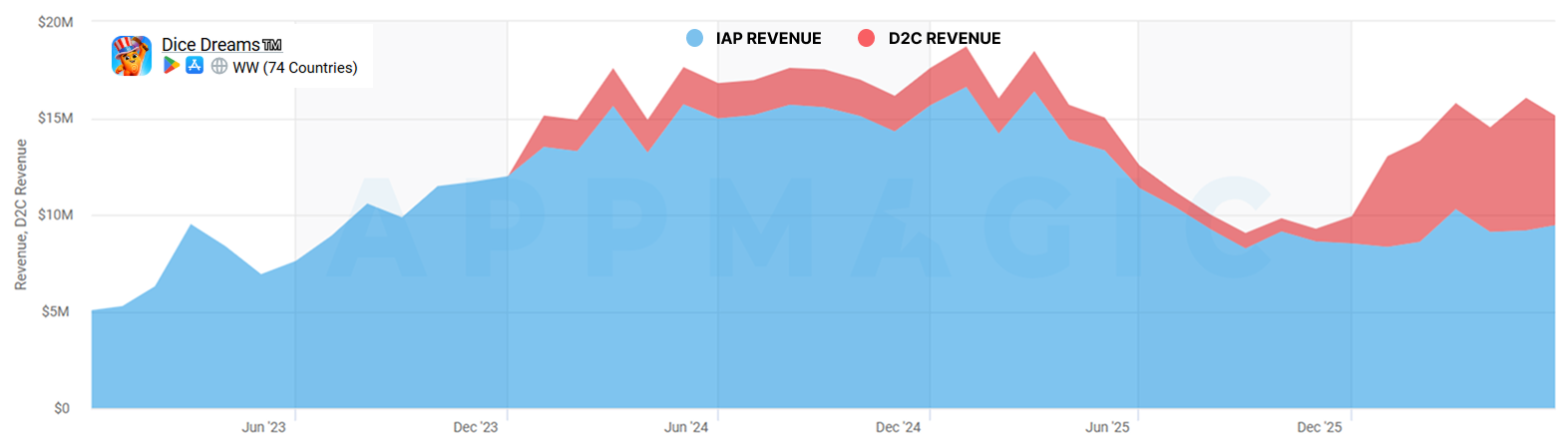 IAP vs D2C revenue share dashboard: MONOPOLY GO!, Coin Master, and Dice Dreams
For Moon Active, this year also brought along another strategic move. The Coin Master franchise expanded with the global launch of Coin Master - Board Adventure, and the title has already climbed into the top 5 with roughly $26M in IAP revenue earned in H1 2026. The game stays close to the IP’s roots, but replaces the slot machine with a board-and-dice format. Yes, much like MONOPOLY GO!, which showed how cozier aesthetics and greater distance from gambling vibes can open the genre to audiences it had never reached before.
The gameplay itself remains highly familiar: roll the dice, move across the board, collect rewards, trigger raids, upgrade the village—you know the drill. What stands out almost immediately is the sheer weight of LiveOps behind it. Events appear within the first session and escalate quickly in both variety and intensity, to the point where event icons barely fit on the game's main screen.
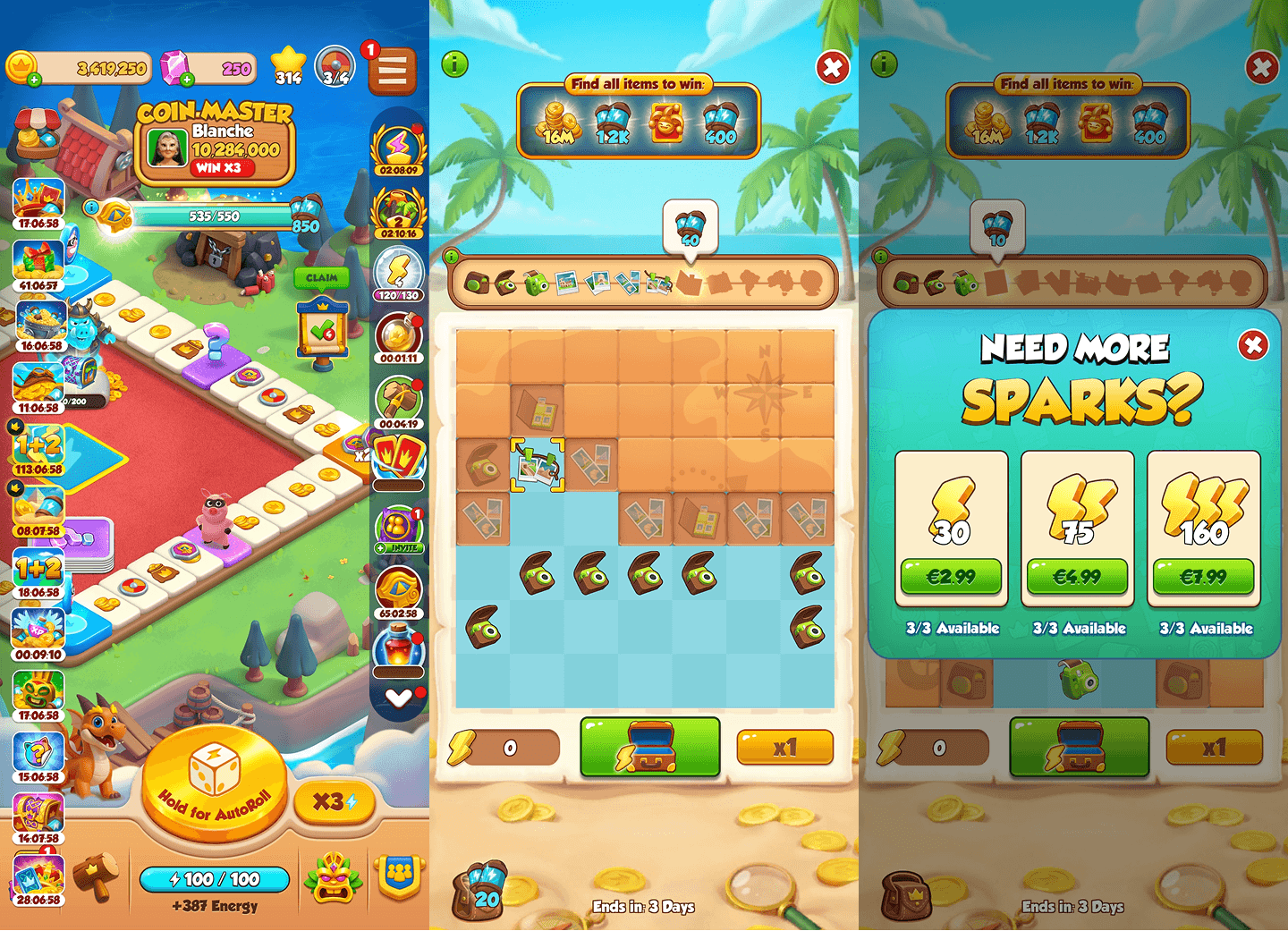
In its LiveOps, the game often borrows ideas from other Casual genres. Events featuring merge boards, such as Merge Island, have become a part of the title’s regular event rotation with visual reskins. They also come with an extra monetization layer: players can buy merging energy directly or earn it through core gameplay, while merging new items pays back in core energy, album cards, and other resources.
This example captures something important about how the game is designed. Almost every event comes with its own resource loop and a dedicated set of packs to spend on. Players can pick the events that appeal to them and progress in the core along the way. At the same time, the enormous amount of offers and time-limited activities can feel overwhelming. Coin Looter players, however, are mostly used to it, as tight event grids are the genre’s established standard even newcomers have to match.
The game followed a well-worn path for the IP, but Moon Active wasn't done experimenting and looked toward Hybridcasual for the next move. The result was Hole Stars: same visual references and characters put into a completely different core. Built on the Eat & Grow mechanic, the game lets players control a hole that grows by swallowing items dropped into it.
And this choice is especially notable. The Eat & Grow category has been dominated by All in Hole since mid-2024. That title single-handedly redefined the niche's growth ceiling back then, and many studios rushed to follow. According to our Advanced Search, around 120 games were released in the category between 2025 and 2026. For a long time, though, none of them could really compete with HOMA. They still can’t, but this might change in the near future, as the genre is seeing a lot of promising newcomers lately, and Hole Stars is one of them.
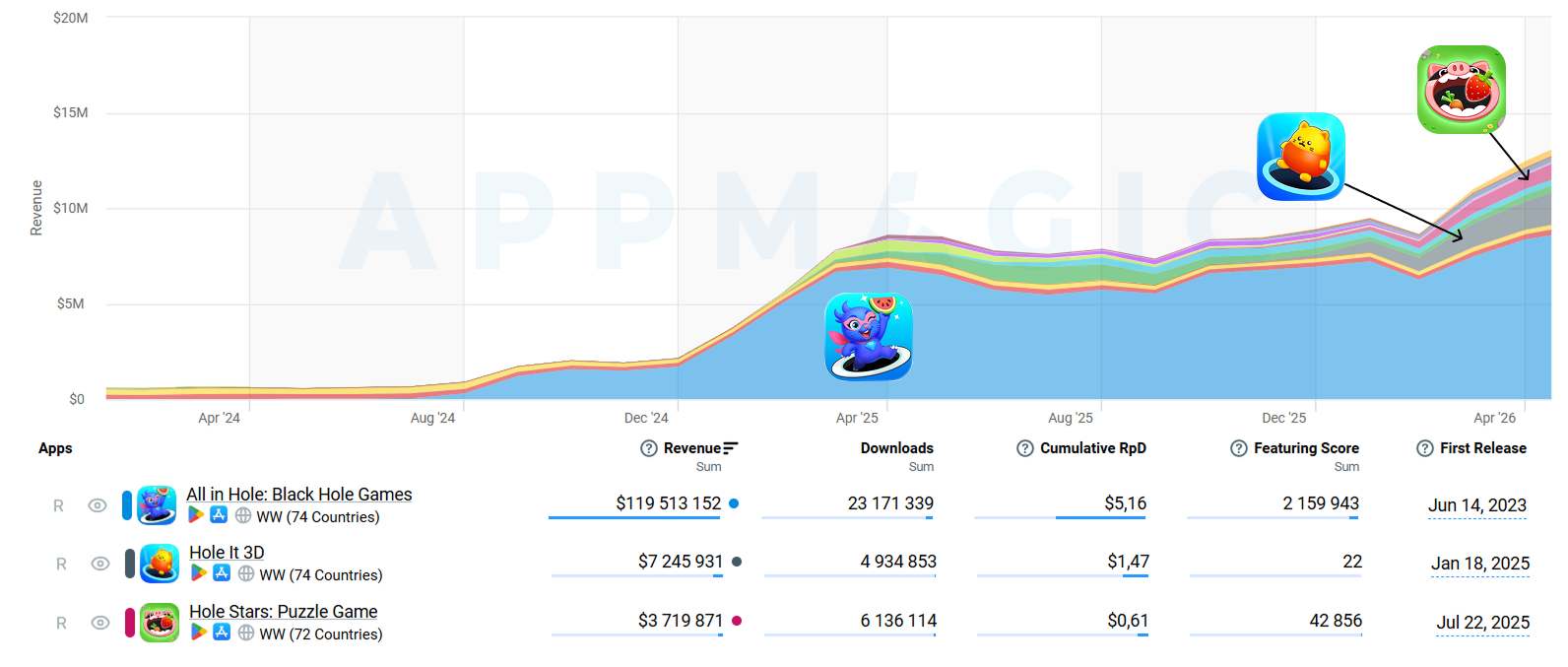 The Eat & Grow market dashboard
The title has already reached $5M in IAP revenue. Though it is far below Moon Active’s own standards, by Eat & Grow's measures, it's a meaningful result! Alongside Hole It 3D by Supersonic Studios, which has already surpassed $10M, the game is bringing fresh players into a still-small category that might eventually break into the bigger leagues!
Meanwhile, opportunities for newcomers within Coin Looters have become even more limited. None of the 42 titles launched in H1 2026 managed to surpass the $100K monthly revenue benchmark, not even once. As the segment's leading games keep raising the bar on what players expect, more teams are drawing the same conclusion: the next big opportunity probably lies elsewhere.
🎯 Games to watch in 2026:
- Clash of Critters by FARLIGHT. While most Coin Looter hits lean on familiar themes—board games, slot machines, amusement parks—this title stands out right away. Its gameplay revolves around collecting cute monsters and earning upgrades through plinko-like mechanics. Despite this unusual setup—or perhaps because of it— the game ranked #9 in the genre with $8M earned during H1 2026.
- Fish of Fortune™ - Go Fishing by Whalo Games LTD and Fishing Travel by Tuyoo Games. Both titles proved the fishing theme’s relevance within the niche. Rapid growth throughout the year pushed them to the #10 and #11 positions in the chart respectively, with each game surpassing $5M this year.
Casino Games: Key Takeaways
As IAP revenue declines across leading Casino titles, growth is moving elsewhere: into D2C channels, franchise extensions, and LiveOps strategies that redefine the genre’s baseline time and time again. Moon Active showed that the Coin Master IP still has room to grow, both within familiar Coin Looter territory and beyond it.
The genre once looked locked up. Coin Master's dominance seemed impossible to challenge, then MONOPOLY GO! proved otherwise. It seemed like the market just traded one monopolist for two. In reality, fresh competition keeps climbing the charts, posting solid revenue—far behind the leading duo, but enough to prove there's still room for ambitious newcomers to build something meaningful here.
Simulation: The Shift in the Farming Territory
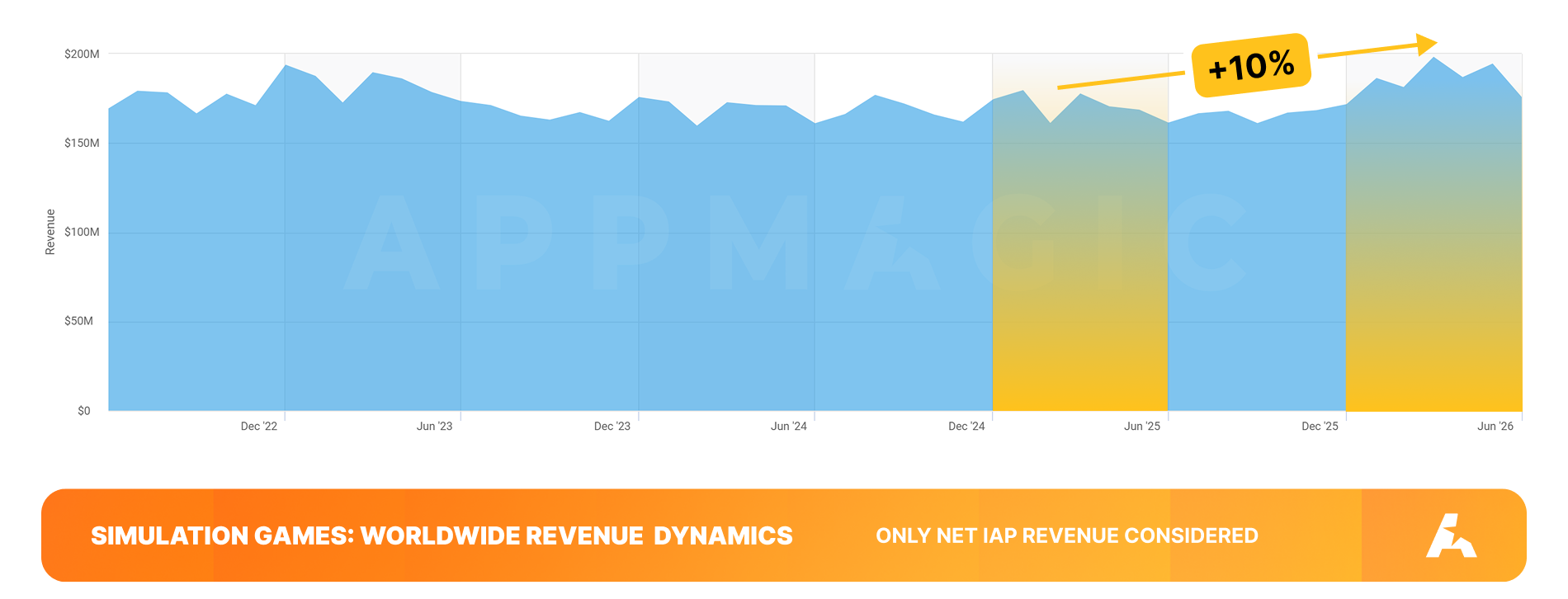 Market Segment Comparison: Simulation market revenue
In H1 2026, the Simulation genre generated around $1.1B, showing modest growth on both revenue and UA sides. Here's how its biggest subgenres performed over the period:
- Farming: $576M in revenue (+15% YoY), 172M downloads (+33% YoY). Township, Hay Day, and My Garden Tale
- Life Sim: $118M in revenue (+76% YoY), 172M downloads (+30% YoY). Heartopia, The Sims™ FreePlay, and BitLife - Life Simulator
- Time Management: $88M in revenue (+18% YoY), 226M downloads (+2% YoY). 时尚百货城, Cooking Diary® Restaurant Game, and Cooking Fever: Restaurant Game
The revenue split makes one thing immediately clear: Farming is the segment's center of gravity, consistently generating around half of Simulation's total income. Even mature titles like Hay Day are still pushing their daily revenue to new highs through steady, precisely tuned LiveOps. Meanwhile, newcomers are winning by applying the proven playbook to the right audiences and markets.
But to spot the biggest shift happening in Simulation right now, we need to break down the top-grossing games across the entire category, not within a single leading subgenre. This is where *Heartopia* comes in with one of the year's biggest breakthroughs. Following its global launch in January, the game broke into the top 3 with $67M generated in H1 2026 and came surprisingly close to Hay Day's $75M.
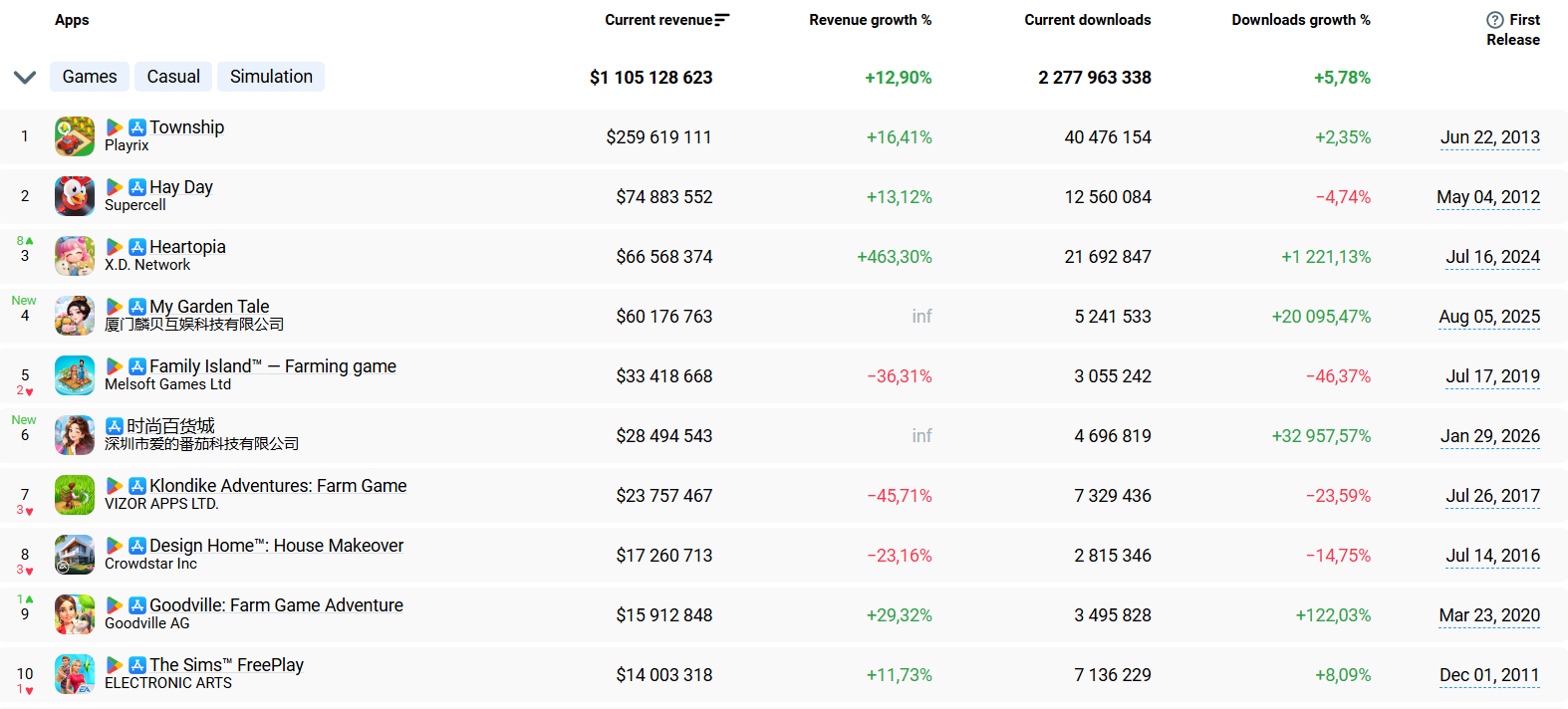 Period Comparison: top 10 grossing Simulation games in H1 2026 (YoY growth)")
That's an important milestone for the market. It shows that a Life Sim game can compete with Simulation's biggest titles when the strategy behind it is right. That success deserves a closer look of its own. We'll dive deeper into what drove Heartopia's rise in our upcoming biweekly newsletter—subscribe here to make sure you don't miss it. But for now, let's turn to the subgenre that keeps reinforcing its dominance within the segment.
Farming: Old Leaders, New Peaks
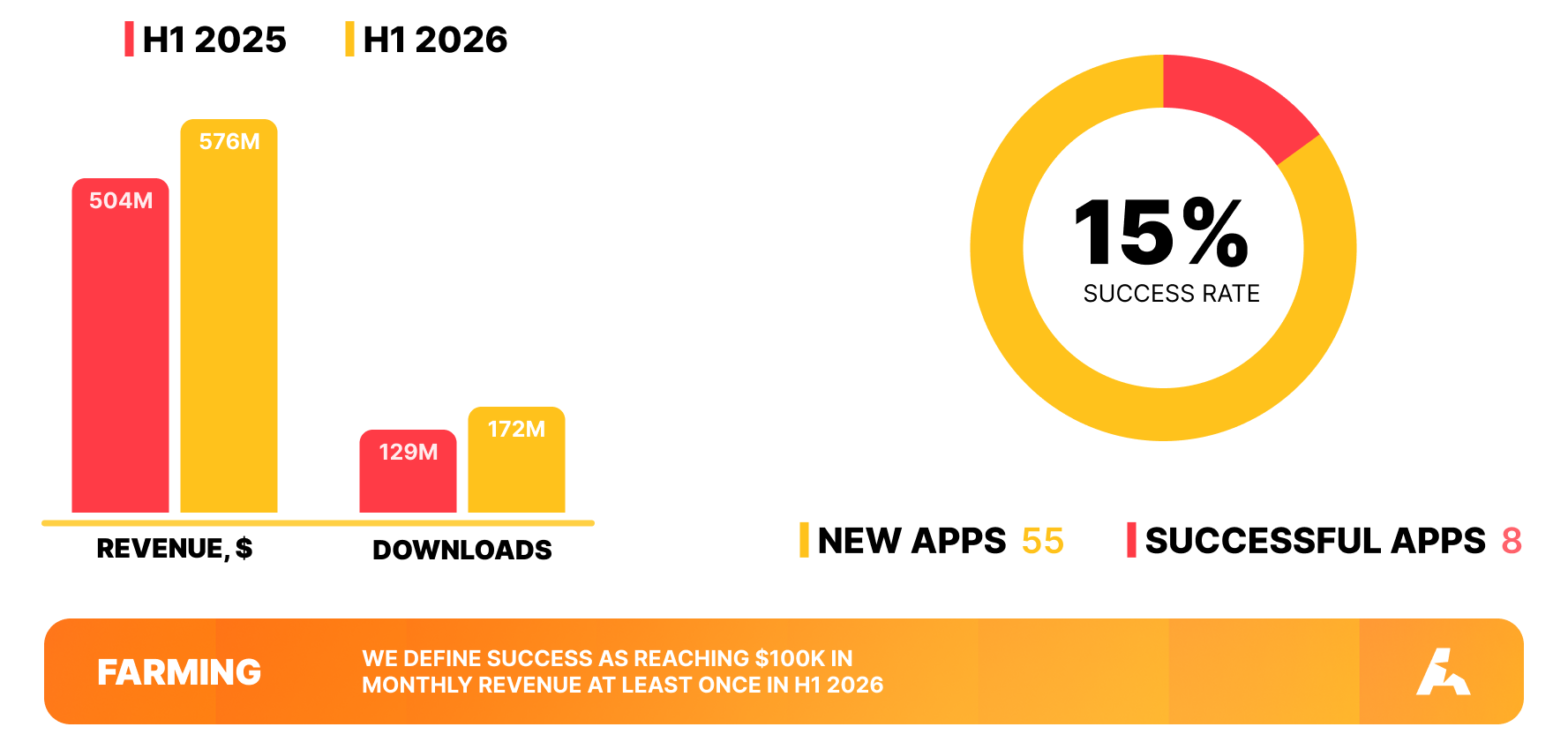
Farming's growth is quite remarkable considering how mature the market already is: $576M in total revenue, up a solid +15% YoY, with installs growing even faster, crossing 172M with a +33% YoY rise. Players aren't getting tired of cozy farming loops, and the genre, it turns out, hasn't reached its limit yet.
Even its longest-standing leaders are still finding room to grow. On May 1, 2026, Hay Day by Supercell crossed $1M in daily revenue. The game has delivered stable and reliable performance for years, but in more than a decade on the market, it hasn’t seen a daily peak this high!
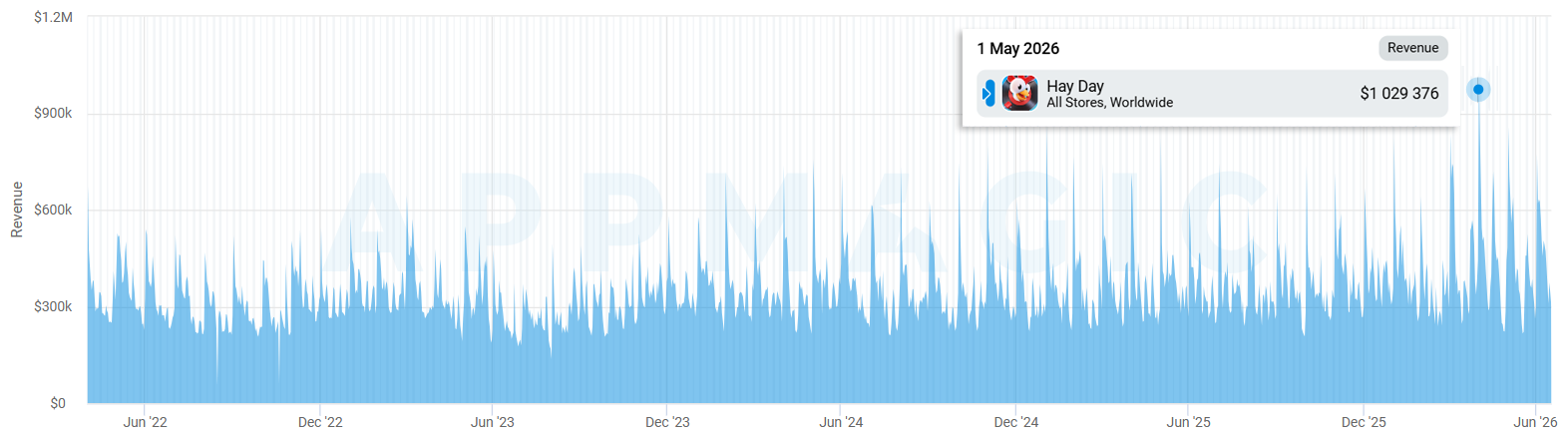 Hay Day daily revenue dashboard
So how did a market veteran suddenly hit a new record? A big part of the answer lies in its LiveOps execution. On that single day, Hay Day launched a full lineup of events:
- Two collection events with farm decorations—Wisteria Dreams and Golden Festival— with the latter dedicated to Golden Week, Japan's major holiday.
- Event tasks rewarding players for producing casual products and ingredients. Tasks can be skipped, but the number of available daily tasks is capped. Rewards include Keys, soft currency, Pass points, and core resources.
- A related exchange shop named Giftes Catalogue (Koi Fish)") where event currency can be earned through tasks or purchased directly through bundles.
- Refreshed regular features, such as the season pass and lucky wheel.
To connect all of that to revenue, the team supported the whole system with more than six special offers launched the same day, including holiday-themed chain offers. Every piece worked in sync: diverse rewards and customization options turned the event into a celebration players wanted to participate in, while the special offers gave them something worth spending on. The revenue spike shows just how effective that combination proved to be.
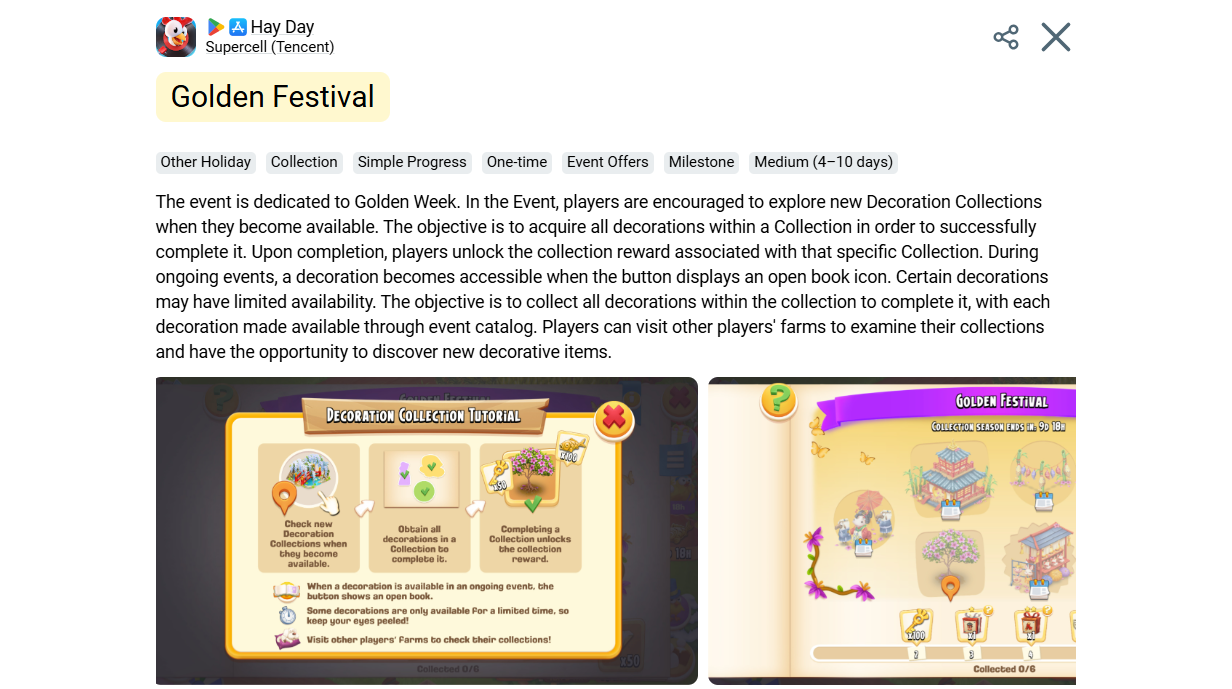 The Golden Festival event in AppMagic’s LiveOps & Updates Calendar
Hay Day masters its LiveOps strategy, even without constantly adding new formats to the schedule. Instead, the team is refining what already works: finding the right event mix, sharpening the timing, and adding small twists. In a genre that has proved it doesn't need breakout innovations to stay relevant, this kind of discipline keeps the game competitive.
Still, the revenue gap behind Hay Day is getting smaller, as My Garden Tale continues its confident rise, ranking third among Farming's top-grossers in H1 2026. The game first broke into the charts last year, riding the horse of the Chinese market alone—an unusual foundation in a genre where the US typically dominates revenue. With more than 90% of its lifetime revenue still coming from China, the game is now closing in on $100M, and the true figure is likely much higher, since AppMagic only tracks iOS revenue in the country.
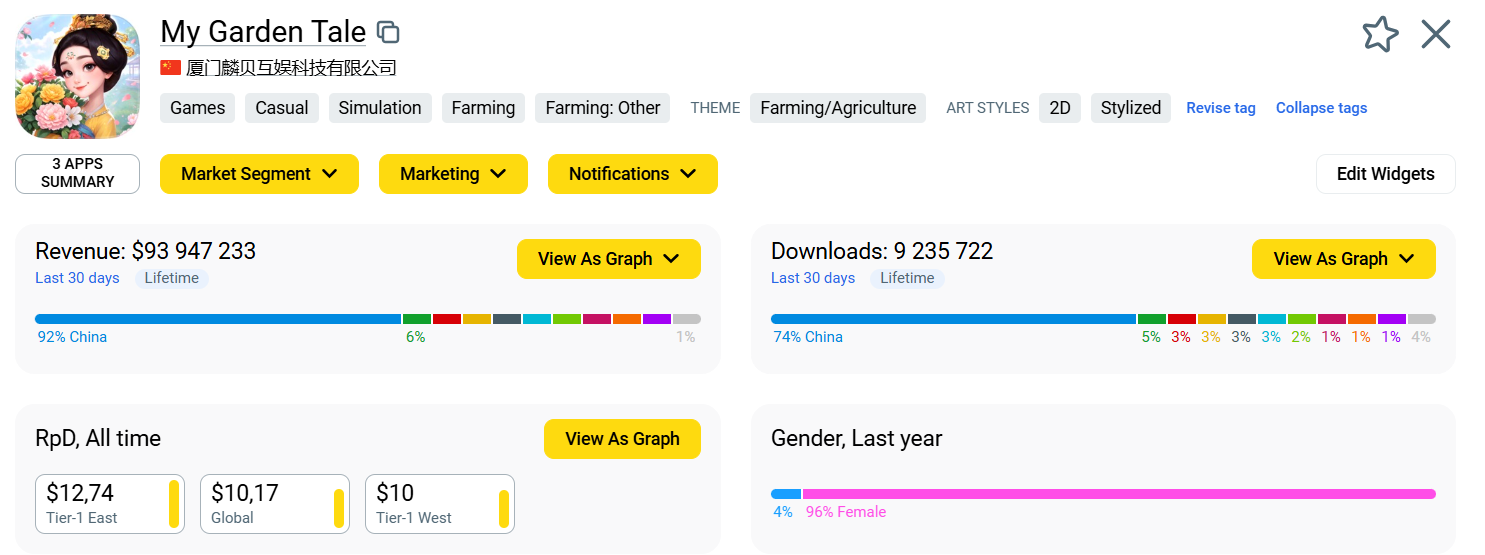
That’s why there is a special lineup of newcomers this year, as the developers started targeting the new audience and got inspired by My Garden Tale rather than Hay Day. This resulted in one of the best success rates we’ve seen today: out of 55 Farming games launched in H1 2026, 8 managed to cross the $100K monthly revenue mark at least once. And every single one of them targets Eastern markets specifically—for example, 오늘의 꽃 by Ujoy Games or Dreamweaving Garden by Pogo Hopper Games. Yes, it takes a lot to succeed on the Chinese market, especially for Western developers, but at least we know for certain where the room for growth is in 2026!
🎯 Games to watch in 2026:
- Big Farm Homestead by Goodgame Studios (Stillfront)"). The Big Farm franchise has been around since 2017, but its flagship, Big Farm: Mobile Harvest, has been on a steady decline since late 2021. Big Farm Homestead changed that trajectory, generating $5.7M in H1 2026, while the original managed just $1.3M over the same period.
- The Cozy Florist by Riftsky Games. Launched in late 2025, the game is already closing in on $6M in total revenue with 7M installs. The concept is classic: a relaxing loop of tending your farm, wrapped in cozy visuals. And that's exactly the point. The genre doesn't reward risk-taking, but it keeps rewarding strong execution of a formula players already love.
Simulation: Key Takeaways
For years, Simulation has been defined by Farming games, and this year, they only reinforced that status. Not only because of genre veterans like Hay Day that manage to hit new highs through disciplined LiveOps refinement, but also new audiences getting into the genre. My Garden Tale hit ~$100M mostly on the Chinese market alone, and might have spawned some of the new East-oriented titles.
Beyond farming, there is a new hit shining in the Simulation market. But *Heartopia*’s rapid rise remains an exception rather than a promising sign for all Life Sim games on the market. We’ll be digging deeper into this story shortly, so subscribe to our newsletter and stay tuned!
Casual Games Report H1 2026: Key Takeaways
Casual gaming didn't stand still in H1 2026, even if the topline numbers suggest otherwise.
Some genres are reshaping their growth strategies. Merge-2 keeps growing at a pace no other Casual genre can match, and the studios behind it—Century Games, Microfun, Happibits, Moon Active, etc.—are no longer betting on a single hit. They're scaling entire portfolios, and every new release raises the bar for whoever comes next.
Some genres prove even the deep monopolies leave a door open. Match-3 stays locked by Royal Match and Candy Crush Saga, while Coin Looter is heavily dominated by MONOPOLY GO! and the expanding Coin Master franchise. Yet both genres showed that deep product expertise and constant refinement can still carve out an exception.
Some genres are stable and consistent. Farming keeps rewarding discipline over bold reinvention: Hay Day reached its highest daily revenue in more than a decade with steady and precise LiveOps, while My Garden Tale built its success by the same playbook established by genre leaders, adapting it for the Chinese audience. This smart twist likely encouraged new Farming games to follow a similar East-first strategy.
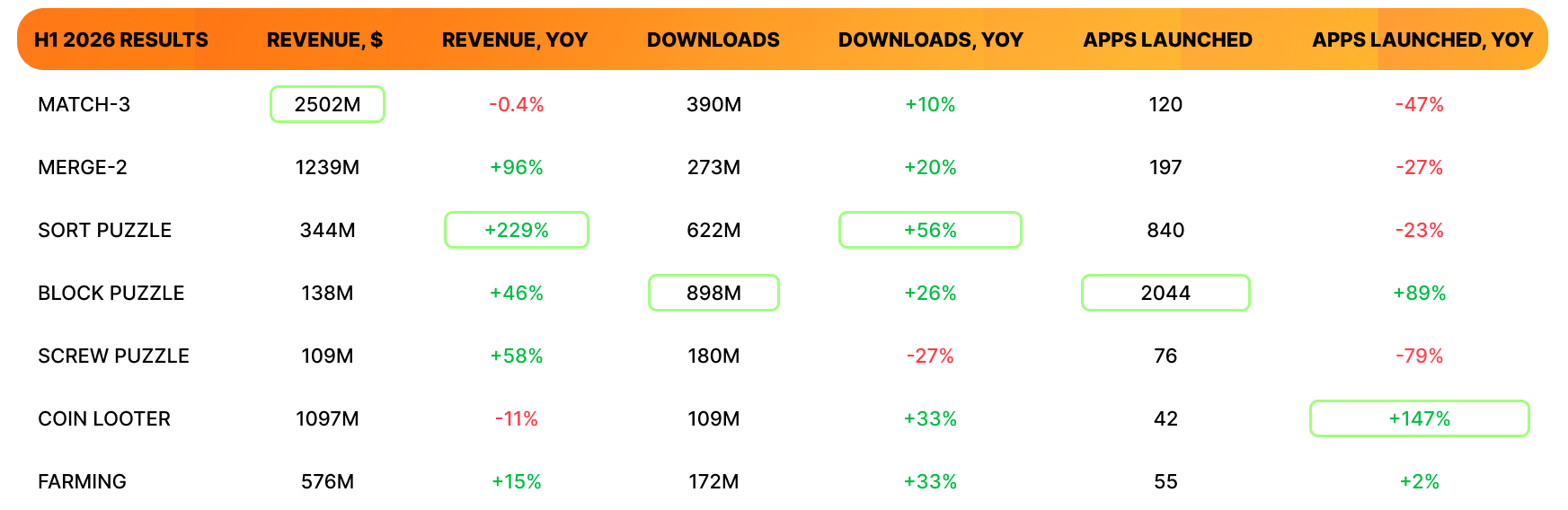
Meanwhile, some genres are still exploding! Hybridcasual Puzzles are pulling players away from both Match-3 and Merge-2, wrapping Hypercasual's simple loops in Casual-grade LiveOps and monetization. Pixel Flow!'s $1B+ acquisition by Scopely is the clearest sign yet that it's a trend Casual teams can't afford to ignore in 2026.
Thanks to you, game developers, the market keeps finding new ways to grow even when the headline numbers stay flat. And having the right data becomes even more crucial to spot the spaces where growth still exists. Luckily, AppMagic always has your back with top-tier data at every step of the journey!