The First $1M: What 158 Mobile Games Tell Us About Launching in 2026
158 mobile games released in 2026 have already crossed $1M in IAP revenue, but they took very different paths to get there. What separates the fastest launches from the slower growers? We look at genre, IP, and geography—and why reaching $1M faster doesn’t always mean earning more overall.
— Andrei Zubov

NTE: Neverness to Everness crossed $1M in revenue one day after its release. Jelly Busters took 144 days to do the same. Even if the gap seems meaningful, both are impressive, right? Yet if we benchmark these two titles by the revenue made over the last 30 days, it’s *Jelly Busters*’ $5.8M against NTE's $3.2M. So how much does the first million actually tell us about a game's potential?
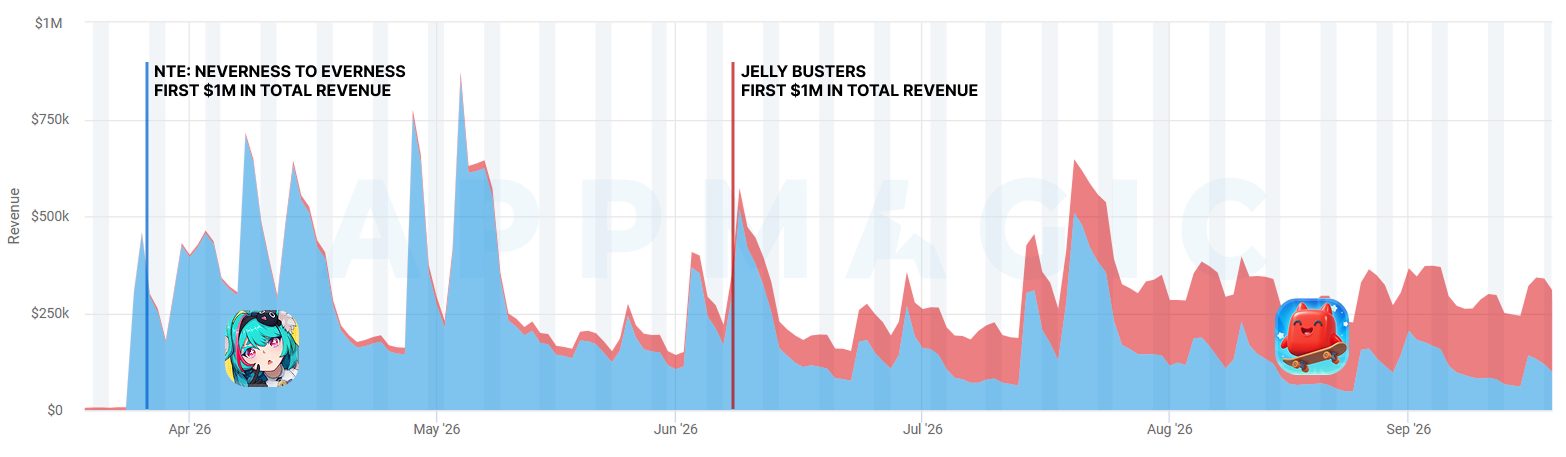
App Comparison: NTE: Neverness to Everness vs Jelly Busters
And more questions follow right away. Which new mobile games are reaching their first $1M? How long does it take, and what can their paths tell us about different genres and the industry as a whole?
To find out, we looked at games with release dates detected between January 1 and October 13, 2026, that had crossed $1M in lifetime IAP revenue by October 17. That gave us 158 titles (after excluding 36 games that earn at least half their tracked revenue in China, where our estimates cover the App Store but not local Android stores).
Let's look at who got there fastest, who took their time, and what happened after that coveted first million.
Puzzle Games: Success Takes Time
Across the sample, games that reached $1M faster generally have higher lifetime revenue. Part of this is built into the comparison: reaching the milestone earlier leaves more time to earn beyond it before our October cutoff. Yet Puzzle games stand out: they take longer to reach $1M, but have higher median lifetime revenue than the other major genres in our sample.
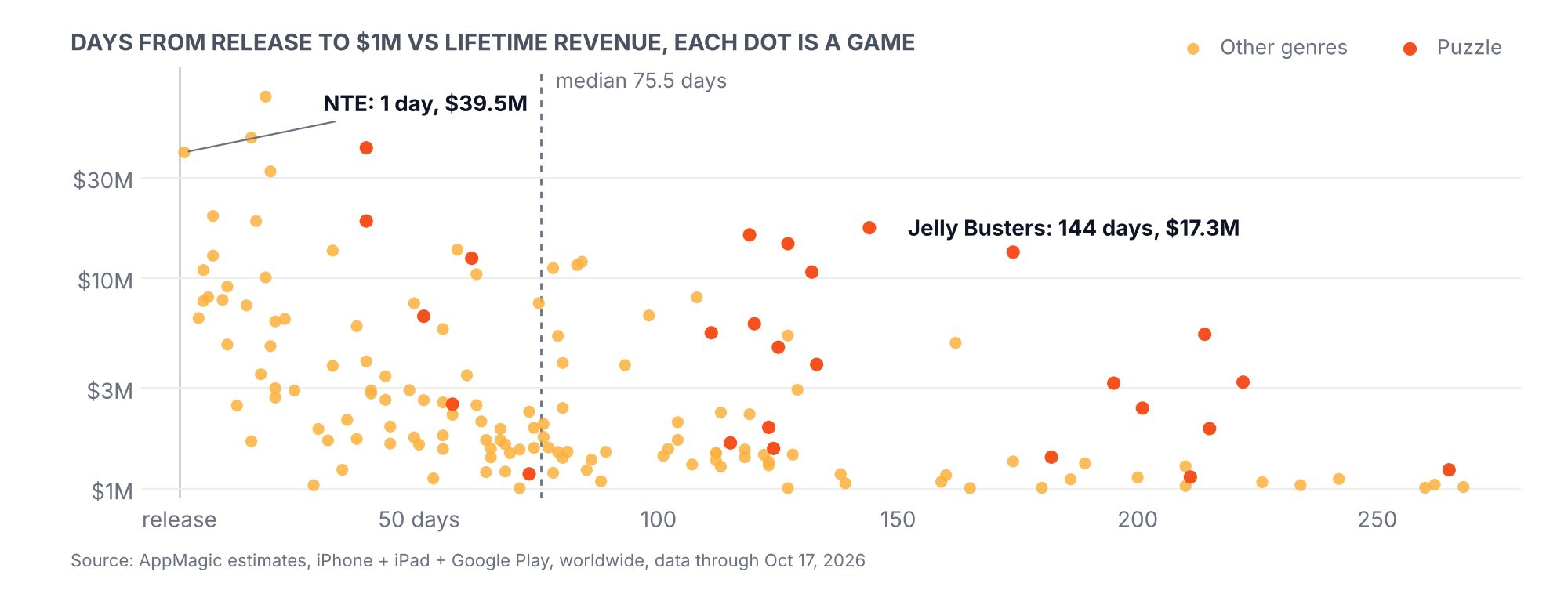
The 26 qualifying titles took a median of 126 days to reach $1M. None got there within 30 days. Yet their median lifetime revenue is $4.3M, the highest among genres represented by at least five games.
For comparison, RPGs took a median of 62.5 days to reach $1M and have generated $2.0M in median lifetime revenue. Puzzle games took roughly twice as long to cross the threshold, but have earned roughly twice as much at the median.
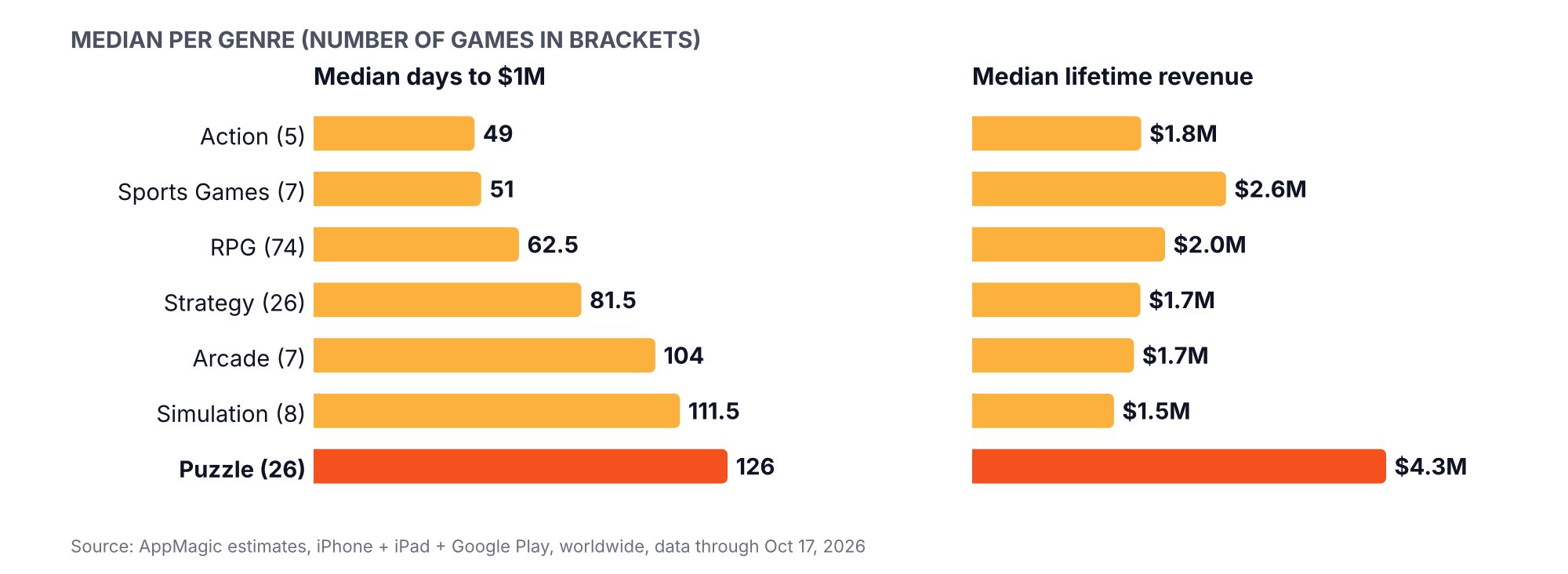
The comparison with RPGs comes with a few caveats: different production cycles, soft launch strategies, and marketing schedules. Puzzle games can test and iterate before scaling, while RPGs typically launch with a more complete product and a larger upfront campaign. Still, Puzzles' strong performance deserves a closer look.
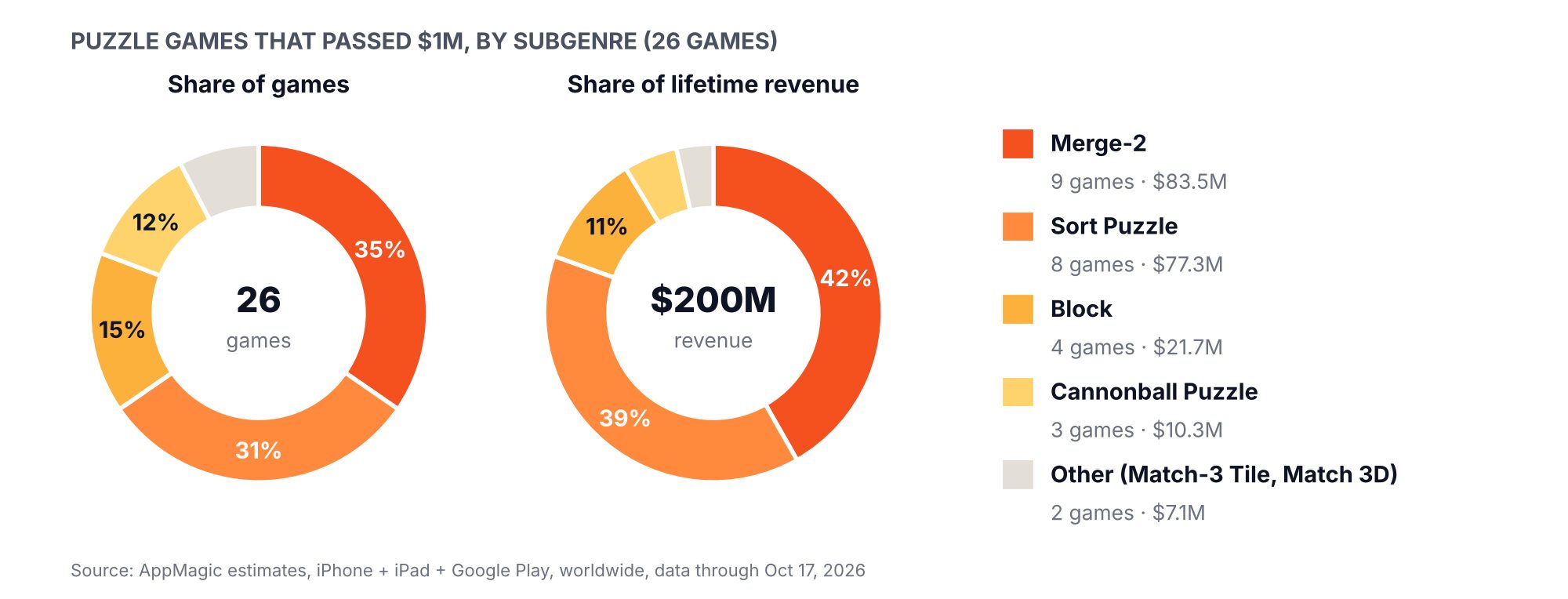
The genre covers a broad range of subgenres, and each sets its own pace for fresh hits. Merge-2 and Sort Puzzle account for 17 of the 26 qualifying titles and 80% of their combined revenue. Nine Merge-2 games have generated $83.5M, while eight Sort games contributed another $77.3M.
Five Puzzle games have already passed $10M despite taking more than 90 days to reach their first million: Jelly Busters, Hotel Legacy, Bus Traffic Fever!, Cube Land, and Car Sort. Once again, Sort and Block puzzles were among the slower starters that went on to build meaningful success. And then there is Merge-2, of course.
Sort shows a very curious pattern here. Its qualifying games took a median of 127.5 days to reach their first million, yet their median lifetime revenue now stands at $11.5M.
Beyond Merge-2 and Sort, the sample includes four Block games with $21.7M in combined revenue and three Cannonball Puzzle games with $10.3M. The latter is especially notable: Smash Fest only kicked off this summer, yet games inspired by its formula are already generating millions. We covered the trend in more detail here, so make sure you check it out.
Much of Puzzle's strong performance therefore comes from the same formats appearing among its slower starters: Merge-2, Sort, and Block. Yet we can’t help but ask another question: a big IP surely gives games a head start, but how much faster do IP-based games reach their first million?
IP Gives Games a Head Start
A strong IP foundation clearly makes a difference. Of the 42 IP-based games in our sample, 20 reached $1M within 30 days. Among 116 original games, just seven did the same. That is 48% against 6%!
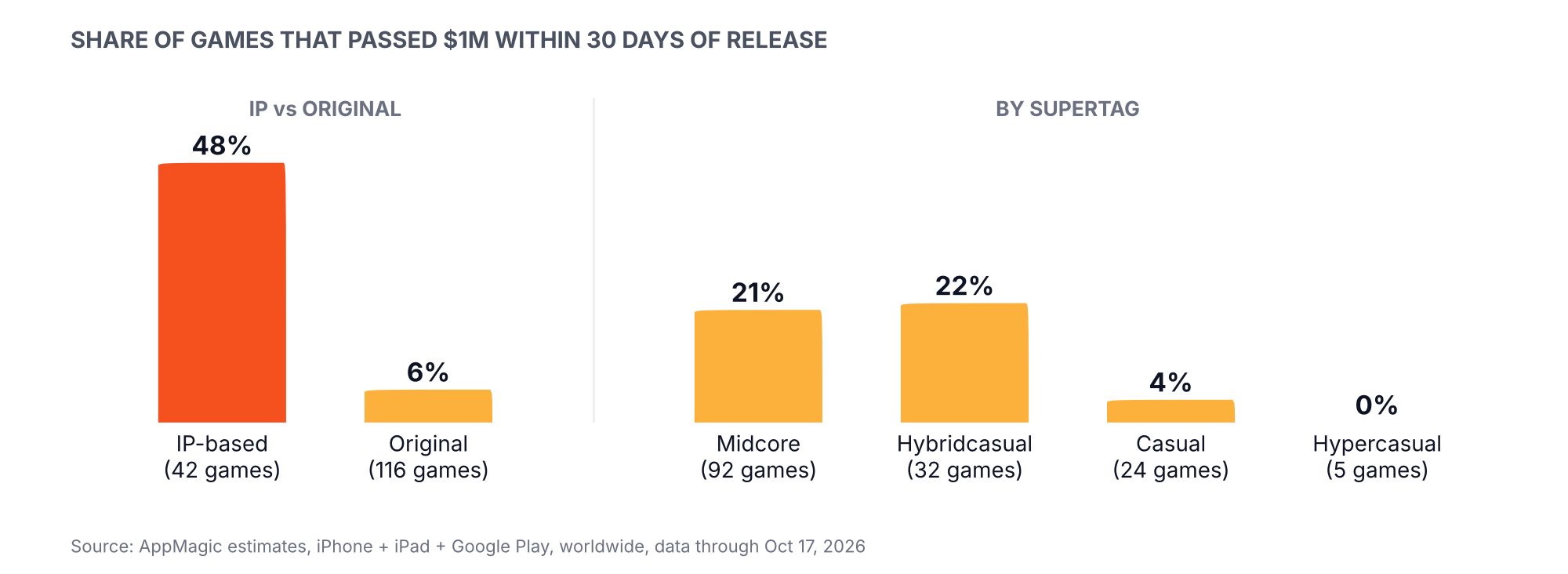
The median IP-based game crossed $1M in 35.5 days, compared to 83.5 days for an original title without an existing audience to support it. But the difference in accumulated revenue is much smaller. IP-based games have a median lifetime revenue of $2.6M—against $2.0M for original games. The launch-speed gap is substantial. The revenue gap, on this snapshot, is far less dramatic.
Of course, an IP game can deliver on both. For example, hololive Dreams reached $1M in 15 days and has generated $46.4M since its listed July release, making it one of the largest games in the sample.
There is an important distinction here. We selected games that have already passed $1M. These figures describe how quickly qualifying games reached the milestone. They do not tell us what share of all IP-based or original releases ever get there.
However, a recognizable franchise is only one of the ways to stand out at launch. A game's strongest market can matter, too.
Geography and That $1M Potential
Now, geography reveals another difference. We grouped games by their largest revenue region: South Korea-led titles reached $1M in a median of 53 days, Japan-led games in 60, and North America-led games in 89. Regional groupings use estimates for 24 major countries, with other revenue assigned to the rest of the world.
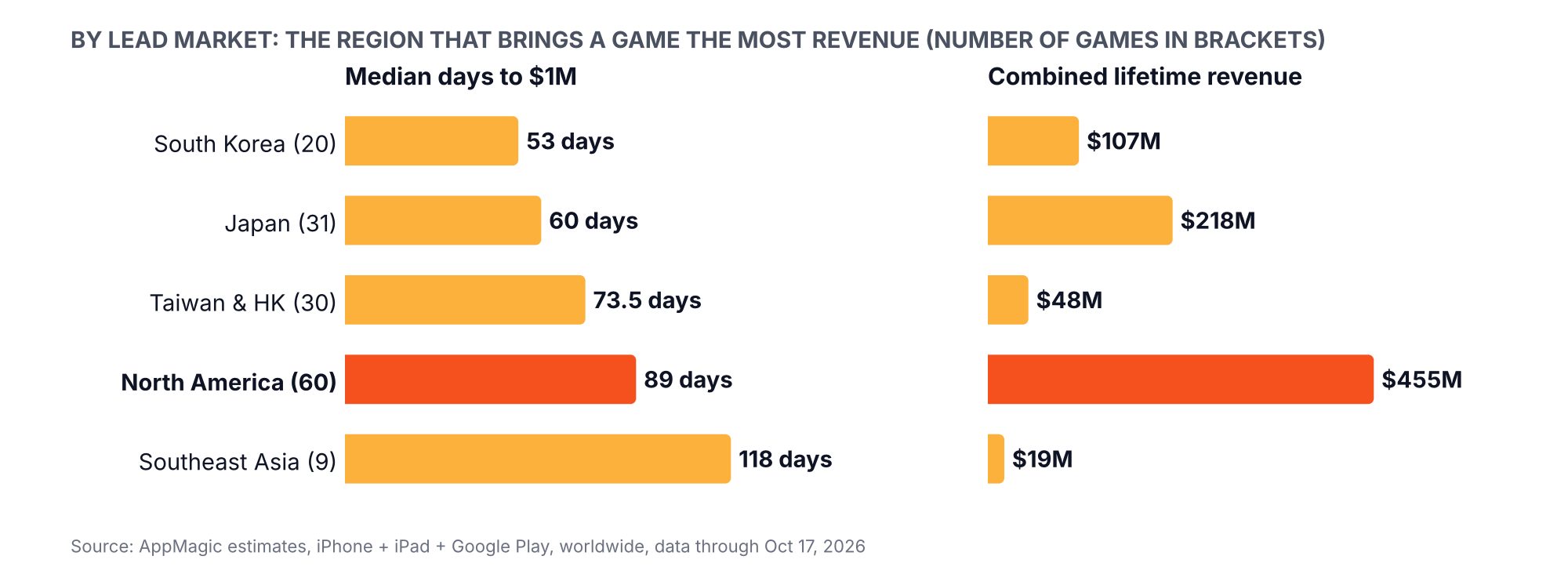
Japan- and Korea-led games tend to concentrate revenue in one market. In both groups, the median title earns more or less all of its tracked revenue in that country. A broad international presence isn't always necessary for earning that first million quickly.
North America-led games are more geographically diversified: the median title earns 48% of its revenue there. Only two of the 60 qualifying games reached $1M within 30 days, yet together they have generated $455.3M worldwide, more than half the sample's total. Their median lifetime revenue is also higher: $3.5M against $2.9M for Japan-led games and $2.3M for Korea-led ones.
The speed gap persisted among releases from January to April: 78 days for Japan- or Korea-led games versus 121 for North America-led titles. That reduces the impact of recent launches, although differences in genre and IP also weigh in.
The likely explanation lies partly in the games behind each region: RPGs make up 69% of Japan- and Korea-led titles, while Puzzle accounts for 38% of North America-led games. As we've already seen, their launch strategies differ, so the regional gap may reflect how these games build their audiences.
Genre, IP, and geography help explain the route to $1M. The next question is what happens once the game gets there.
What Happens After the First Million?
Reaching the milestone quickly is a strong indicator of early success, but it doesn’t guarantee sustained and/or scalable success. Going back to where we started, let's compare what NTE, Jelly Busters, and two other slower starters are earning now. Here, the latest 30-day window runs from September 18 to October 17, 2026.
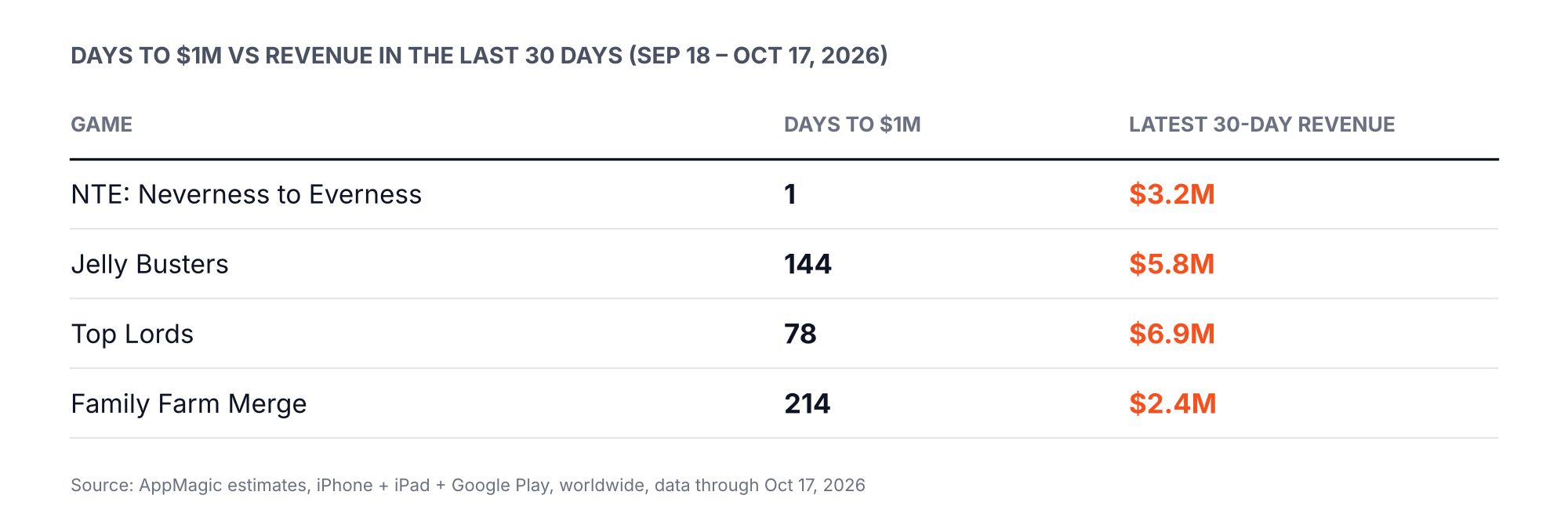
The launch-speed ranking looks very different from this angle. Jelly Busters took almost five months to reach $1M, yet now it earns nearly twice as much over 30 days as NTE. Top Lords took 78 days and now leads these four titles at $6.9M. Even Family Farm Merge, which needed 214 days to reach the threshold, has since built up to $2.4M over 30 days. The pattern we saw in Puzzles extends to 4X: a slow first million can still be followed by much stronger growth.
That’s why the first million benchmark tells us more when we look at the context behind it: a genre, an established IP, a regional focus, or a product that takes months to test and scale. It is a useful milestone, but the revenue that follows can change the comparison completely. With more than two months of 2026 still ahead, the slower starters can still outpace the competition. Jelly Busters has already shown us how it’s done.